
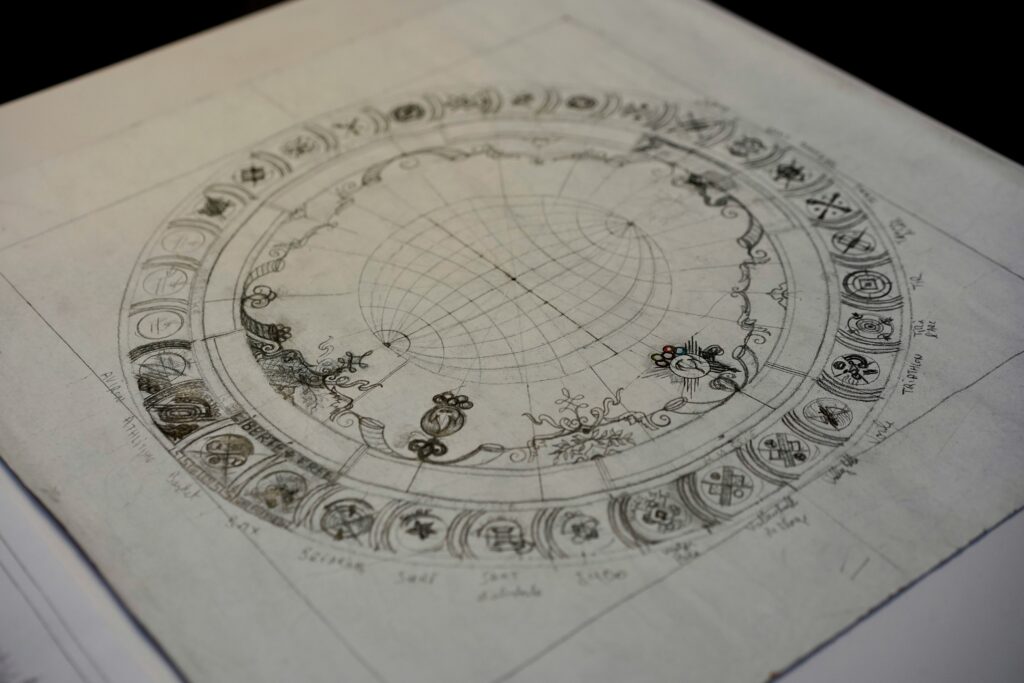
Most people encounter astrology as a language for describing personality: the confident Leo, the analytical Virgo, the indecisive Libra. This surface level is real enough as far as it goes, but it leaves out what is arguably the most psychologically rich dimension of astrological interpretation. Your birth chart is not only a map of your strengths and characteristic tendencies. It is also a map of your wounds, your fears, your unconscious patterns and the places where your deepest work is concentrated.
Used this way, astrology becomes a remarkably precise tool for shadow work: a symbolic framework that can show you not only who you have become but what you have suppressed in the process of becoming it.
How Astrology Maps the Unconscious
The birth chart is a snapshot of the sky at the moment of your birth, interpreted as a symbolic representation of your psychological structure. Different planets and points in the chart correspond to different dimensions of the psyche, some of which are primarily conscious and some of which operate largely below the level of awareness.
The sun, which most people identify as their primary astrological identity, represents the conscious self: the identity you have built and present to the world. But the chart contains far more than the sun. The placements that speak most directly to shadow work are those that represent what the conscious self has pushed aside, what the psyche is still in the process of integrating and where the most significant inner work of this lifetime is concentrated.
Understanding these placements does not tell you who you are in any fixed sense. It shows you the territory your shadow tends to inhabit, which is considerably more useful.
Pluto: The Planet of Depth and Transformation
Pluto moves so slowly through the zodiac that it spends between twelve and thirty years in a single sign, meaning it defines the shadow themes of entire generations. Its house placement in your individual chart is where its influence becomes personal: the specific area of life where you will encounter the most intense experiences of loss, power, transformation and the confrontation with what cannot be avoided.
Where Pluto sits in your chart is where you are most likely to experience power struggles, both internal and external. It is where you may have developed controlling tendencies as a response to deep fear, where obsessive patterns tend to concentrate and where the things you most fear losing tend to be located. It is also, for precisely these reasons, where the most significant transformation available to you in this lifetime is possible.
Shadow work with Pluto begins by looking honestly at the themes of the house it occupies. Pluto in the seventh house, for example, tends to produce intense, transformative relationships and often a history of power dynamics in partnership that reflects unexamined shadow material around control, vulnerability and the fear of being consumed by another person. Pluto in the second house may produce a complicated relationship with money, security and self-worth that goes far deeper than practical circumstances would explain.
The question Pluto always asks, in whatever area of life it occupies, is: what are you holding onto that needs to die so that something truer can emerge?
Chiron: The Wound That Becomes Wisdom
Chiron was discovered in 1977 and occupies a position in the solar system between Saturn and Uranus, which is symbolically apt given its astrological function. It bridges the personal and the transpersonal, the wound of individual experience and the wisdom that can come from genuinely integrating rather than merely surviving that wound.
In the birth chart, Chiron represents the core wound: the place where you feel most fundamentally inadequate, broken or other. This wound typically forms early in life and tends to be reinforced by later experiences that resonate with the same theme. Chiron in Aries often speaks to a wound around the right to exist fully and take up space as an autonomous individual. Chiron in the fourth house frequently points to a wound that formed within the family system and that colors the entire experience of belonging and home.
What makes Chiron particularly significant for shadow work is the nature of its mythology. Chiron was a wounded healer: a figure whose own wound was unhealable but whose intimate knowledge of wounding made him an extraordinarily effective healer for others. The shadow work implication is that the material around your Chiron placement is not meant to be fixed or eliminated. It is meant to be understood deeply enough that it becomes a source of genuine insight rather than a source of ongoing limitation.
The shadow tends to form heavily around the Chiron wound because the wound is precisely the kind of material that gets pushed underground. Acknowledging it means acknowledging vulnerability and inadequacy in the specific area where these feel most threatening. Shadow work with Chiron involves approaching that material with enough sustained honesty and compassion to finally stop defending against it.
The Moon: Emotional Patterns and Childhood Conditioning
The moon in the birth chart represents the emotional body: the instinctive responses, the deep needs and the patterns of feeling that formed in the earliest years of life. Unlike the sun, which represents conscious identity, the moon operates largely automatically. Your moon sign and house describe how you respond before you have had time to decide how to respond, which makes it one of the most direct windows into shadow material.
The moon also represents the relationship with the mother or primary caregiver and, through that relationship, the foundational beliefs about emotional safety, nurturance and what it means to have needs. A moon in Capricorn, for example, often reflects an early environment in which emotional expression was discouraged and practicality was valued over feeling, which can produce an adult who has suppressed an entire dimension of their emotional life and experiences genuine difficulty accessing or expressing vulnerability. A moon in Scorpio frequently reflects early experiences of intensity, secrecy or loss that have produced a deeply defended emotional interior.
Shadow work with the moon begins by examining the emotional responses you have never examined: the ones that feel automatic, that seem to come from nowhere and that are followed by the sense that you reacted in a way you did not quite choose. These automatic responses carry the most concentrated shadow material because they predate conscious self-reflection.
Saturn: Where Fear Has Calcified into Limitation
Saturn is often described as the planet of discipline, structure and responsibility, which is accurate but incomplete. Saturn is also the planet of fear, and specifically of the fears that have been present for long enough that they no longer feel like fears. They feel like reality.
Where Saturn sits in your chart is where you have learned to expect difficulty, failure, inadequacy or judgment. These expectations are usually not consciously held. They operate as invisible constraints on what you allow yourself to pursue, what you believe you deserve and what you permit yourself to even imagine as possible for you.
Saturn in the fifth house, the house of creativity, self-expression and joy, often produces someone who has suppressed their creative and playful dimensions because those dimensions were met with criticism or dismissal early enough that the suppression now feels like simply not being a creative person. Saturn in the tenth house, associated with career and public life, frequently produces either driven overachievement that is haunted by imposter syndrome or chronic avoidance of public visibility due to a deep fear of being seen and found wanting.
The shadow work with Saturn involves distinguishing between genuine limitations and internalized fear. Saturn’s lessons are real but they are also learnable. The contraction that Saturn produces is meant to be engaged with rather than endured. The question to bring to your Saturn placement is not why does this area of life feel so hard but what specific fear is operating here and where did I first encounter it?
The Lunar Nodes: Karmic Patterns and the Direction of Growth
The lunar nodes are not planets but points where the moon’s orbit intersects the ecliptic. They are always exactly opposite each other in the chart and they represent, in astrological tradition, the axis of past and future: where you have come from psychologically and in terms of deeply ingrained patterns, and where your growth is oriented.
The South Node represents what is already deeply familiar, the qualities, tendencies and ways of navigating life that feel natural precisely because they have been practiced for so long that they have become the default. This familiarity can be a resource but it can also be a trap. The South Node material tends to be the path of least resistance, the place the psyche returns to under stress because it is known, even when it is not serving the current life well.
The North Node represents the direction of growth and it characteristically feels uncomfortable, unfamiliar and somewhat daunting. This is not because it is dangerous but because it requires developing capacities that are not yet second nature.
Shadow work with the nodes involves examining where you default to South Node patterns when North Node development is what the situation actually requires. Someone with a South Node in Libra and North Node in Aries may have a deeply ingrained pattern of managing conflict through accommodation and diplomacy that has become its own form of avoidance: the shadow here is the suppressed directness, the unacknowledged anger and the genuine desire that never gets expressed because keeping the peace has been the priority for so long it has become identity.
Planetary Transits as Shadow Work Initiators
The birth chart is not a static document. The planets continue moving after your birth and as they form relationships with the placements in your natal chart, they activate different areas of the psyche. Certain transits are particularly associated with periods of intensified shadow work.
Pluto transits, when the current position of Pluto forms a significant angle to a natal planet, are among the most psychologically intense periods available in astrological timing. They tend to bring shadow material to the surface with a force that makes continued avoidance difficult. What has been suppressed tends to demand attention during Pluto transits and the resistance to that demand typically produces more suffering than the engagement with it would.
The Saturn return, which occurs approximately every twenty-nine years when Saturn returns to the position it occupied at birth, is another reliably significant period for shadow confrontation. The first Saturn return, typically experienced between ages twenty-eight and thirty, often involves a reckoning with the life structures that were built on inherited patterns rather than genuine self-knowledge. It is the psyche’s demand for authenticity, which necessarily involves confronting the ways in which you have been living according to someone else’s script.
Chiron return, which occurs around age fifty, brings a second significant opportunity for integration of the core wound. People who have been avoiding their Chiron material often find it presenting itself during this period with unusual clarity and insistence.
Using Your Birth Chart as a Shadow Work Tool
You do not need extensive astrological knowledge to use your chart for shadow work. The most valuable approach is to identify the placements described above and bring genuine reflective attention to the themes they represent in your actual life experience.
Look at where Pluto sits in your chart and write about the house themes in terms of your own history with power, control, loss and transformation in that area. Look at your Chiron placement and write about the specific quality of inadequacy or wound it describes, asking where that wound first formed and how it has shaped your subsequent choices. Look at your moon sign and the automatic emotional responses it describes, asking which of those responses you have never examined because they feel too basic to question.
The chart provides the map. Your honest engagement with your own experience provides the territory. The two together create a framework for shadow work that is both structured and deeply personal.
A Practice for This Week
Identify one placement in your chart from the ones described above, whichever one produces the strongest reaction when you read its description, whether that reaction is recognition, resistance or discomfort.
Write for twenty minutes about the themes of that placement in your own life. Be specific rather than general. Rather than writing about the concept of Chiron in Virgo, write about the specific experiences of criticism, inadequacy or the pressure toward impossible standards that you have actually lived through. Rather than writing about Pluto in the eighth house as an idea, write about your actual experiences with shared resources, intimacy, power and loss.
Then write about what you have suppressed in relation to these themes. What have you pushed underground because it felt too painful, too shameful or too threatening to carry consciously? What would it mean to bring that material into awareness and work with it rather than continue managing it from a distance?
The chart does not determine who you are. It describes where your work is concentrated and what shape that work tends to take. Used with that understanding, it is one of the most useful maps available for navigating the territory of the shadow.
Photo by Meizhi Lang on Unsplash






[…] Astrology & The Shadow – How Your Birth Chart Reveals Your Hidden Self examines the astrological placements most directly associated with shadow material: Pluto, Chiron, the Moon, Saturn and the Lunar Nodes. Understanding these placements provides a structured map of where unconscious material tends to concentrate and what form the work is likely to take. […]