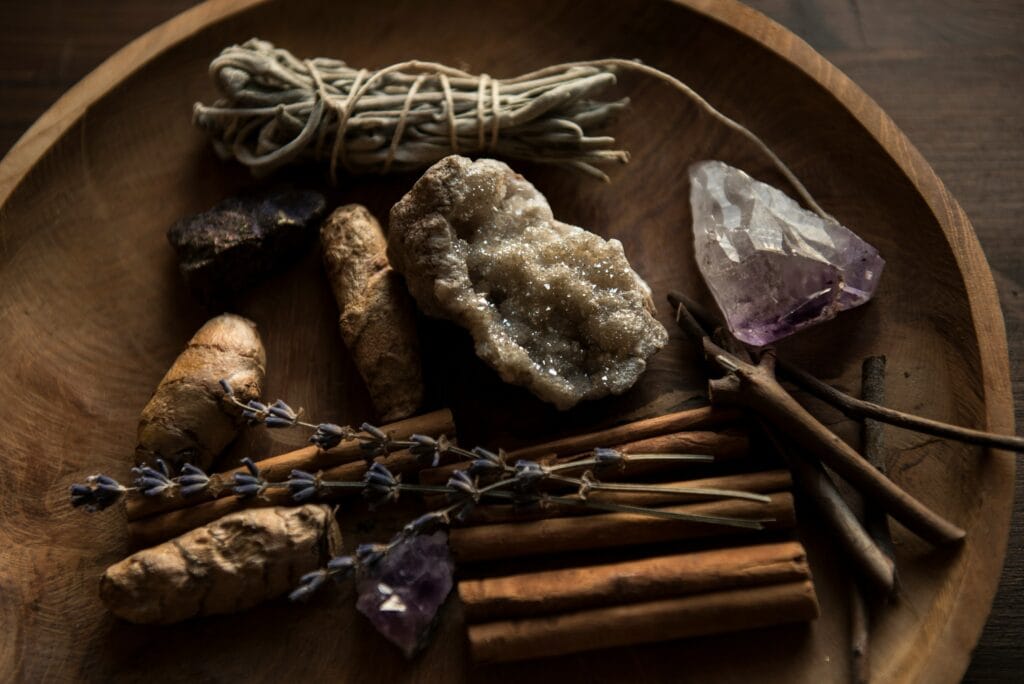
The Wheel of the Year is a calendar of eight festivals that mark the turning points of the solar cycle. Together they track the journey of the sun from its lowest point at the winter solstice through its peak at midsummer and back again, weaving the rhythms of nature into a continuous cycle of death, renewal and abundance. Each festival occupies a distinct energetic moment in that cycle and each calls for a different kind of attention: grief and remembrance, hope and beginnings, action and celebration, gratitude and release.
The wheel is not the invention of any single tradition. Its eight points draw from Celtic, Norse, Germanic and wider European agricultural and pastoral traditions that honored the solstices, equinoxes and the cross-quarter days between them. The eight-sabbat framework as it is practiced today was largely assembled and named in the mid-twentieth century through the influence of Gerald Gardner and later Wiccan writers, who synthesized existing seasonal lore into a coherent annual cycle. Individual festivals are far older than this framework, but the wheel as a complete eight-pointed structure is a modern synthesis.
For those practicing witchcraft, paganism or any earth-based spirituality, the wheel provides a living framework for practice. It aligns magical work with natural energy rather than working against seasonal flow and it gives the year a rhythm that most modern lives otherwise lack.
The Structure of the Wheel
The eight festivals divide into two groups. The solar festivals, also called the Lesser Sabbats, fall at the solstices and equinoxes: Yule, Ostara, Litha and Mabon. These are astronomically fixed points that mark the extremes and midpoints of the sun’s apparent journey.
The cross-quarter festivals, also called the Greater Sabbats or fire festivals, fall midway between the solar points: Samhain, Imbolc, Beltane and Lammas. These were the major festivals of the ancient Celtic agricultural year, tied to the practical rhythms of livestock, planting and harvest rather than astronomical observation.
Together the eight festivals divide the year into roughly equal segments of six to seven weeks, creating a continuous rhythm rather than isolated celebrations.
Northern and Southern Hemisphere Dates
The wheel follows the actual seasons of the earth, not a fixed calendar. Practitioners in the southern hemisphere celebrate the same festivals but at opposite times of year, aligned with their own seasonal reality rather than mirroring the northern dates.
| Sabbat | Northern Hemisphere | Southern Hemisphere |
|---|---|---|
| Samhain | October 31 – November 1 | April 30 – May 1 |
| Yule | Around December 21 | Around June 21 |
| Imbolc | February 1 – 2 | August 1 – 2 |
| Ostara | Around March 20 | Around September 22 |
| Beltane | April 30 – May 1 | October 31 – November 1 |
| Litha | Around June 21 | Around December 21 |
| Lammas / Lughnasadh | August 1 | February 1 |
| Mabon | Around September 22 | Around March 20 |
The solar festivals shift slightly each year with the actual astronomical date of the solstice or equinox. The cross-quarter festivals are traditionally fixed calendar dates rather than calculated astronomical midpoints, though some practitioners prefer to calculate the true midpoint between solstice and equinox.
The Eight Sabbats
Samhain
October 31 – November 1 (Northern) / April 30 – May 1 (Southern)
Samhain marks the end of the harvest season and the beginning of the dark half of the year. In ancient Celtic tradition it was the most significant festival of the year: the end of summer, the beginning of winter and the moment when the boundary between the living and the dead was understood to be at its thinnest. Livestock were brought in from pasture, final stores were counted and animals that could not be fed through winter were slaughtered. It was a time of reckoning with what had been and what lay ahead.
The thinning of the veil made Samhain a natural time for ancestor veneration and communication with the dead. Offerings were left at doorways for wandering spirits, places were set at tables for deceased family members and bonfires were lit both as protection and as guides for the dead finding their way. The practice of carving lanterns from turnips and later pumpkins came from this tradition of lighting the way.
In modern practice Samhain is the most widely observed sabbat outside of formal Wiccan circles. It is a time for ancestor altars, divination, honoring the dead and sitting with the reality of mortality and change. Energetically it is a powerful time for releasing what is no longer alive in your life, for grief work and for crossing-over rituals of any kind.
Learn more: Samhain: Honoring the Cycle of Life and Death | Samhain vs. Halloween: What’s the Difference? | Witchy Halloween Rituals for Celebrating Samhain
Yule
Around December 21 (Northern) / Around June 21 (Southern)
Yule is the winter solstice, the longest night and shortest day. From this point the light begins to return and it is this rebirth of the sun that the festival celebrates. The darkness is at its maximum but it has also reached its limit. Ancient Norse and Germanic traditions marked this with the Yule log, great bonfires, feasting and the decoration of homes with evergreens as a reminder that life persists through the cold.
The twelve days of Yule were a time of intense feasting and community in Norse tradition. Odin was associated with this period, leading the Wild Hunt through winter storms. The practice of leaving gifts, decorating with greenery and burning a log through the night all have deep roots in pre-Christian midwinter observance and many passed directly into Christmas tradition.
In practice Yule is a time for turning inward, for lighting candles in the darkness and for setting intentions for the returning light. It is one of the most contemplative sabbats despite its celebratory aspects. The darkness before the solstice is a genuine invitation to sit with what needs to be released before the light returns.
Imbolc
February 1 – 2 (Northern) / August 1 – 2 (Southern)
Imbolc falls at the midpoint between the winter solstice and the spring equinox. The name derives from the Old Irish meaning approximately “in the belly,” referring to the first stirrings of spring within the earth and to the ewes beginning to lactate in preparation for lambing. It is the first festival of returning life after the long winter, a moment of promise rather than fulfillment.
Imbolc is sacred to Brigid, the Celtic goddess of poetry, healing, smithcraft and the sacred flame. Her association with fire and inspiration makes Imbolc a natural festival for candles, for hearth rituals and for creative intentions. The cross-quarter fire festival tradition of lighting all the candles in the house at once or processing with torches, symbolizes the coaxing of the sun back toward its full strength.
The Christian feast of Candlemas on February 2nd and the folk figure of Saint Brigid both absorbed and continued earlier Imbolc traditions, which is partly why so much of the original observance has survived in some form. The Brigid’s cross woven from rushes is still made in Ireland on February 1st as both a protective symbol and an invitation to the goddess’s blessing.
In practice Imbolc is a time for purification, for setting creative intentions, for cleansing the home and space energetically and for dedicating work or projects to Brigid. It is particularly suited to writers, artists, healers and anyone working with fire in any form.
Ostara
Around March 20 (Northern) / Around September 22 (Southern)
Ostara is the spring equinox, the point at which day and night are equal and the balance tips decisively toward the light. The name is linked by the monk Bede to an Anglo-Saxon goddess Eostre, though direct evidence for her worship is limited. What is certain is that spring equinox festivals were widely observed across Europe and that the imagery associated with modern Ostara, eggs, hares, seeds and new growth, represents a very old layer of seasonal symbolism tied to fertility and the return of warmth.
The equinox was tracked with precision by ancient peoples. Megalithic sites across Europe are aligned to the rising sun at the equinoxes, suggesting that this astronomical moment held deep significance long before the named festivals we know. The balance of opposites at the equinox, neither light nor dark dominant, made it a natural time for ritual attention to harmony and preparation.
In practice Ostara is a time for planting, both literally and in terms of intentions. It is a festival of action after the contemplation of winter: this is when the seeds you have been holding through Imbolc are ready to go into the earth. Rituals involving eggs, seeds and fresh growth connect to this generative energy. It is also a natural time for balance work, addressing areas of life where one force has been dominant at the expense of another.
Beltane
April 30 – May 1 (Northern) / October 31 – November 1 (Southern)
Beltane is the great fire festival of May, marking the beginning of the summer half of the year. In ancient Celtic tradition it was as significant as Samhain: the two festivals together divided the year into its dark and light halves. On Beltane the cattle were driven between two bonfires to purify and protect them before going to summer pasture. People leaped the fires for luck and protection. It was a festival of vitality, desire and the full opening of the earth’s generative power.
The union of the divine masculine and feminine, sometimes personified as the May King and the May Queen or the Green Man and the Flower Bride, is central to Beltane mythology. This sacred marriage represents the peak of creative and generative force in the natural world. The Maypole, a later folk tradition whose origins are debated, became the most visible symbol of this energy, with its weaving of ribbons around a central pole representing the dance of opposites into wholeness.
Beltane and Samhain occupy opposite points on the wheel and together create a powerful polarity. Where Samhain honors the ancestors and the dead, Beltane honors the living and the generative. Where Samhain thins the veil to the underworld, Beltane is traditionally a time when the fae are active and the otherworld is close in a very different way.
In practice Beltane is a time for love magic, abundance work, fire rituals, outdoor celebration and anything connected to passion, creativity and the full expression of vitality. It is one of the most socially celebratory sabbats and lends itself naturally to group ritual.
Litha
Around June 21 (Northern) / Around December 21 (Southern)
Litha is the summer solstice, the longest day and the peak of the sun’s power. From this point the light begins to wane, so there is a dual quality to the celebration: honoring the fullness of summer while acknowledging that the wheel has turned and the descent toward darkness has begun. The Oak King and Holly King myth articulated this directly: at Litha the Holly King defeats the Oak King and the waning half of the year begins.
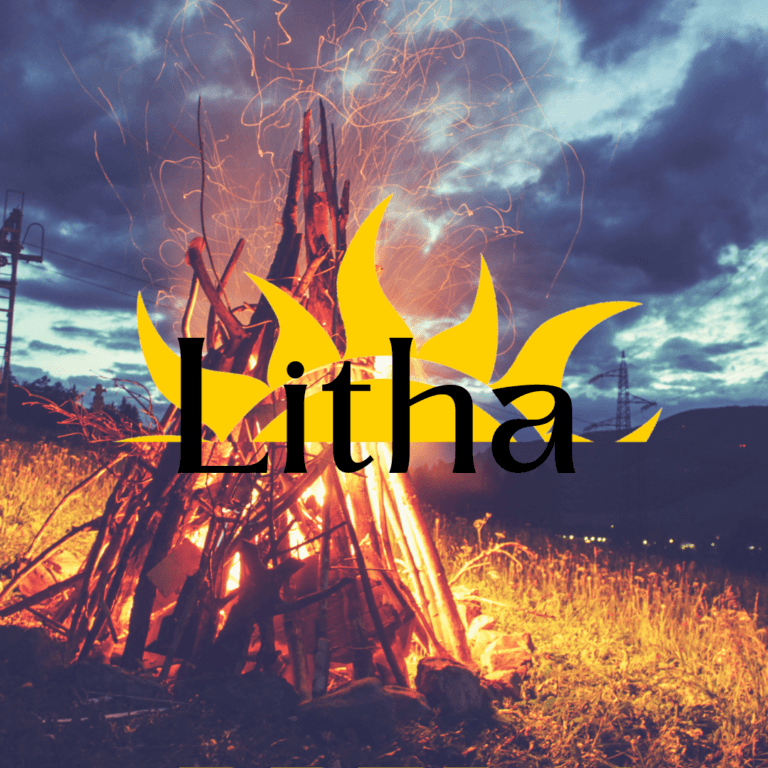
Midsummer bonfires were lit across Europe on the solstice night, a tradition so widespread that it cuts across cultural and linguistic boundaries. The fires honored the sun at its peak and were believed to strengthen and purify the community. Herbs gathered at Litha were considered to hold their greatest potency, a belief rooted in the genuine peak of plant oil content during the longest days. St. John’s Wort, vervain and meadowsweet are particularly associated with midsummer gathering.
The solstice was also a time of heightened fairy activity in British folk tradition, echoed in Shakespeare’s A Midsummer Night’s Dream. The liminal quality of the solstice night, suspended between the peak of light and the beginning of its return, created a space where ordinary rules did not fully apply.
In practice Litha is a time for celebrating achievements, for abundance and manifestation work, for herb gathering and for honoring the sun through outdoor ritual. It is also a time for acknowledging what will need to be released as the wheel turns toward autumn, making it a natural moment for gratitude paired with honest assessment.
Lammas / Lughnasadh
August 1 (Northern) / February 1 (Southern)
Lammas is the first harvest festival, marking the point when the grain is ready to cut. The name comes from the Old English hlaf-mas, meaning loaf mass and reflects the tradition of bringing the first baked loaf to the church or sacred space as an offering of thanksgiving. The Celtic name Lughnasadh honors the god Lugh and was associated with great assemblies, athletic competitions and the formal beginning of harvest contracts and marriages.
The first harvest carries a particular kind of poignancy: it is the beginning of the season of abundance but also the beginning of the end of summer. The grain must die to become bread. The light is visibly shorter than it was at midsummer. Lammas holds this dual awareness of gratitude and mortality in a way the later harvest festivals do not, because the fullness of summer is still present while the dying begins.
Corn dollies, woven from the last sheaf of grain to be cut, were kept through winter as vessels for the spirit of the harvest and burned at Imbolc to release the energy back into the earth. This practice connects Lammas directly to the wider cycle of the wheel, the harvest feeding not just the present but the following year’s planting.
In practice Lammas is a time for gratitude for work completed, for first fruits offerings, for bread magic and kitchen craft and for reflecting on what your labor has actually produced versus what you hoped it would. It is one of the best sabbats for magic connected to skills, talents and the manifestation of effort into tangible form.
Mabon
Around September 22 (Northern) / Around March 20 (Southern)
Mabon is the autumn equinox and the second harvest festival. As at Ostara, day and night are equal, but where the spring equinox tipped toward increasing light, Mabon tips toward increasing darkness. The harvest is near its peak: fruits, roots and final vegetables are gathered and stored. The name Mabon comes from a figure in Welsh mythology, Mabon ap Modron, though his direct historical connection to the equinox festival is a modern attribution. The equinox itself was observed across ancient Europe long before the name was attached.
The themes of Mabon are balance, gratitude and the honest reckoning that comes with completing a cycle. What grew from the seeds of Ostara and Beltane is now fully visible. This is a time to count what was actually harvested, to release what did not ripen and to prepare for the inward journey that Samhain and the dark half of the year will bring.
In practice Mabon is a natural time for release rituals, for gratitude work, for altar-building with autumn harvest elements and for the kind of reflection that prepares you genuinely for the winter ahead rather than resisting it. Apple magic is strongly associated with Mabon, as apples ripening in autumn and their hidden pentagram when cut horizontally connect the harvest to deeper magical symbolism.
Working with the Wheel in Practice
The wheel is most useful when treated as a living framework rather than a list of dates to observe. Each sabbat builds on the previous one and prepares for the next. The intentions set at Imbolc are planted at Ostara, reach their fullness at Beltane and Litha, yield their harvest at Lammas and Mabon, are released at Samhain and germinate through the darkness of Yule back to Imbolc again.
Tracking the wheel over several full years reveals patterns in your own energy, creativity and emotional life that shorter-term observation misses. What consistently feels difficult at the same point in the year? What reliably opens up for you at certain festivals? The wheel is as much a map of inner landscape as it is a calendar of outer seasons.
You do not need to observe every festival with elaborate ritual to work with the wheel. Lighting a candle on the sabbat date with a brief acknowledgment of the season’s energy is a genuine act of alignment. The key is consistency over time rather than the scale of any single observance.
Frequently Asked Questions
What is the Wheel of the Year?
The Wheel of the Year is a cycle of eight annual festivals observed in Wicca, modern paganism and many witchcraft traditions. It marks the solstices, equinoxes and the four cross-quarter days between them, dividing the year into a continuous rhythm of seasonal energy. Each festival corresponds to a specific point in the solar cycle and carries its own themes, symbolism and magical correspondences.
Are all eight sabbats from ancient Celtic tradition?
No. The four cross-quarter festivals, Samhain, Imbolc, Beltane and Lammas, are rooted in ancient Celtic agricultural and pastoral practice. The solstice and equinox festivals were observed across many European cultures but are not specifically Celtic in origin. The eight-festival framework as a coherent system was assembled in the mid-twentieth century, primarily through the influence of Gerald Gardner and later Wiccan writers drawing on various European seasonal traditions.
Does the Wheel of the Year work the same in the southern hemisphere?
The wheel follows the actual seasons of the earth, so practitioners in the southern hemisphere celebrate the festivals at opposite times of year aligned with their own seasonal reality. Samhain in the southern hemisphere falls in late April or early May, when autumn is deepening, rather than in late October. The energetic meaning of each festival remains the same but is grounded in the actual seasonal experience of the practitioner rather than mirroring the northern calendar.
Do I need to be Wiccan to work with the Wheel of the Year?
No. The wheel is used across a wide range of pagan, witchcraft and earth-based spiritual traditions that have no formal connection to Wicca. Many practitioners who do not identify with any specific tradition use the wheel as a practical framework for aligning their practice with seasonal energy. The festivals are available to anyone who finds them meaningful.
How do I start working with the Wheel of the Year?
Begin with whatever sabbat is coming next and observe it simply. Read about its history and themes, make a small altar with seasonal elements, light a candle and sit with the energy of the season for a few minutes. Build consistency over one full year before adding complexity. The wheel is a long-term practice that rewards sustained attention more than elaborate single observances.
Photo by Joanna Kosinska on Unsplash