Most people think of astrology as a way to describe who they are. Vedic astrology goes further and asks a different question: when. Not just what your birth chart contains but which part of it is active right now, and for how long.
The Vimshottari Dasha system is the mechanism behind that timing. It divides your life into planetary periods, each one ruled by a specific planet that shapes the themes, opportunities and challenges of that chapter. A dasha period lasts years, sometimes nearly two decades, and it explains why the same person can feel like they are living completely different lives at 25 and at 45.
What Is the Vimshottari Dasha System?
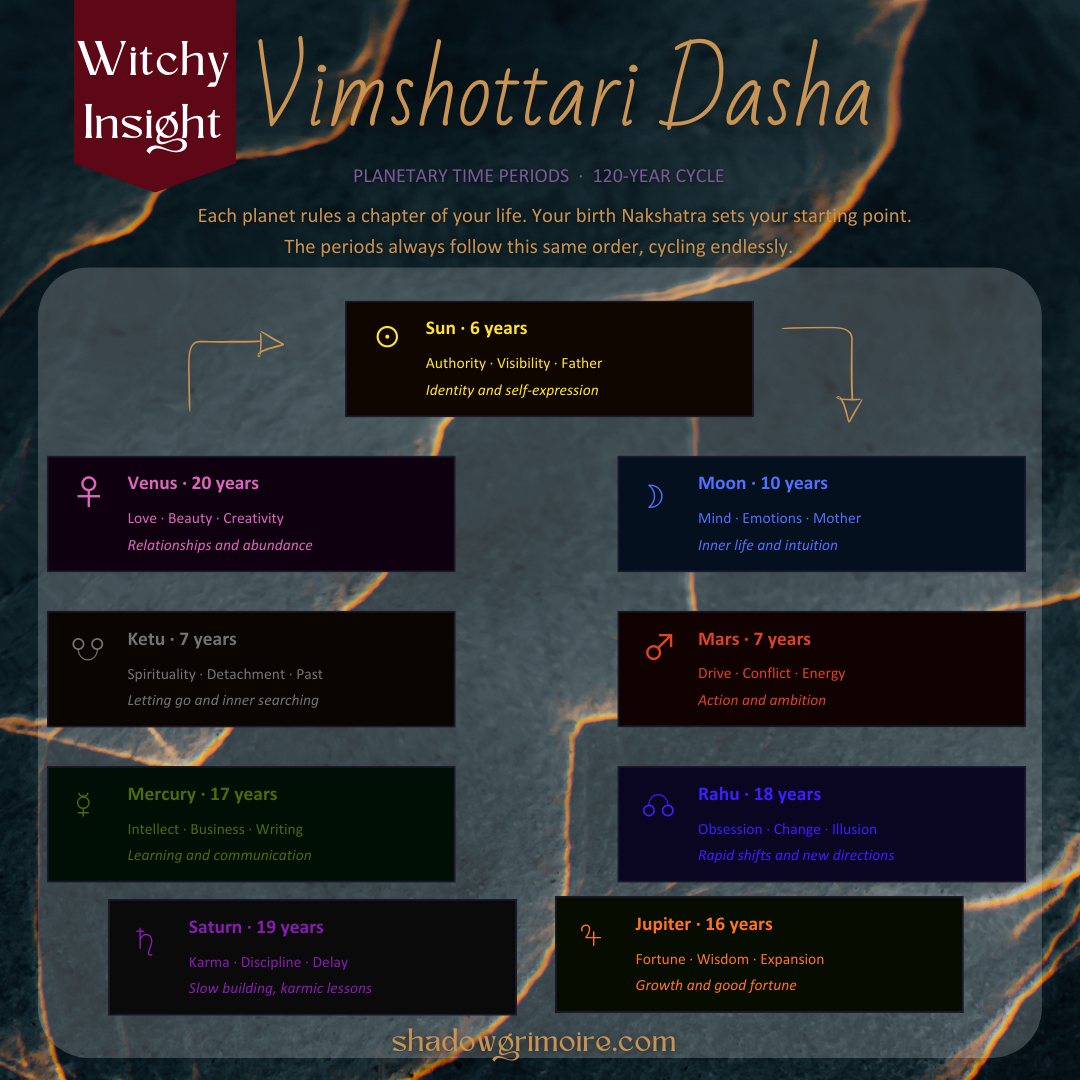
Vimshottari means 120 in Sanskrit and the system runs on a 120-year cycle divided among nine planets. Each planet governs a specific number of years and the periods always follow the same fixed sequence. You cannot skip a period or rearrange the order. What changes between people is where in the cycle they begin.
Your starting point is determined by your birth Nakshatra, specifically the position of your Moon at the exact moment of birth. If your Moon falls in a Nakshatra ruled by Saturn, you begin life in Saturn Mahadasha. If it falls in a Jupiter Nakshatra, you begin in Jupiter. The remaining years of that first period depend on how far through the Nakshatra your Moon had already traveled.
This is why two people born on the same day can experience very different life chapters at the same age. One might be in a Venus period at 35, enjoying creative and relational expansion, while the other is deep in a Saturn period, building slowly through discipline and constraint.
The Nine Periods at a Glance
| Planet | Sanskrit name | Duration | Core themes |
|---|---|---|---|
| ☉ Sun | Surya | 6 years | Identity, authority, father, vitality |
| ☽ Moon | Chandra | 10 years | Mind, emotions, mother, cycles |
| ♂ Mars | Mangal | 7 years | Drive, courage, conflict, action |
| ☊ Rahu | Rahu | 18 years | Obsession, ambition, rapid change |
| ♃ Jupiter | Guru | 16 years | Wisdom, expansion, fortune, grace |
| ♄ Saturn | Shani | 19 years | Karma, discipline, delay, structure |
| ☿ Mercury | Budha | 17 years | Intellect, business, communication |
| ☋ Ketu | Ketu | 7 years | Spirituality, detachment, past karma |
| ♀ Venus | Shukra | 20 years | Love, beauty, creativity, wealth |
The total adds up to 120 years. After Venus the cycle returns to the Sun and begins again, though in practice most people do not live long enough to complete a full cycle.
Mahadasha and Antardasha
Each major period is called a Mahadasha. Within every Mahadasha there are nine sub-periods called Antardashas, one for each planet in the same sequence. The Antardasha brings the flavor of a second planet into the foreground while the Mahadasha planet continues to set the overall tone.
For example during a Jupiter Mahadasha you might enter a Saturn Antardasha. Jupiter’s expansive, fortunate energy remains the backdrop but Saturn’s discipline, delay and karmic themes become active within it. This layering is what gives Vedic timing its precision.
Beyond Antardashas there are even finer subdivisions called Pratyantardashas, though most practitioners focus primarily on Mahadasha and Antardasha for everyday reading.
How to Read Your Current Dasha
Open your Vedic chart on Astro-Seek and look for the Dasha or Vimshottari Dasha section. You will see a timeline showing which planet rules each period of your life with start and end dates.
Find your current date in the timeline. Note both the Mahadasha planet and the Antardasha planet. Then ask three questions. First, what does this planet represent in your chart generally? Second, which houses does it rule from your Lagna? Third, where does it sit in your chart and how strong is it?
A Jupiter Mahadasha will expand and illuminate the themes of whichever houses Jupiter rules and occupies in your chart. For a Sagittarius Lagna, Jupiter rules the first and fourth houses, so a Jupiter period often brings forward themes of self, body, home and inner peace. For a Gemini Lagna, Jupiter rules the seventh and tenth houses, so the same period emphasizes partnership, career and public life.
The planet’s condition matters enormously. A strong Jupiter in a good house during a Jupiter period can bring extraordinary fortune and growth. A weak or challenged Jupiter will still activate Jupiter’s themes but through difficulty, delay or the need to earn what others receive more easily.
The Nine Dashas Explained
Sun Mahadasha — 6 Years
The Sun Mahadasha is one of the shorter periods at six years and it brings themes of identity, authority and life purpose to the foreground. This is often a time when a person steps into greater visibility, takes on leadership or confronts questions about who they really are beneath their roles and relationships.
The Sun governs the father, government, the soul and vital energy. Events related to these themes tend to surface during this period. Career recognition is common during a strong Sun Mahadasha and so is a sharper awareness of one’s own ego and the ways it either serves or limits.
The quality of the period depends heavily on the Sun’s placement and strength in the natal chart. A Sun in exaltation in Aries or in its own sign Leo tends to bring a genuinely luminous and empowering period. A Sun in Libra, where it is in debilitation, may bring challenges around self-confidence, authority figures or recognition.
Moon Mahadasha — 10 Years
The Moon Mahadasha governs the mind, emotional life, mother, home and the quality of inner experience. During this ten-year period the inner world tends to become louder and more present, dreams may intensify, emotional sensitivity increases and the need for nourishment and belonging becomes central.
This is often a period of significant change in domestic life, whether through moves, family changes or a deepening relationship with the mother or with one’s own need for roots. The Moon also governs the public in Vedic astrology, so public-facing work, creative visibility and popular recognition can all feature during this period.
A Moon in a strong Nakshatra and well-placed sign brings emotional richness, creativity and a period of genuine inner growth. A challenged Moon can bring emotional turbulence, anxiety or difficulties in close relationships during this time.
Mars Mahadasha — 7 Years
Mars Mahadasha is one of the shorter periods and it tends to bring intensity, decisive action and a heightened drive to accomplish and compete. This is a period for getting things done. The energy is direct and often impatient.
Mars governs courage, physical vitality, siblings, property and the capacity to fight for what one wants. Events during this period often involve taking action, facing conflicts, making bold moves or dealing with matters related to land and property.
A strong Mars in the chart makes this period energizing and productive, often producing significant achievements through sustained effort. A challenged Mars can bring accidents, conflict, impulsiveness or health issues related to heat and inflammation. The key during Mars Mahadasha is learning to channel the energy constructively rather than letting it turn outward as aggression or inward as frustration.
Rahu Mahadasha — 18 Years
Rahu Mahadasha is the longest period after Saturn and Venus and it is often the most disorienting. Rahu is the north lunar node, a shadow planet with no physical body. It represents obsession, material desire, foreign influences, unconventional paths and the parts of life where we are pulled toward what is unfamiliar.
During an 18-year Rahu period life often accelerates and transforms in unexpected ways. Ambitions intensify, sometimes to the point of consuming everything else. There can be a quality of chasing something without quite knowing why, of being driven by a hunger that is difficult to articulate or satisfy.
At its best Rahu Mahadasha produces extraordinary worldly achievement and brings the person into contact with knowledge, places or experiences far outside their original world. At its most challenging it brings confusion, illusion, sudden reversals and the eventual recognition that what was being chased was not what was actually needed.
The sign and house Rahu occupies in the natal chart reveals where this obsessive, expansive energy will play out.
Jupiter Mahadasha — 16 Years
Jupiter Mahadasha is widely considered the most fortunate period in the Vimshottari cycle. Jupiter is the great benefic, the planet of wisdom, grace, abundance and divine favor, and its 16-year period tends to bring expansion, opportunity and a quality of being supported by life.
This is often a time of spiritual growth, higher education, travel, marriage, children or significant professional recognition depending on what houses Jupiter governs in the chart. There is a quality of things falling into place, of teachers and guides appearing at the right moments and of generosity flowing both toward and from the person.
Even a challenged Jupiter Mahadasha tends to be one of the more manageable periods because Jupiter’s nature is to protect and uplift. The areas of expansion will correspond to Jupiter’s houses and placement in the natal chart.
Saturn Mahadasha — 19 Years
Saturn Mahadasha is the longest single period in the cycle at 19 years and it is often the most demanding. Saturn is the planet of karma, time, discipline, limitation and the consequences of past actions. During this period life tends to slow down, responsibilities increase and shortcuts become unavailable.
This is a period for building. What is constructed during a Saturn Mahadasha tends to be solid and lasting precisely because it was earned through sustained effort rather than luck or grace. Career, business and long-term projects often advance significantly during this time, but through work rather than fortune.
Saturn also governs themes of loss, solitude, the elderly, chronic health conditions and confronting what has been avoided. Difficult Saturn periods often bring some of these themes to the surface in ways that, while hard, ultimately serve the person’s growth and maturity.
The houses Saturn rules and occupies in the natal chart reveal where this karmic reckoning will focus. A well-placed Saturn in the chart can make this period one of genuine achievement and the satisfaction of building something real.
Mercury Mahadasha — 17 Years
Mercury Mahadasha governs intellect, communication, learning, business and the analytical mind. During this 17-year period thinking sharpens, curiosity deepens and activities related to writing, teaching, commerce, technology or skilled work often come to the foreground.
Mercury is a neutral planet in Vedic astrology, meaning it takes on the qualities of the planets it associates with in the chart. This makes Mercury Mahadasha highly variable depending on the natal chart. If Mercury is well-placed and in good company the period can bring sharp success in communication-related fields. If Mercury is weak or associated with malefic planets the period can bring nervous tension, scattered thinking or difficulties in contracts and agreements.
This is often a productive period for writers, teachers, traders, analysts and anyone whose work involves the transmission of information or the mastery of a skill.
Ketu Mahadasha — 7 Years
Ketu is the south lunar node, representing past karma, spiritual liberation, detachment and the themes of what must be released. Ketu Mahadasha at seven years is one of the shorter periods but it can be one of the most internally significant.
During this period the pull toward the material world often weakens and a deeper spiritual seeking can emerge. Things that were once important may lose their appeal without obvious explanation. There can be a quality of dissolution, of old identities or attachments falling away to make room for something more essential.
At its most challenging Ketu Mahadasha can feel directionless or isolating. At its highest expression it produces genuine spiritual insight, a release from patterns that no longer serve and a clarity about what truly matters.
The house and sign Ketu occupies in the chart shows where this process of release and deepening will focus.
Venus Mahadasha — 20 Years
Venus Mahadasha is the longest period in the cycle at 20 years and it is often the most beautiful. Venus governs love, beauty, creativity, wealth, sensory pleasure and the quality of enjoyment in life. During a Venus period these themes tend to expand and flourish.
Relationships deepen or begin, creative work flows more easily, aesthetic sensibilities sharpen and there is often an increase in material comfort and the capacity to enjoy what life offers. For those in creative fields Venus Mahadasha can be extraordinarily productive and recognized.
Venus also governs women in general charts and the nature of romantic partnership. Events related to marriage, significant relationships or the deepening of creative identity are common during this period.
The quality and duration of these gifts depends on Venus’s strength and placement in the natal chart. A Venus in good dignity in a harmonious house can make this one of the most genuinely pleasurable and productive periods of a lifetime.
What the Dasha System Reveals
Looking back through your life with your Dasha timeline open is often one of the most striking experiences in Vedic astrology. Most people find that the major chapters of their life, the years of extraordinary growth, the periods of difficulty, the times of change and the times of consolidation, correspond closely to the planetary periods running at the time.
This is not fatalism. Knowing your Dasha does not mean the period’s themes are fixed or unavoidable. It means you have a map. A Saturn Mahadasha approached with awareness becomes an opportunity to build deliberately and release what no longer serves. A Rahu period understood as a time of intensity and redirection can be navigated with more grace than one entered blindly.
The Dasha system is ultimately a tool for living with greater alignment, meeting each chapter of life with the understanding of what it is asking from you.
Photo by Sanjeev Nagaraj on Unsplash