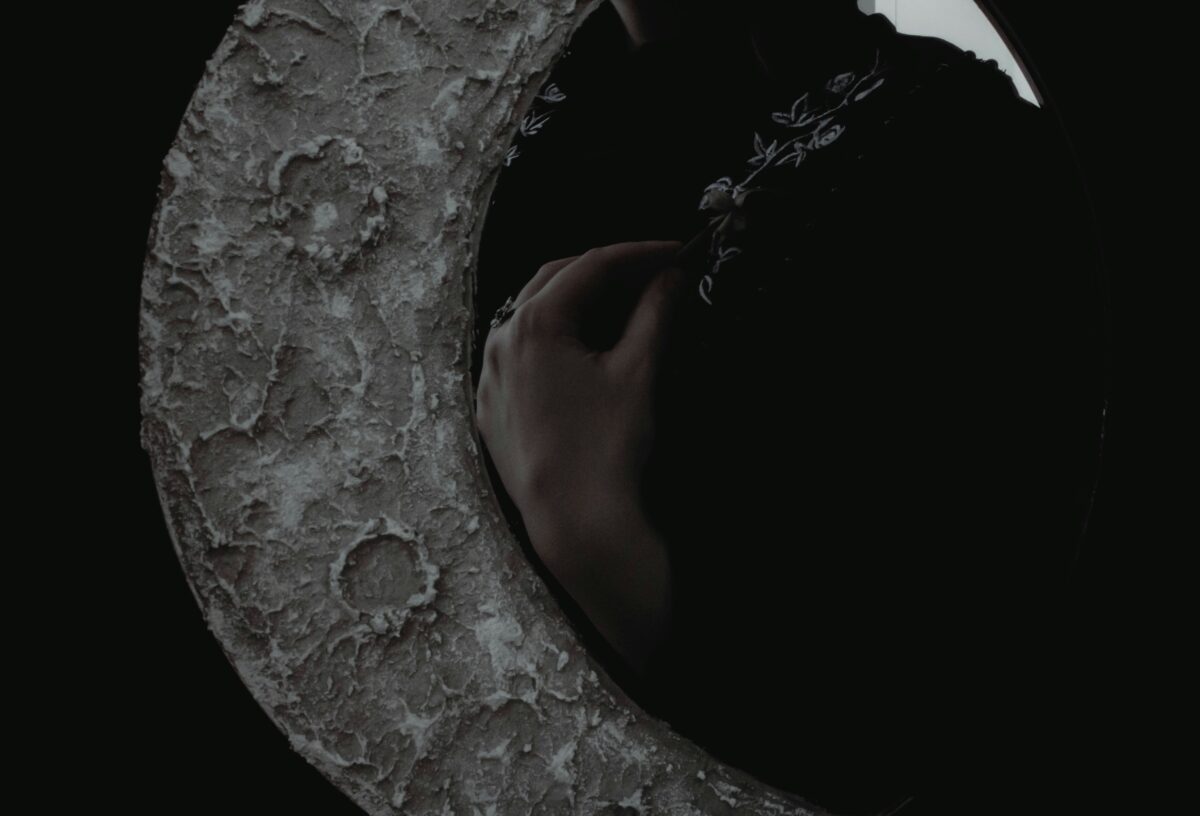
A black mirror is one of the most direct divination tools you can work with and also one of the easiest to make yourself. You do not need polished obsidian or an expensive purpose-made tool. A picture frame from a charity shop and a can of black spray paint will produce a functional scrying mirror for a few euros or less. What matters far more than the materials is the practice itself: the patient, unfocused gaze that allows the surface to stop being a surface and start being a threshold.
Scrying comes from the Old English word descry, meaning to reveal or to make out dimly. It describes the practice of gazing into a reflective or translucent medium to receive visions, symbolic imagery or impressions that bypass the ordinary waking mind. A black mirror is one specific form of scrying medium. Its darkness does something that an ordinary mirror cannot: it absorbs rather than scatters light, eliminating the distracting brightness of your own clear reflection and creating the visual stillness that deeper perception seems to require.
What Is the History of Black Mirror Scrying?
The use of dark reflective surfaces for divination predates glass mirrors entirely. Before glass existed, the most prized scrying material was obsidian, a volcanic glass that forms when molten lava cools rapidly and produces a naturally polished, deep black surface. Obsidian mirrors, called tezcatl, were used in ancient Mesoamerican cultures for divination and ceremonial contact with spiritual forces. The practice was not merely folk magic: these were formal ritual objects used by priests and associated directly with the highest levels of the Aztec pantheon.
Tezcatlipoca, whose name translates as Smoking Mirror, was one of the supreme deities in the Aztec cosmology, associated with the night, sorcery, fate and the jaguar. He is depicted consistently with an obsidian mirror as his primary attribute, worn on his chest, placed in his headdress or replacing his right foot, which mythology holds was torn off by a primordial earth creature. His mirror was said to reveal all things: the movements of enemies, hidden truths and the workings of destiny. Obsidian mirrors serving ritual functions appear even earlier in Olmec deposits over a thousand years before the Aztecs, suggesting the tradition is significantly older than any surviving written records of it.
The most documented European black mirror practitioner is John Dee, the Elizabethan mathematician, occult philosopher and advisor to Queen Elizabeth I. Dee’s primary scrying tool was a polished obsidian mirror of Aztec origin, brought to Europe after the Spanish conquest of Mexico. From the late 1570s onward and more intensively throughout the 1580s, Dee worked with Edward Kelly using this mirror to attempt communication with angelic intelligences. The mirror, which Dee called a shewstone, now sits in the British Museum in London. Compositional analysis has confirmed its Mexican origin.
Dee reframed an Aztec ceremonial object entirely within Hermetic and Kabbalistic frameworks without any awareness of its original ritual context. The mirror’s physical form stayed the same. Its meaning changed completely depending on who held it and what tradition they brought to it. That flexibility is itself characteristic of scrying: the tool serves the practitioner’s framework.
What Makes a Black Mirror Different from a Regular Mirror?
An ordinary mirror reflects light clearly and returns a sharp, bright image of whatever stands before it. That clarity is exactly what makes it unsuitable for scrying. The mind engages with a clear reflection: you see yourself, you think about what you look like and you notice details. The ordinary mirror anchors you firmly in the present moment and the physical world.
A black mirror works differently. Its dark surface absorbs rather than scatters light. In dim conditions, it becomes less a reflective surface and more a depth. You look into it rather than at it. This distinction sounds subtle but in practice it is significant: gazing into the middle distance of a black mirror produces a different quality of attention from staring at a bright reflection of your own face.
There is also a documented perceptual phenomenon worth understanding. A 2010 study by Giovanni Caputo at the University of Urbino, published in the journal Perception, found that participants who gazed into their own reflection in a dimly lit mirror for ten minutes consistently began to see their facial features distort: merging, shifting and in some cases appearing as completely different faces or figures. This effect, related to what is known as the Troxler effect or peripheral fading, describes how the visual system gradually stops processing information that does not change and begins filling in gaps with generated imagery. This is not a supernatural phenomenon, but it is a real perceptual one. The altered imagery produced during mirror gazing appears to be a genuine function of visual perception under conditions of sustained, low-stimulus focus. What you make of the imagery that surfaces (whether you interpret it psychologically or as genuine spiritual information) is a question each practitioner must resolve within their own framework.
How Do You Make a Black Mirror at Home?
Making a black scrying mirror is straightforward and requires no special materials. The results are functionally equivalent to a purpose-made tool.
What you need:
- A picture frame with a glass insert (not acrylic; glass produces a better result)
- Black spray paint, matte or gloss finish, rated for use on glass
- Glass cleaner or isopropyl alcohol
- A lint-free cloth
- Newspaper or cardboard to protect your working surface
Round or oval frames are traditional and preferred by many practitioners, but a rectangular frame works equally well. Charity shops are the ideal source: frames there often have character and age and the cost is minimal. Make sure the frame uses actual glass rather than plastic, since plastic does not accept spray paint cleanly and produces an uneven surface.
How to make it:
- Remove the glass from the frame. Set the frame aside.
- Clean both sides of the glass thoroughly with glass cleaner or isopropyl alcohol and a lint-free cloth. Any dust, fingerprints or grease trapped between the glass and paint will show permanently. Take your time with this step.
- Lay the glass on newspaper in a well-ventilated space, painted side facing up. Work outdoors if possible.
- Hold the spray can at least 50 centimeters (20 inches) away from the glass. Apply a thin, even coat using smooth side-to-side movements. Do not hold the can still or paint in one spot as this causes pooling.
- Allow the first coat to dry completely. This typically takes one to two hours depending on conditions. Do not rush this.
- Apply a second thin coat. Check coverage by holding the glass up to a light source: you want no light showing through. Apply a third or fourth coat if needed, waiting for each to dry completely before adding the next.
- Once the final coat is fully dry, cut a piece of black card or cardboard to fit behind the glass. This protects the paint from scratches and covers any pinholes.
- Place the glass back into the frame with the unpainted side facing outward. The painted surface should face inward, away from you.
- Clean the front surface of the glass once more before use.
The finished mirror will have a deep, matte or gloss black surface with no visible reflection in normal light. In dim candlelight it will appear as a dark depth rather than a surface. This is what you want.
Alternative: obsidian or other dark stones
If you prefer a natural material, you need a polished obsidian disc specifically, not a tumbled or raw obsidian stone. A small tumbled obsidian stone has an irregular, uneven surface that is unsuitable for gazing. What you want is a flat, round disc that has been polished to a smooth mirror-like finish on at least one side. These are sold specifically as obsidian scrying mirrors, typically 10 to 15 centimeters (4 to 6 inches) in diameter, and are widely available from crystal suppliers and sites like Etsy. They are more expensive than a painted glass mirror but not dramatically so.
Obsidian carries associations specifically aligned with scrying and protection work, while its surface depth has a slightly different quality from painted glass that many practitioners find more conducive to extended gazing. Black tourmaline and jet have also been used historically as scrying surfaces, though obsidian is the most practical due to its naturally high polish. Both obsidian and painted glass work. The painted glass version is simply more accessible as a starting point.
Phone screens and monitors
A black phone screen or turned-off monitor functions technically as a dark reflective surface and can be used for scrying, particularly if you want to experiment before committing to a dedicated tool. Some modern practitioners use them deliberately and find them effective.
The practical concern is context. A phone is used for dozens of other things every day: social media, news, messages and work. A dedicated scrying mirror holds only what you bring to it intentionally. A phone screen carries the accumulated energy of everything else you do with it, which for most people is a high-volume, high-stimulation stream of other people’s content, conflicts and attention-capture. Whether that matters to you depends on your framework. If you treat scrying primarily as a perceptual practice, the screen is just a dark surface. If you work within a framework where tools accumulate and transmit energy, a phone is arguably one of the least neutral objects you own.
The folk belief that phones and screens can transmit negative energy or absorb it in ways that affect the viewer is a modern extension of much older mirror logic. If a mirror is a threshold that works in both directions, a device that shows you a constant stream of charged content from thousands of sources is an unusually active one. This is not a literal claim about demonology. It is a way of articulating something many people notice experientially: extended screen exposure affects mood, energy and mental state in ways that a neutral object in your environment typically does not.
How Do You Prepare a New Scrying Mirror?
A newly made or acquired mirror benefits from being cleansed and dedicated before first use. This applies whether you have made it yourself or purchased it.
Cleanse the mirror using smoke from protective herbs such as sage, rosemary or cedar, passing it through the smoke on both sides. Alternatively, leave it outdoors or on a windowsill in moonlight overnight. The full moon is traditional, but any phase works for initial cleansing. Some practitioners also wipe the surface with saltwater, though this is most appropriate for glass rather than natural stone. Salt in Witchcraft covers salt’s use as a cleansing material in more depth.
After cleansing, hold the mirror and set a clear intention. State aloud or internally what you intend this mirror to serve: clear sight, honest reflection, access to your own deeper awareness. Some practitioners consecrate a mirror specifically to one purpose and keep it for that use only. Others use a single mirror for all scrying work. Both approaches are valid.
Once dedicated, most practitioners store the mirror wrapped in a dark cloth between sessions. Black velvet or silk is traditional. This protects the surface from dust and scratches and keeps the mirror from absorbing ambient visual and energetic information between uses.
How Do You Scry with a Black Mirror?
Scrying is one of the less structured forms of divination. Unlike tarot or runes, which produce specific information through defined positions and symbols, scrying produces whatever surfaces and it may be highly specific or entirely abstract. This makes it one of the more demanding practices in terms of interpretive skill and also one of the more rewarding for practitioners who develop comfort with symbolic thinking and ambiguity.
Divination Basics: Tools for Reflection and Prediction covers the broader landscape of divination methods and is useful context for where black mirror scrying sits relative to other approaches.
Setting up:
Choose a time when you will not be interrupted. Evening or night is preferred for two reasons: reduced ambient light makes the session easier to sustain and the reduced external stimulation of night tends to support the receptive mental state scrying requires. Dim the room significantly. A single candle placed slightly to one side of or behind the mirror, out of your direct line of sight, is ideal. You want enough light to see the mirror’s surface without the candle’s reflection becoming distracting.
Position the mirror on a flat surface where you can look into it comfortably without straining your neck or holding it up. Looking into the mirror from a slight angle, rather than dead on, helps avoid seeing your own reflection. Many practitioners find a 10-15 degree angle from the vertical works well.
The session:
Spend a few minutes settling into stillness before you begin. Take slow, deliberate breaths and allow ordinary thoughts to quiet. You are transitioning from normal focused attention into a more receptive, softer awareness.
When you are ready, soften your gaze into the mirror. You are not looking at the surface. You are looking into or beyond it. Allow your eyes to go slightly unfocused in the way they do when you are staring at nothing in particular. Blink naturally; there is no need to stare without blinking.
What happens next varies considerably between practitioners and between sessions. Some people perceive visual imagery forming in the mirror’s surface: shapes, colors, figures, landscapes or moving scenes. Others receive impressions rather than clear visuals: a sudden thought that feels externally originated, an emotion that has no obvious personal source or a knowing that arrives without any specific image; some sessions produce nothing discernible, particularly in early practice.
Do not force or strain after results. The quality of attention that supports scrying is not effortful concentration but something closer to patient, open receptivity. Effort tends to produce nothing. Relaxed, sustained attention tends to produce results over time.
Typical sessions last 20 to 40 minutes. End the session when you feel complete, when restlessness sets in or when the quality of attention has deteriorated. Ground yourself afterward: eat something, drink water, walk outside or do any other activity that returns your attention firmly to the physical present.
Recording:
Record everything you experienced immediately after each session before the details dissolve. Scrying impressions share a quality with dreams: vivid in the moment, rapidly inaccessible afterward if not captured. A dedicated section of your grimoire serves this purpose well. Over time, patterns emerge that would not be visible from any single session.
What Are the Different Approaches to Black Mirror Work?
Practitioners use black mirrors for several distinct purposes and how you approach a session should match what you are using it for.
Self-reflection and shadow work: Many modern practitioners use the black mirror primarily as a tool for accessing unconscious material, the parts of yourself that do not surface in ordinary awareness. In this frame, the imagery produced during scrying is understood as your own unconscious communicating symbolically, in the same way dreams do. This interpretation makes the black mirror a useful companion to shadow work, which involves the deliberate exploration of the unconscious for personal insight and integration.
Divination: The traditional use is direct: bring a specific question, hold it in mind as you enter the receptive state and interpret whatever arises in relation to that question. The imagery produced is typically symbolic rather than literal. A figure appearing in the mirror does not necessarily represent a real person; a landscape does not necessarily represent a physical place. Meaning emerges through the practitioner’s interpretive relationship with their own symbolic vocabulary, developed over time through consistent practice and recording.
Spirit communication: Some practitioners use the black mirror as a focal point for contact with ancestors, guides or other entities. This approach sits within a long historical tradition reaching from Dee and Kelly back through ancient Mesoamerican priestly practice. If this is your intention, protective precautions before the session are particularly recommended: cleanse the space, cast a protective boundary and set a clear intention for the type of contact you are open to. Working with entities through a mirror is not to be approached carelessly.
Candle reading in combination: Some practitioners position a lit candle so that its flame reflects in the mirror surface during scrying. The moving flame provides a point of focus and the interplay of flame and darkness in the mirror can deepen the meditative state and provide additional visual information to interpret alongside the mirror’s depths.
How Do You Cleanse and Maintain a Scrying Mirror?
A mirror used regularly in practice should be cleansed at consistent intervals and after any session that felt heavy or unclear.
Regular cleansing can be as simple as moonlight exposure or smoke cleansing between sessions. After any session involving difficult emotions, unclear or disturbing imagery or deliberate spirit contact, a more deliberate cleansing is worthwhile. Smoke from protective herbs, a wipe with lightly salted water (for glass surfaces only) or placement on black tourmaline overnight are all effective methods.
The front surface of the mirror should only be cleaned with a soft, lint-free cloth and glass cleaner or isopropyl alcohol. Avoid anything abrasive. Even small scratches become very visible during scrying and distract from the depth of the surface.
Most practitioners feel strongly that a scrying mirror should be handled only by its owner and kept covered when not in use. The logic is practical: the mirror is calibrated to your own perceptual patterns and energetic signature through consistent use. Another person’s handling introduces a different quality that can muddy the mirror’s responsiveness. If someone does handle your mirror, cleanse and re-dedicate it before your next session.
FAQ
What is a black mirror used for in witchcraft?
A black mirror is primarily used for scrying, which is the practice of gazing into a reflective surface to receive visions, impressions or symbolic information. It can be used for divination with a specific question, for open-ended self-reflection and access to unconscious material or as a focal point for spirit communication. Some practitioners also use black mirrors in protection and reversal magic, where the mirror’s reflective quality is directed toward returning harmful energy to its source.
Do you need to buy an obsidian mirror to start scrying?
No. An obsidian mirror is a traditional and highly regarded scrying tool, but a homemade painted glass mirror works equally well for the practice, particularly when you are beginning. The scrying itself depends on your own perception and practice, not on the cost or material of the tool. Many experienced practitioners prefer a simple handmade glass mirror because they made it themselves and have worked with it consistently.
How long does it take to see visions in a black mirror?
This varies significantly between individuals. Some practitioners report impressions in their first few sessions. Others practice consistently for months before the quality of perception needed for clear scrying develops. The most important factor is regularity: short sessions practiced frequently produce more development than occasional long sessions. Managing expectations honestly is also important. Most sessions will produce subtle impressions rather than dramatic visions and that is entirely normal.
What does it mean if you feel uncomfortable while scrying?
Mild disorientation or a feeling of strangeness during scrying is common and generally harmless. The altered state of attention scrying requires can feel unusual if you are not accustomed to it. If you feel genuinely distressed or frightened, end the session, ground yourself thoroughly and consider what intentions and protective measures you brought into the practice. Some practitioners find that working with a black mirror in a space that has not been cleansed or without having set clear boundaries produces an uncomfortable quality to sessions that disappears once those steps are taken.
Can I use a regular mirror instead of a black mirror?
Yes, in low light conditions. An ordinary mirror in a dimly lit room loses much of its usual reflective clarity and can function as a scrying surface. It is less consistent than a dedicated black mirror because the ordinary mirror in full light gives a clear reflection, which trains a different quality of attention. A dedicated black mirror keeps a consistent surface quality regardless of lighting, which is why most practitioners who work with mirrors regularly prefer one.
Does the shape of the scrying mirror matter?
Round and oval mirrors are traditional for scrying and preferred by many practitioners, but there is no functional reason a rectangular mirror cannot be used. The preference for round shapes may relate to their visual simplicity: a rectangular frame has corners that can anchor the eye, while a round mirror presents a more uniform perceptual field. In practice, use whatever shape you are drawn to and can work with comfortably.
Can a phone screen or TV be used as a scrying mirror?
Technically yes. A turned-off phone screen or monitor is a dark reflective surface and functions as a scrying tool in the same basic way a painted glass mirror does. Some practitioners use them deliberately and find them effective.
The more interesting question is whether it is a good idea. A dedicated scrying mirror holds only what you bring to it intentionally. A phone is one of the least neutral objects most people own: it carries the accumulated energy of social media, news, notifications and other people’s content in constant rotation. In the framework where mirrors are thresholds that work in both directions, a phone screen is a threshold that has been actively open and receiving for most of your waking hours. Whether that affects a scrying session is something each practitioner notices for themselves.
The folk belief that phones and screens transmit or absorb negative energy is a modern extension of older mirror logic rather than a new idea. It describes something many people notice experientially regardless of their magical framework: prolonged screen exposure affects mood, energy and mental state in ways that a neutral object simply does not. If you want to experiment with scrying before acquiring a dedicated mirror, a phone screen in a dark room is a reasonable starting point. For regular practice, a separate dedicated tool keeps the working space cleaner.
Photo by Ksenia Yakovleva on Unsplash