

Tarot is widely misunderstood as a system for predicting the future. This misunderstanding is unfortunate not because prediction is beneath the cards but because it undersells what tarot can actually do. As a shadow work tool, tarot functions as a structured mirror for the unconscious mind: a way of accessing material that the rational, self-protective mind would rather not volunteer and of asking questions that ordinary reflection tends to route around.
This guide is for anyone who wants to use tarot seriously for self-inquiry. You do not need to believe the cards are magical to find them useful, though you are welcome to. What you need is honesty, a willingness to sit with discomfort and the ability to resist reaching immediately for the most comfortable interpretation.
Why Tarot Works for Shadow Work
The shadow, as Carl Jung described it, is the part of the psyche containing everything we have suppressed, rejected or refused to identify with. The problem with examining this material directly is that the same mind that suppressed it in the first place is the one doing the examining. The rational, self-image-protecting mind is not a reliable guide to its own blind spots.
This is where tarot becomes genuinely useful. When you pull a card in response to a question about yourself, you introduce an element your conscious mind did not choose and cannot immediately control. Your reaction to that card, including the resistance, the discomfort, the desire to reinterpret it, the relief or the sharp recognition: all of that is information. The card is a prompt. Your response to it is the actual shadow work.
Psychologically, tarot works similarly to projective techniques used in clinical settings. An ambiguous image is presented and what the person sees in it reveals more about their inner world than about the image itself. Tarot cards are richer and more structured, but the essential mechanism is the same. What you find in the card reflects what you are carrying.
How to Read Tarot for Shadow Work
Shadow work readings require a different orientation than predictive readings. The question shifts from what will happen to what is happening beneath the surface of my awareness right now. This changes everything about how you engage with the cards.
Begin by grounding yourself physically before you touch the deck. A few minutes of slow breathing and settling your nervous system makes a genuine difference to the quality of the reading. Shadow work requires a degree of interior stability. Trying to access deep unconscious material when you are already activated tends to produce either flooding or superficiality.
Formulate your question before you shuffle. Shadow work questions are most effective when they are specific and genuinely uncomfortable to ask. Not what does the universe want me to know, which is vague enough to receive almost any answer, but what am I refusing to see about my behavior in this relationship or what belief about my own worth is driving this pattern of self-sabotage. The more precisely the question points at something you would rather not examine, the more useful the reading tends to be.
When you lay the cards, write down your immediate, uncensored reaction to each one before you consult any reference. Record what the card produces in you: the feelings, the physical sensations, the thoughts that arise and any resistance you notice. This first reaction is often the most honest shadow data available in the entire reading. Only after recording it should you look up interpretations, and even then use them as suggestions rather than definitions. The reading that fits the shadow work context is the one that produces the most discomfort or the sharpest recognition.
The Major Arcana and Shadow Themes
The twenty-two Major Arcana cards map large archetypal forces of the psyche. Several have a particularly direct relationship with shadow material.
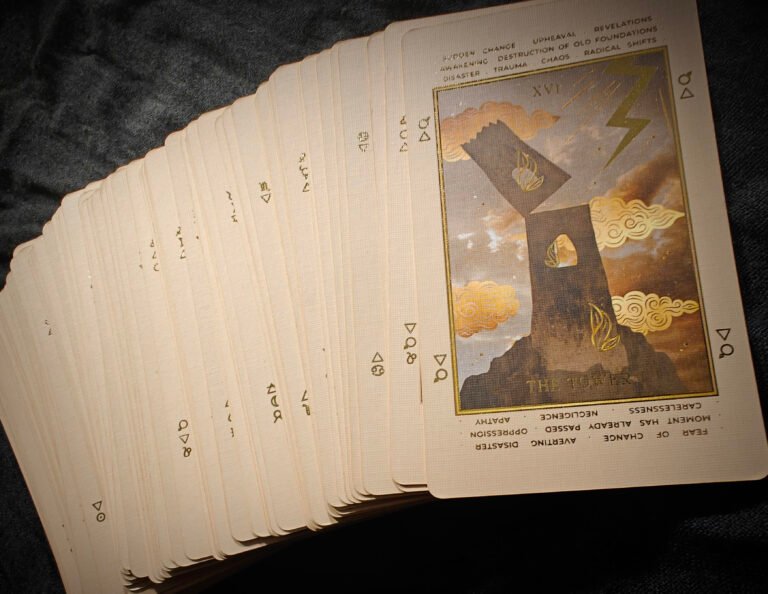
The Tower represents the collapse of structures built on false foundations: beliefs about ourselves that felt solid but were never actually true. In shadow work, the Tower points at something that needs to be dismantled rather than preserved. The fear this card produces is itself worth examining.
The Moon is the card of illusion and what operates beneath the surface. It points directly at material that has not been brought into the light and that may be distorting perception in the area of life the reading concerns.
The Devil is consistently misread in shadow contexts. It does not represent external evil. It represents the chains we forge ourselves: the compulsions, unhealthy attachments and limiting beliefs we maintain because they feel safer than the alternative. In traditional imagery the chains are always loose enough to remove. The Devil in a shadow reading asks what you are choosing to remain bound to and why.
The High Priestess represents the unconscious itself and the deep knowing that exists below rational thought. She is the keeper of what remains unspoken. In shadow work she often points at the intuitive knowledge the conscious mind has been overriding.
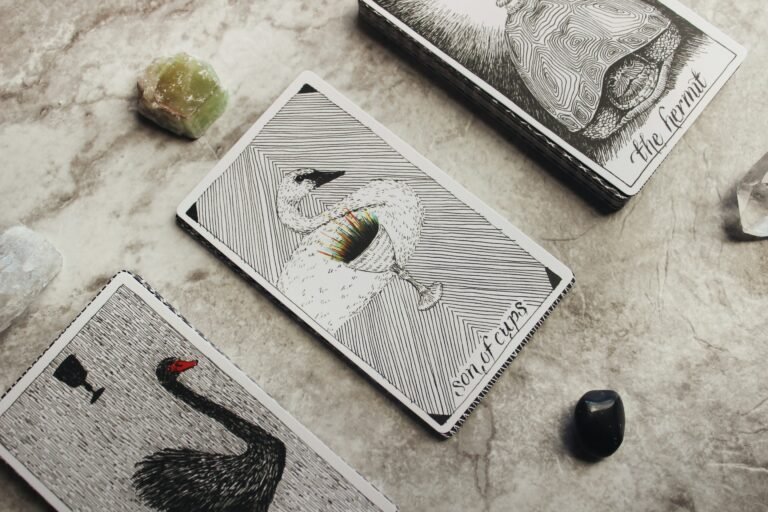
The Hermit is the archetype of the one who turns inward. He appears in shadow readings when the work requires solitude, honest self-examination and the willingness to hold your own lantern in uncomfortable territory.
Judgment represents the call to honest reckoning: seeing yourself and your patterns clearly, without the protective distortions of ego, and making the choice to integrate what you find rather than continuing to avoid it.
The Four Shadow Work Spreads
The Daily Mirror — One Card
The simplest and most sustainable shadow work practice with tarot is a single daily card pulled with a specific shadow work question. This is not a general guidance pull. It is a deliberately uncomfortable question chosen because you would rather not answer it.
Pull one card each morning with a question such as: what am I not seeing about myself today, or where am I currently lying to myself. Record the card, your immediate reaction and one honest observation about how the card’s theme might be showing up in your life right now.
Sustained over weeks and months, this practice produces a cumulative picture of your shadow material that is more revealing than any single intensive reading.

The Shadow Triangle — Three Cards
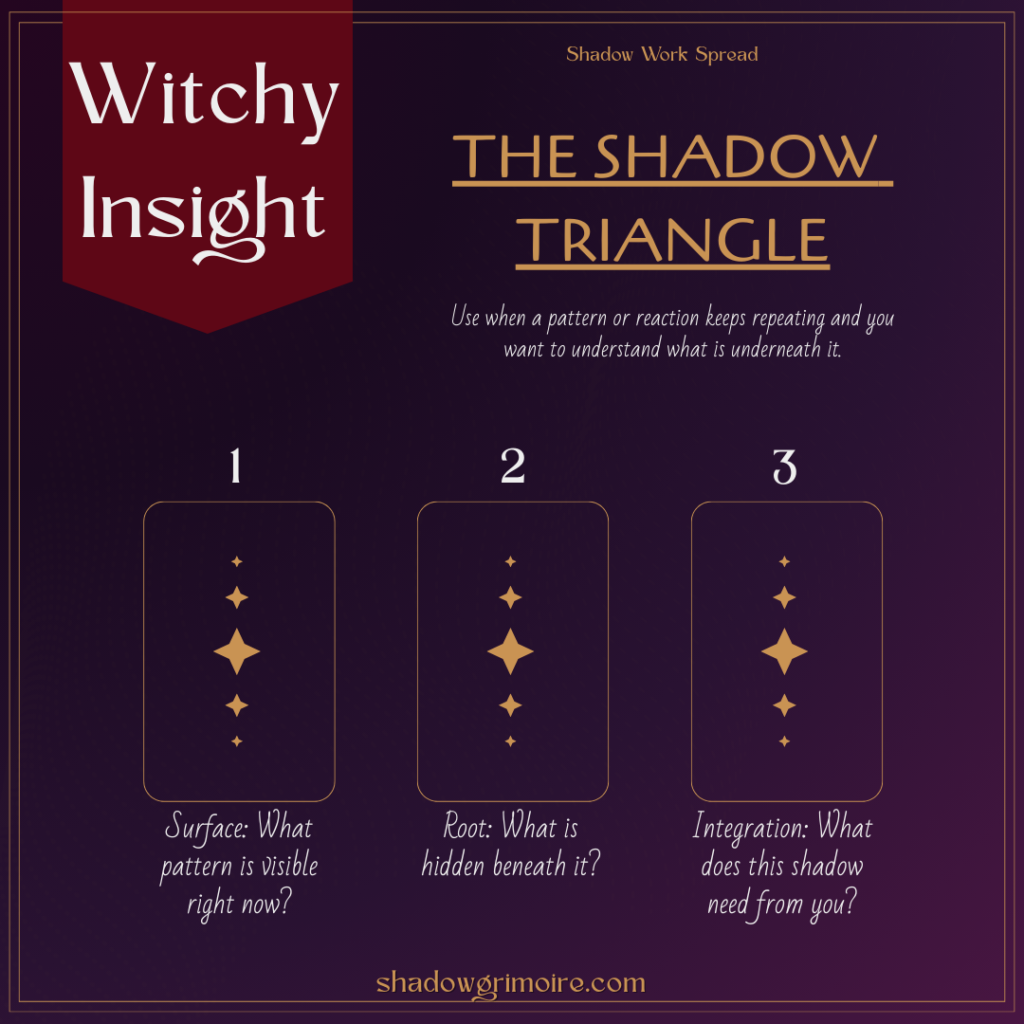
This spread is the most efficient structure for examining a specific pattern or emotional reaction you want to understand more deeply. Use it when something has been triggered and you want to move from the surface reaction to what is underneath it.
Lay three cards left to right. Card 1 is the surface pattern: the behavior, reaction or emotional response you are trying to understand. Card 2 is the root: the suppressed wound, belief or need that is driving the surface pattern. Card 3 is the integration path: not a solution imposed from outside but the quality of attention or action that would allow genuine integration to begin.
Spend significantly more time with card 2 than with the others. The root is where the shadow work is concentrated.
The Mirror Spread — Five Cards
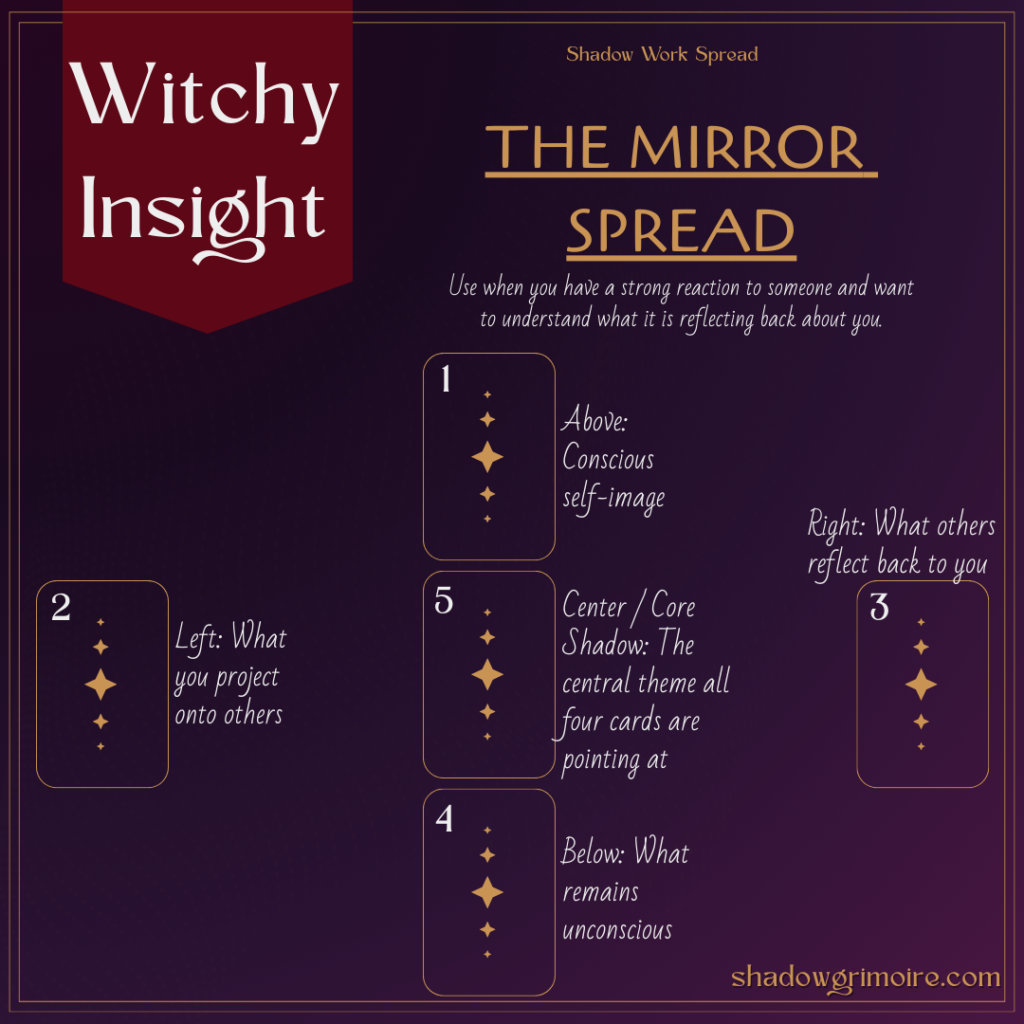
This spread is specifically designed to work with projection: the mechanism by which we attribute our own suppressed material to other people. Use it when you are experiencing a strong reaction to someone, whether that is intense irritation, contempt, idealization or an attraction you cannot explain.
Card 1 sits at the top and represents your conscious self-image. Card 2 is to the left and shows what you are projecting onto others. Card 3 is to the right and shows what your relationships are reflecting back to you. Card 4 is below and points at what remains unconscious. Card 5 sits at the center and is the core shadow: the central theme that all four surrounding cards are pointing at.
Reading this spread honestly requires the willingness to sit with card 2 without immediately dismissing its relevance to your own experience.
The Deep Shadow Spread — Seven Cards
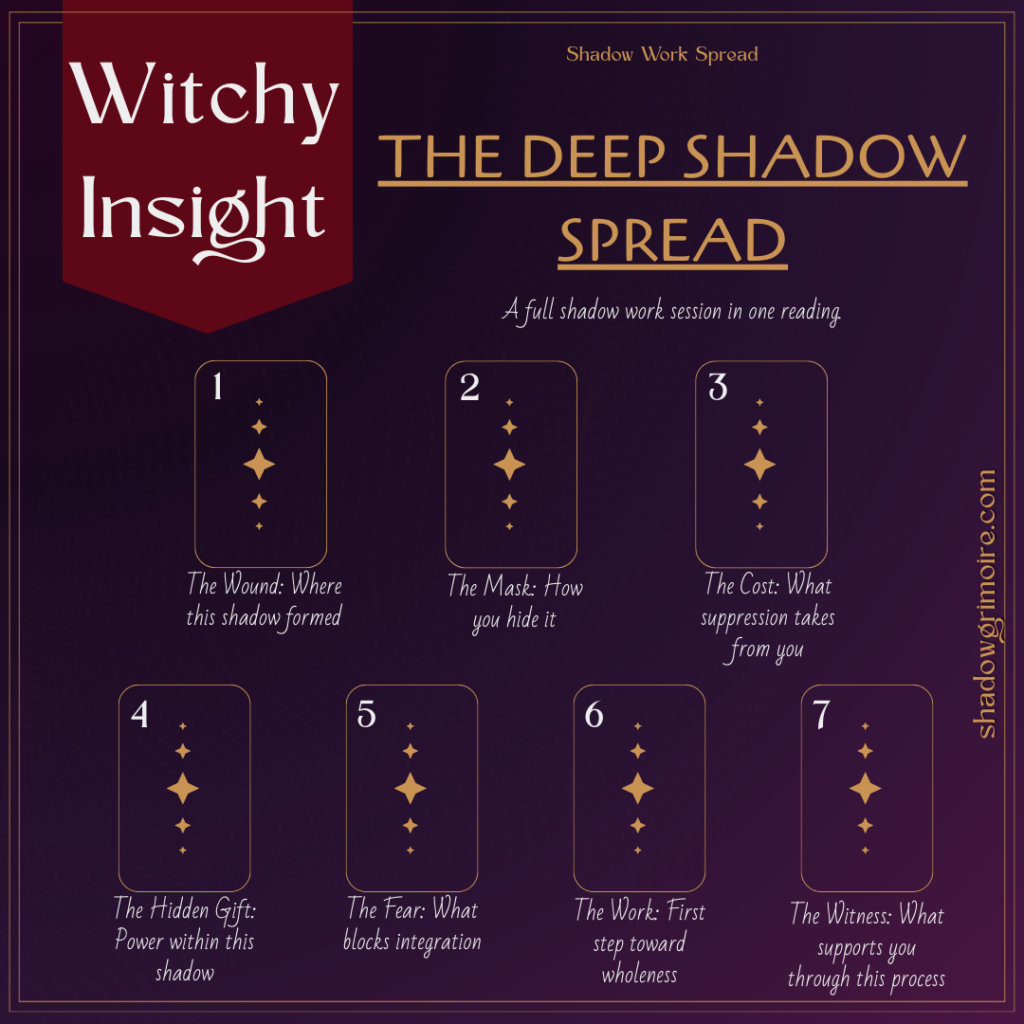
This spread is a complete shadow work session in one reading. Use it when you have identified a significant pattern or recurring theme you want to examine at depth. Allow at least an hour and have your journal nearby.
Cards 1 through 3 form the first row and address the history and structure of the shadow. Card 1 is the wound: where this shadow originally formed. Card 2 is the mask: the behavior or persona used to cover the wound. Card 3 is the cost: what the ongoing suppression of this material has been taking from you.
Cards 4 through 7 form the second row and address integration. Card 4 is the hidden gift: the power or wisdom that lives within this shadow. Card 5 is the fear: what has been preventing integration. Card 6 is the work: a concrete first direction for engaging with this material. Card 7 is the witness: the quality of support or inner resource that will be most useful as you move through this process.
Sit with each card for several minutes before moving to the next. Write about each one before laying the following card. Done slowly and honestly this spread can shift your relationship with a piece of shadow material significantly.
The Cards That Disturb You Most
In shadow work readings, the most valuable cards are rarely the ones you feel comfortable with. The cards that produce immediate resistance, the ones you catch yourself wanting to reinterpret or dismiss, the ones that feel irrelevant or wrong in ways you feel strongly about: these are doing the most useful work.
When a card produces strong resistance, write about the resistance before you write about the card. What specifically does not want to engage with this image? What would it mean if the card were accurate? What would have to be true about you for this card to fit the question?
The cards you most dislike pulling are worth spending time with outside of readings. Look at the imagery in detail and notice what specifically produces the discomfort. The discomfort is always pointed and it is always pointing at something real.
What To Do After a Reading
A reading that surfaces genuine shadow material requires more than interpretation. It requires a response, otherwise the insight dissolves back into the unconscious and the reading produces nothing more than interesting information you do not act on.
After any significant shadow reading, write for at least fifteen minutes about what surfaced. Not an analysis of the cards but your honest response to what they showed you. What did you recognize? What did you resist? What do you now see about yourself that you did not see before the reading?
Then identify one small, concrete action the reading is pointing toward. Not a complete resolution of the shadow material but one honest step in the direction of greater awareness. This might be a conversation you have been avoiding, a pattern you are committing to observe rather than act out automatically or simply a question you are agreeing to sit with rather than answer prematurely.
The cards show. The work is what you do with what they showed you.
A Practice to Begin This Week
Pull a single card each day for seven days with this question: what am I currently unwilling to look at about myself?
Record the card and your immediate, unedited reaction each day. On the seventh day, read back through all seven entries and notice what themes appear across the week. Notice which reactions were strongest and which cards you found yourself wanting to dismiss most quickly.
Choose the one entry where your resistance was highest and write for twenty minutes about what the card was pointing at and why that particular thing has been difficult to acknowledge. That resistance, examined honestly, is where some of the most productive shadow work available to you right now is located.
Photo by Cat Crawford on Unsplash




[…] Tarot as a Shadow Work Tool – A Complete Guide to Reading the Unconscious covers how to use tarot specifically for shadow inquiry rather than prediction, including four shadow work spreads, guidance on working with the Major Arcana cards most directly related to shadow material and how to read your own resistance to particular cards as the most useful information in the reading. […]