If there is one metal that belongs to the witch, it is silver. Not because someone decided it should be so, but because the evidence points that way from multiple directions at once: from the Greek goddess who gave it to humanity as a gift, from the shamans and seeresses who used it as a scrying surface, from the folklore that identified it specifically as a threat to witches in animal form, and from the continuous tradition of practitioners wearing silver as protection, intuition and a declaration of alignment with the moon.
Silver is classified in the classical seven-metal system as lunar, feminine and intuitive. But like the moon itself, it is more complex than any single label. It reflects. It amplifies what it receives. And across history it has been understood as a boundary object, something that exists at the threshold between the ordinary world and whatever lies beyond it.
The Seven Sacred Metals
Medieval alchemists inherited from classical antiquity a system linking each of the seven known metals to a planet, a day of the week and a set of spiritual qualities.
| Metal | Planet | Day | Primary Magic |
|---|---|---|---|
| Gold | Sun | Sunday | Vitality, success, solar deity work, authority, manifestation |
| Silver | Moon | Monday | Intuition, psychic work, lunar magic, protection, dream work |
| Iron | Mars | Tuesday | Protection, banishing, strength, boundaries |
| Mercury | Mercury | Wednesday | Communication, travel, wit, change |
| Tin | Jupiter | Thursday | Abundance, expansion, luck, growth |
| Copper | Venus | Friday | Love, harmony, creativity, prosperity |
| Lead | Saturn | Saturday | Binding, time, endings, deep transformation |
Silver sits opposite gold in this system. Where gold commands and asserts, silver receives and reflects. Where gold is the noon sun at its peak, silver is the full moon on still water. Both are precious, both carry power, but they work through entirely different mechanisms. Gold pushes outward. Silver opens inward.
Greece and the Gift of Selene
The ancient Greeks understood silver as a gift from Selene, the goddess of the moon. This was not symbolic language. It was understood as a literal account of the metal’s origin and nature. Silver came from her. It carried her. Working with it placed you in her current.
Selene is distinct from Artemis and Hekate, though all three are associated with the moon in different registers. Selene is the moon itself, the physical body of it, the light that falls on sleeping fields and dark water. Her name gives us the word selenium, the element later named for its moonlike luster.
Silver mirrors were used in Greek divination. The surface of polished silver, like the surface of still water, was understood as a boundary: a place where the reflective quality of the material created an opening between the visible world and what lay behind it. Scrying, the practice of seeing beyond ordinary vision through a reflective surface, has one of its oldest documented forms in polished silver.
Egypt: Bones of the Moon
In Egyptian cosmology, gold was the flesh of the gods and silver was their bones. This is a subtle but significant distinction. Flesh is the living, warm outer layer. Bones are the structure that persists after death, the enduring interior, what remains when everything else is gone. Silver in this understanding was connected to what endures beneath the surface: the invisible framework of things, the hidden structure of the world.
The moon god in Egypt was Khonsu, a deity of time, healing and protection who moved through the night sky. Silver was his metal by correspondence. He was invoked for healing and for protection against supernatural threats, and his temples incorporated silver where gold temples used gold. The difference in material expressed a difference in the kind of divine power being invoked.
Norse and Germanic Tradition: The Moon Is a Man
Here is one of the most interesting reversals in the entire cross-cultural history of silver and the moon. In Norse and Germanic tradition, the moon is male. Máni is a god, the brother of Sól the sun goddess, who drives the moon’s chariot across the night sky. He is chased by the wolf Hati, who will eventually catch him at Ragnarök.
This means that for a practitioner working in a Norse framework, the silver-moon correspondence carries a masculine lunar current rather than a feminine one. Máni is gentle, associated with the measurement of time and with the kind of quiet knowing that comes in the night. He has no large mythology compared to Odin or Thor, which in practice means he is a deity with very little accumulated distortion. He is what he is: the moon, moving steadily through the dark.
Swedish and Norse folklore described silver as effective protection against forest spirits, specifically the skogsrå, a shapeshifting creature of the forest who could lead men to destruction. Silver bullets were recorded in Swedish tradition as means of defeating the skogsrå and the sjöjungfru, the mermaid figure in Scandinavian folk tradition. In Finnish-Swedish territory the same belief was held. A Norse folk tale describes a man rescuing his bride from the Huldre-folk, the hidden people, by firing a silver bullet over her head: the silver disrupted the magic holding her.
The consistent thread in Nordic silver folklore is not aggression but disruption of illusion. Silver breaks the enchantment. It cuts through the glamour of spirits who mislead and deceive. This is consistent with the broader understanding of silver as a clarifying metal, one that reveals what is actually present rather than what appears to be.
The Witch and the Silver Bullet: What Folklore Actually Says
The silver bullet story is widely known from horror films. The common understanding is that silver kills werewolves. This is almost entirely a Hollywood invention.
The Wolf Man, the 1941 Universal Pictures film, codified silver as the definitive weapon against werewolves in popular culture. The screenwriter Curt Siodmak either invented or heavily adapted this element, likely because of silver’s established alchemical connection to the moon, and werewolves in his version were already linked to the lunar cycle. Before this film the silver-werewolf connection was almost nonexistent in documented folklore. Historians examining medieval grimoires and folklore collections have found virtually no direct references to silver being used against werewolves specifically.
What folklore does say is different and considerably more interesting for practitioners. The Brothers Grimm recorded a tale of The Two Brothers in which a bullet-proof witch is brought down by silver buttons fired from a gun. New England ghost-hunting tradition held that silver bullets could be fatal to witches when lead would not suffice. Swedish folklore applied the same principle to wizards and forest spirits.
The pattern is consistent: silver in historical European folklore was associated with breaking supernatural concealment, forcing shapeshifters back into their true form and disrupting magical protection. It was specifically a threat to those who used magic, including witches, precisely because silver was understood to be a clarifying, truth-revealing substance. It cut through illusion.
This creates the fascinating paradox at the heart of silver’s relationship with witchcraft. The metal understood as dangerous to witches in folk belief is the same metal witches have always used as their primary tool. The explanation is the same in both directions: silver reveals what is true. For a practitioner, that quality is a gift. It sharpens intuition, opens psychic perception and clears the inner vision. In the hands of someone trying to stop a witch, the same quality was understood to break her concealment. Silver does not take sides. It simply makes things clear.
The Beast of Gévaudan story, often cited as historical evidence for silver bullets, does not hold up. The silver bullet detail enters the story through a 1946 novel by Henri Pourrat, written five years after The Wolf Man had already been released. Contemporary accounts of the actual events contain no mention of silver.
Hekate and the Triple Moon
Hekate is among the most powerful deities associated with silver in modern practice, and one of the most important figures in witchcraft’s broader history. She is a goddess of crossroads, of the liminal space between worlds, of keys and thresholds and the deep night. She holds torches that illuminate what is hidden. She works at the edges of things.
Silver is associated with Hekate because it is the metal of the moon and of the boundary between worlds, both of which are her domain. Her triple form, the triple moon of waxing, full and waning, maps onto silver’s relationship with the lunar cycle. Silver objects on a Hekate altar, particularly during the dark of the moon, create a material link to her energy. Traditional offerings to her at crossroads included silver coins, silver vessels and moonlit water held in silver containers.
Artemis and Diana: The Silver Bow
In Greek tradition, Artemis carried a silver bow. Her twin brother Apollo carried a golden one. The pairing expresses the sun-moon duality in precise metallic terms: gold for the commanding solar force, silver for the night-hunting, wilderness-dwelling lunar force.
Artemis is a goddess of the hunt, of wild places, of young women and of the protective isolation that comes before maturity. Diana, her Roman equivalent, became specifically associated with witchcraft and with covens of women who gathered at night under the moon. The word diana became, in some Italian folk traditions, a name for the spirit of the moon who taught witchcraft to humanity. Silver is the material expression of both goddesses, carrying their combination of independence, precision and lunar authority.
Selene, Hekate and Artemis: Three Faces of the Moon
In Greek tradition these three exist in a relationship that is sometimes described as three aspects of a single lunar force:
Selene is the moon in the sky, the physical light, the body of the thing itself. She is associated with scrying, with seeing by moonlight and with the simple power of the moon’s illumination.
Artemis is the moon at its most active and independent, hunting in the wild places, protective of what is hers, associated with female autonomy and with the liminal spaces outside settled life.
Hekate is the moon at the crossroads, the dark moon, the aspect that moves between worlds and holds the keys to what is hidden. She is the most directly magical of the three and the most associated with witchcraft as a practice.
Working with silver in magic can be oriented toward any of these three registers depending on the nature of the working.
The Baltic and Slavic Traditions
The Baltic goddess Meness is the moon god and is male, like Máni in the Norse tradition. He appears in Latvian dainas, traditional folk songs, as a figure who moves across the night sky and is associated with the souls of the dead traveling between worlds. Silver in Baltic folk practice was protective against the evil eye and against night spirits, sewn into clothing and worn as jewelry for ongoing protection.
In Slavic tradition, the moon was sometimes called the shepherd of the stars, and silver was understood as moonlight made solid. Silver amulets were among the most common protective objects in Slavic folk practice. The belief that silver repelled evil spirits and the evil eye was widespread across the Slavic world, appearing in Russian, Polish, Ukrainian and Bulgarian traditions independently, which suggests either a very old shared root or a conclusion that different cultures reached by observing similar properties in the metal.
Silver as a Psychic Tool: Scrying, Mirrors and Moon Water
Silver’s most distinctive role in practical magic is as a psychic tool, a surface or medium through which the inner vision is opened and refined.
Silver scrying mirrors are among the oldest forms of divination equipment. The reflective quality of polished silver makes it a natural boundary object, a surface that belongs to both sides at once. John Dee, the Elizabethan mathematician and occultist, used a black obsidian mirror for his famous scrying sessions, but earlier European tradition favored polished silver or silver bowls filled with water. The principle is the same: a reflective surface, approached in a calm and receptive state, becomes a window.
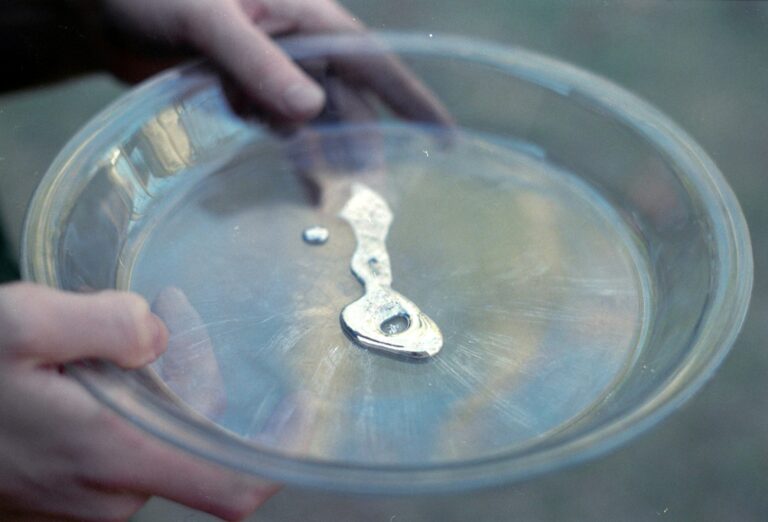
Silver bowls with water are one of the simplest and most historically grounded forms of scrying. A silver or silver-colored bowl filled with water and left in moonlight overnight creates what many traditions call moon water, water that has absorbed lunar energy. This water can be used in rituals, anointed on the third eye before meditation or divination, sprinkled for purification or used to charge other magical objects.
Moonlight charging is one of the most common uses of silver in modern practice. Silver jewelry, tools and objects left in moonlight, particularly under a full moon, absorb and hold lunar energy. The full moon is the peak time for this. The new moon is better suited to introspective work and workings involving what is hidden or emerging.
Dream Work and the Subconscious
Silver’s association with the moon extends naturally to dreams, because the moon has always been understood as the domain of what the conscious mind does not control. Dream work is one of the areas where silver has no direct equivalent among the other six metals.
Placing silver under the pillow or on the bedside table before sleep is a traditional practice for encouraging meaningful dreams and improving dream recall. Silver near the sleeping body is understood to open the channel between the waking mind and the dream state, making the threshold between them more permeable.
This connects to the broader psychic function of silver. Where gold sharpens the will and the capacity for directed action, silver softens the boundary between self and other, between the known and the unknown. This is why silver is the metal most associated with psychic development, intuition and the kind of knowledge that comes through reception rather than effort.
Silver in Modern Witchcraft: Practice and Tools
Jewelry and personal talismans
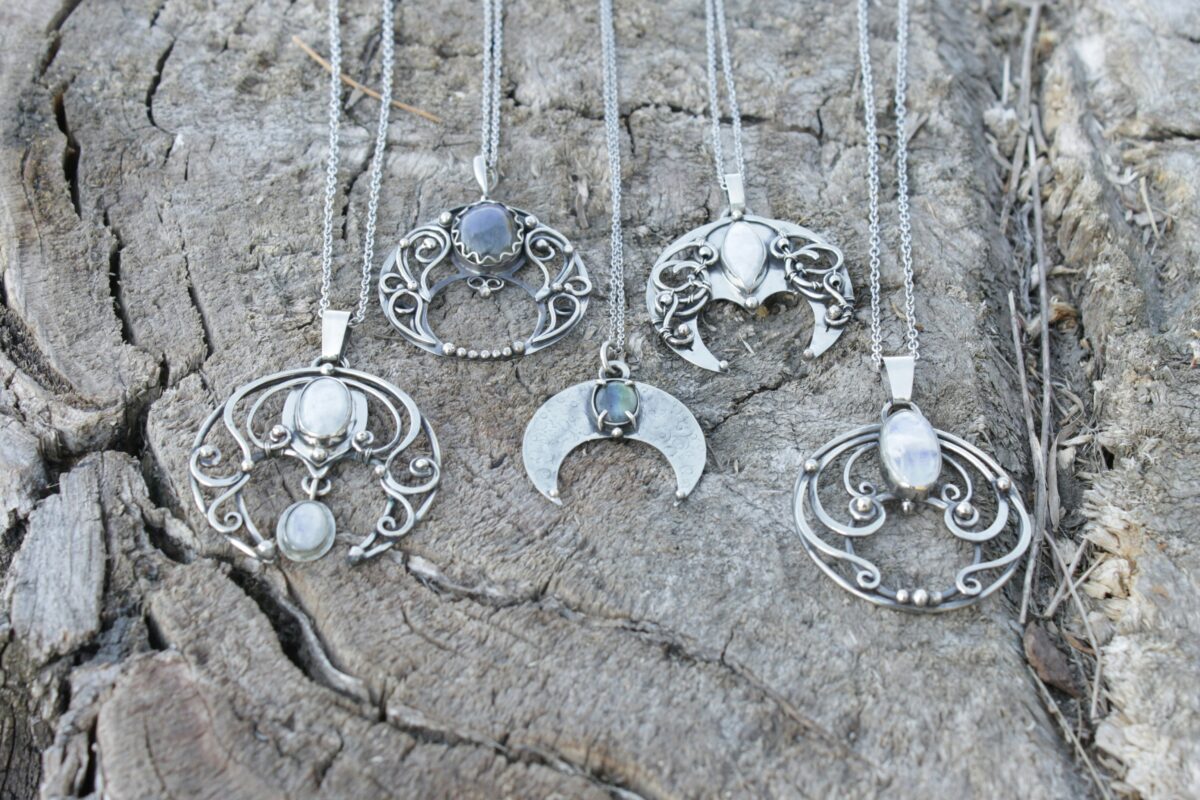
Silver jewelry is worn by more practitioners than any other metal specifically for magical purposes. A silver ring, pendant or bracelet consecrated under the full moon and worn with clear intention functions as a continuous psychic anchor, keeping the practitioner connected to lunar energy throughout daily life. Silver near the throat supports truthful communication. Silver near the third eye or worn as a headband or circlet supports psychic clarity.
Altar tools
A silver chalice or goblet on the altar is among the most traditional of magical tools, used to hold water, wine or moon water in ritual. Silver candleholders for white or silver candles amplify lunar work. A silver dish for offerings to lunar deities creates a fitting material connection between the offering and the deity.
Protection magic
Silver’s traditional role as a protector against illusion and supernatural deception makes it useful in protection work. Silver placed at doorways or windows is a folk practice found across European traditions. Silver coins buried at the corners of a property carry protective charge.
Prosperity and abundance
Though copper is the primary metal for prosperity in the Venusian tradition, silver has its own relationship with wealth through its historical role as currency and its connection to the moon’s influence over cycles and flow. Silver coins placed in prosperity jars or carried in a wallet connect the working to the longer rhythms of growth and accumulation rather than the immediate draw of copper.
Timing for Silver Work
Monday is the day of the moon in every tradition that uses a planetary week. It is the strongest day for silver workings of all kinds.
Within any day, moonrise through midnight carries the most potent lunar energy. The hour of the moon can be calculated with a planetary hours table and used on any day of the week when Monday is not practical.
The full moon is the peak time for charging silver objects, scrying and all psychic work. The new moon is better for workings involving what is hidden, intentions that have not yet formed, and deep inner work. The waxing moon amplifies growth and intuition. The waning moon supports releasing what clouds the inner vision.
Monday combined with a full moon is the strongest combination available for silver work of any kind.
Is Silver Feminine?
In the Western alchemical and occult tradition, yes. The moon in this system is feminine and silver carries that designation. This is consistent across Greek, Roman, Arabic and medieval European sources.
The Norse and Baltic traditions present a different picture. Both Máni and Meness are male moon deities. The Slavic moon traditions sometimes personify the moon as male, sometimes as a more neutral force. The Japanese moon god Tsukuyomi is male, born from Izanagi’s right eye when he cleaned himself after returning from the underworld.
What this tells us is the same thing the gold article established: the feminine and masculine designations are cultural positions, not universal truths. Silver carries receptive, reflective, boundary-dissolving qualities. It opens rather than commands. These qualities have historically been called feminine in Western tradition, but practitioners of any gender working with silver are working with the actual qualities of the metal: clarity, intuition, the opening of the inner vision, and the capacity to receive what the ordinary mind cannot grasp.
Deities Associated with Silver
Selene (Greek): the moon herself, the physical body of lunar light. Associated with scrying, moonlight, night vision and the direct power of the full moon.
Hekate (Greek/later Roman and universal): crossroads, boundaries, keys, dark moon, witchcraft. Silver is among her primary materials alongside iron and black.
Artemis/Diana (Greek/Roman): hunt, wilderness, female autonomy, the waxing and full moon, protection. Silver is her metal by the bow she carries.
Máni (Norse): the male moon, steady time-keeping, gentle knowing, the night journey. A legitimate patron for silver work in a Norse framework.
Meness (Baltic): the male moon in Latvian tradition, associated with the souls of the dead and the night journey. Relevant for practitioners working in Baltic or Lithuanian Pagan traditions.
Khonsu (Egyptian): moon god of time, healing and protection. Silver was his material by correspondence.
Tsukuyomi (Shinto/Japanese): male moon god, born alongside Amaterasu. The severing of his relationship with Amaterasu, after he killed the food goddess Ukemochi, explains in Japanese cosmology why the sun and moon no longer travel together.
Chakra Connections
Silver is primarily associated with the third eye chakra (Ajna), the center of intuition, inner vision and psychic perception. Wearing silver near the third eye or placing it on the forehead during meditation supports the opening of this center.
It also has a secondary connection to the crown chakra (Sahasrara), the point of connection to what lies beyond the individual self. Silver’s quality of dissolving the boundary between inner and outer makes it natural at the crown, where individual consciousness opens into something larger.
In energy work silver is used to cleanse and clarify the aura, moving through it like moonlight through darkness: not aggressive, but revealing. Practitioners who work with silver for aura work often pass silver jewelry or a silver wand slowly around the body to clear energetic debris before ritual.
How to Cleanse and Consecrate Silver
Silver tarnishes through oxidation when exposed to air, forming a dark grey or black layer of silver sulfide. Tarnish is a chemical process and does not indicate spiritual contamination, but regular cleansing keeps both the physical and energetic qualities clear.
Physical cleansing: A paste of baking soda and water applied gently and rinsed thoroughly removes tarnish. Commercial silver polish works but rinse carefully before any ritual use. Warm water and mild soap for light cleaning between deeper treatments.
Energetic cleansing: Moonlight is the most natural medium for cleansing silver and the most historically grounded. Leave it outside or on a windowsill under the full moon overnight. Incense smoke (frankincense, sandalwood or mugwort) is also effective. Burying briefly in clean earth resets the energetic charge.
Consecration: Hold the silver in the light of the moon if possible. State a clear intention. Anoint with jasmine, sandalwood, mugwort or moonflower oil for psychic work; with rose or ylang-ylang for emotional and heart-centered work. If working with a specific deity, invoke her or him as you set the intention.
Reconsecrate silver tools at each full moon or at the beginning of a new working.
Frequently Asked Questions
Does silver really kill witches or werewolves?
The Hollywood version, where silver is the definitive weapon against werewolves, is largely a 20th-century invention, codified by The Wolf Man in 1941. The actual folkloric record is different. European folklore from the 1600s onward describes silver as effective specifically against witches in animal form, disrupting their shapeshifting and causing wounds that would not heal. Norse and Swedish traditions describe silver bullets used against forest spirits and the skogsrå. The logic in every case is the same: silver was believed to cut through magical illusion and force things back into their true form. It was a metal of clarity and truth, and those who depended on concealment could not withstand it. Werewolves in original folklore did not have silver as a specific weakness. That detail belongs to cinema, not tradition.
What is the best day to work silver magic?
Monday, being the day of the moon in the planetary week tradition. For the most potent timing, work on a Monday during a full moon, at moonrise or at midnight. Planetary hours of the moon can be calculated for any day using a planetary hours table, which provides additional windows if Monday falls at an inconvenient time.
Can I use silver-plated items instead of solid silver?
Yes. Silver-plated items carry the correspondence and can be consecrated and used effectively. Solid silver holds the correspondence more strongly because of the material concentration, but the principle remains the same. The intention and the consecration matter as much as the material composition. Work with what you have and consecrate it properly.
How is silver different from gold in magical practice?
Gold commands and asserts. It is the metal of will, directed action and solar authority. Silver receives and reflects. It is the metal of intuition, psychic opening and lunar receptivity. In practical terms: use gold when you are pushing toward a goal with focused intention. Use silver when you are opening to receive information, insight or the kind of knowing that comes without effort. Both are valuable. They work in opposite but complementary directions.
What is moon water and how is silver used to make it?
Moon water is water that has been left under the light of the full moon overnight to absorb lunar energy. Using a silver bowl or silver-rimmed container amplifies this process because the material correspondence reinforces the energetic intention. The resulting water can be used in ritual, added to baths, sprinkled for purification, used to anoint the third eye before divination or scrying, or offered to lunar deities. It keeps for several days if stored in a sealed glass container away from direct sunlight.
Is silver connected to psychic ability?
Yes, in nearly every tradition that has worked with it. The connection is consistent and appears independently across Greek, Egyptian, Slavic, Norse, Baltic and modern Western occult practice. Silver’s association with the moon, the boundary between waking and dreaming, and the reflective quality that makes things visible which would otherwise remain dark, all point in the same direction. Working with silver regularly is understood to gradually open and refine the intuitive faculties, not through a single dramatic event but through continuous gentle exposure to the lunar current.
Photo by The Witch’s House on Unsplash