
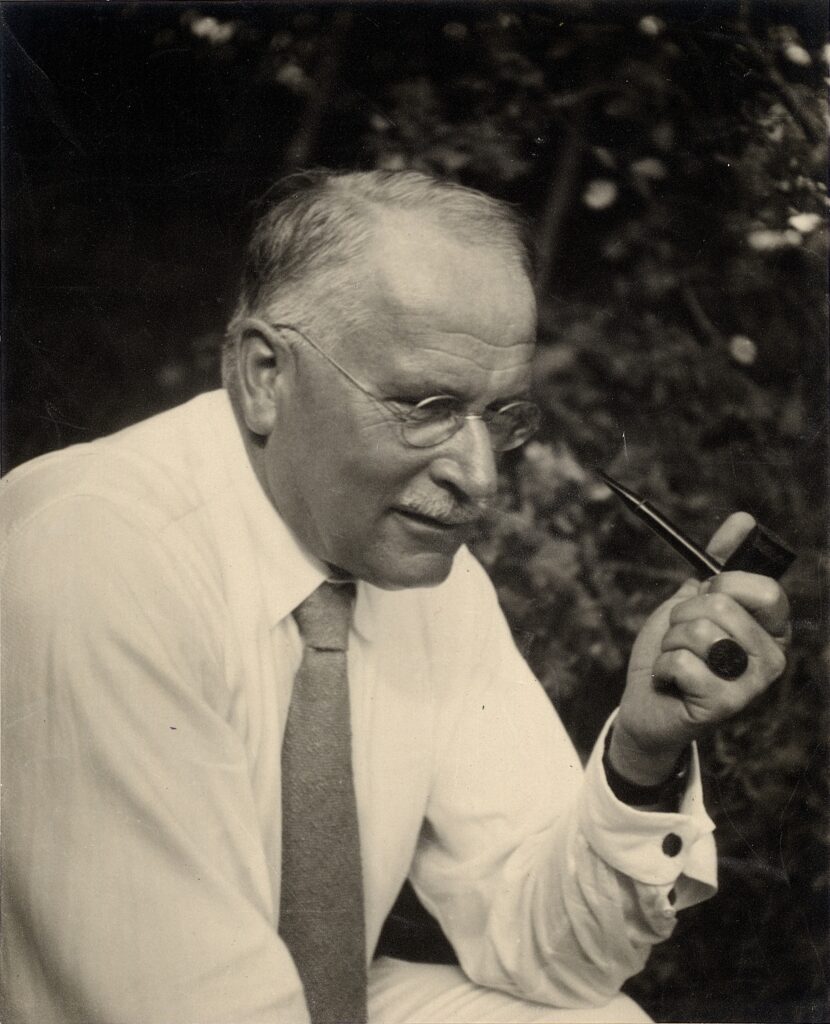
Name: Carl Gustav Jung
Born: July 26, 1875, Kesswil, Switzerland
Died: June 6, 1961, Küsnacht, Switzerland
Profession: Psychiatrist, Psychoanalyst, Author, Founder of Analytical Psychology
Known for: Archetypes, Collective Unconscious, Synchronicity, Anima&Animus
Major Works: Psychological Types, Symbols of Transformation, Man and His Symbols, Memories, Dreams, Reflections
Influence: Psychology, Philosophy, Spirituality, Occultism, Alchemy, Literature
Who was Carl Jung and why is he important
Carl Jung is my personal favorite thinker of all time. He stands out because he was not only a psychiatrist but also a philosopher of the soul, a seeker who dared to bridge science and spirituality. His work continues to inspire me because it reaches far beyond clinical psychology into myth, religion, alchemy and the occult. Jung believed that the human psyche is a vast landscape, layered with both personal experiences and a collective unconscious that connects all of humanity.
Jung’s importance lies in the way he expanded psychology into a study of meaning. He introduced concepts such as archetypes, the collective unconscious, synchronicity, and individuation. These ideas gave people a framework to understand dreams, myths and spiritual experiences as more than illusions. He argued that symbols and stories are expressions of deep psychological truths. His famous statement, “Until you make the unconscious conscious, it will direct your life and you will call it fate,” captures his belief that self‑knowledge is the path to freedom.
He broke away from Sigmund Freud, who emphasized sexuality as the core of the psyche and instead emphasized the symbolic and spiritual dimensions of human life. Jung saw the psyche as a living system that seeks balance between opposites, light and shadow, masculine and feminine, conscious and unconscious. This vision made him not only a pioneer in psychology but also a guide for anyone interested in philosophy, spirituality or esoteric traditions.
Jung’s importance today is undeniable. Therapists use his theories to interpret dreams and guide personal growth. Writers and artists draw on his archetypes to create timeless stories. Spiritual seekers find in his work a language for mystical experiences. He legitimized the study of myth, religion and occult symbolism within psychology, showing that the human quest for meaning is as important as the study of behavior.
“Knowing your own darkness is the best method for dealing with the darknesses of other people.” – Carl Jung
What are Carl Jung’s archetypes?
Carl Jung described archetypes as universal patterns that live in the collective unconscious. They are symbolic images and roles that appear across cultures, myths, dreams, and stories. Archetypes are not rigid categories but recurring motifs that shape how humans experience life. Jung believed that by recognizing these archetypes, we can better understand ourselves and the forces that guide our behavior. Archetypes are central to his idea of individuation, the process of becoming whole by integrating both conscious and unconscious aspects of the psyche.
The twelve core archetypes often discussed today
The twelve archetypes most commonly discussed today were developed by psychologist Carol S. Pearson drawing on Jung’s framework. Jung himself focused primarily on a smaller set of core archetypes: the Shadow, the Anima and Animus, the Persona and the Self. These were central to his theory of individuation.
- The Innocent – Represents purity, optimism and the desire for happiness. Guided by trust and faith.
- The Everyman – Symbolizes belonging, realism and the wish to connect with others. Grounded and relatable.
- The Hero – Embodies courage, determination and the drive to overcome challenges. Seeks achievement and honor.
- The Caregiver – Stands for compassion, nurturing and protection. Motivated by service and generosity.
- The Explorer – Represents freedom, discovery and adventure. Always searching for new horizons.
- The Rebel – Symbolizes revolution, breaking rules and challenging authority. Driven by change and disruption.
- The Lover – Embodies passion, intimacy and commitment. Seeks connection and beauty in relationships.
- The Creator – Represents innovation, imagination and originality. Motivated by building something lasting.
- The Jester – Stands for humor, joy and playfulness. Brings lightness and perspective through laughter.
- The Sage – Embodies wisdom, truth and guidance. Seeks knowledge and understanding above all.
- The Magician – Represents transformation, vision and the ability to make dreams real. A catalyst for change.
- The Ruler – Symbolizes order, control and leadership. Motivated by stability and responsibility.
Other key archetypes in Jung’s theory
Beyond these twelve, Jung emphasized deeper archetypal figures:
- The Shadow – The hidden, repressed aspects of the self that must be faced for growth.
- The Anima and Animus – The inner feminine in men and inner masculine in women, guiding balance and relationships.
- The Self – The archetype of ultimate wholeness, representing integration of all aspects of the psyche.
“In all chaos there is a cosmos, in all disorder a secret order.” – Carl Jung
How did Carl Jung connect psychology and alchemy
Carl Jung saw alchemy not as primitive chemistry but as a symbolic language of the soul. He believed that the ancient alchemists, in their search for the philosopher’s stone, were unconsciously describing the same inner processes that modern psychology seeks to understand. For Jung, alchemy was a metaphor for transformation: turning base metals into gold represented the psyche’s journey from fragmentation toward wholeness.
Jung studied medieval alchemical texts extensively and interpreted their imagery; fire, vessels, transmutation, as symbols of psychological change. He argued that the alchemical stages mirrored the stages of individuation, the lifelong process of integrating the conscious and unconscious mind. In this view, the “nigredo” or blackening stage, symbolized confronting the shadow and the darker aspects of the self. The “albedo” or whitening, represented purification and clarity. The “rubedo” or reddening, symbolized the final union of opposites and the emergence of the Self.
Alchemy gave Jung a framework to explain how inner conflicts and contradictions could be reconciled. He believed that the psyche naturally seeks balance between opposites, light and dark, masculine and feminine, conscious and unconscious. Alchemical symbols such as the ouroboros, the serpent eating its own tail, became for him images of eternal cycles and self‑renewal. Jung wrote, “Who looks outside dreams, who looks inside awakes,” emphasizing that true transformation is an inward process.
By connecting psychology and alchemy, Jung legitimized the idea that spiritual traditions and esoteric practices hold psychological truth. He showed that the mystical language of alchemy could be reinterpreted as a map of human development. This integration made his work unique: he bridged science and spirituality, offering a vision of psychology that was not only clinical but profoundly philosophical and symbolic.
What is synchronicity and how does it shape our lives
Carl Jung introduced the concept of synchronicity to describe meaningful coincidences that cannot be explained by cause and effect. He defined it as “an acausal connecting principle,” suggesting that events in the outer world can align with inner states of mind in ways that feel deeply significant. Synchronicity is not about random chance but about patterns of meaning that reveal themselves when the psyche and the universe seem to move in harmony.
Jung observed that people often experience moments when their thoughts, dreams or emotions correspond with external events. For example, thinking of a friend and suddenly receiving their message or dreaming of a symbol that appears the next day in reality. These experiences feel charged with purpose, as if the universe is speaking directly to us. Jung believed synchronicity shows that the psyche is not isolated but connected to a larger order of reality.
Synchronicity shapes our lives by offering guidance and insight. It can act as a signal during times of uncertainty, pointing us toward choices or relationships that matter. Many spiritual traditions interpret synchronicity as evidence of divine timing or cosmic alignment. Jung’s framework gave psychological legitimacy to these experiences, showing that they are not mere superstition but reflections of the unconscious interacting with the world.
In practical terms, synchronicity encourages us to pay attention to symbols, dreams and coincidences. It teaches that meaning is not only found in rational analysis but also in the subtle connections between inner and outer reality. Jung’s insight helps us recognize that life is full of hidden patterns and that awareness of these patterns can transform how we understand ourselves and our journey.
Did Carl Jung talk about twin flames?
Carl Jung did not write about twin flames in the modern sense of “two halves of the same soul destined to reunite.” The phrase itself comes from later spiritual and New Age traditions. However, Jung’s work on anima and animus, the unconscious feminine side of a man and the unconscious masculine side of a woman, provides a framework that many writers connect to the twin flame journey.
Jung believed that every individual carries both masculine and feminine energies within. The process of individuation or becoming whole, requires integrating these inner opposites. He described the union of anima and animus as a hieros gamos, a sacred marriage within the psyche. This union is not only psychological but also symbolic of spiritual transformation.
Modern interpreters of Jung argue that the twin flame dynamic mirrors his ideas:
- Twin flames reflect both the light and shadow aspects of each other, forcing growth and self‑realization.
- The relationship acts as a mirror, showing hidden parts of the psyche that must be integrated.
- The journey is not about romantic fulfillment alone, but about wholeness and individuation.
In this sense, while Jung never used the language of twin flames, his theories about archetypes, anima and animus and the collective unconscious provide a psychological explanation for why such connections feel profound and transformative.
“Loneliness does not come from having no people around you, but from being unable to communicate the things that seem important to you.” – Carl Jung
How does Carl Jung influence spirituality and occult traditions
Carl Jung’s influence on spirituality and occult traditions is profound because he treated myths, symbols and esoteric practices not as superstitions but as meaningful expressions of the psyche. He believed that the human unconscious communicates through images and archetypes and that spiritual traditions preserve these images across cultures and centuries. By studying them, Jung gave psychology a language that could embrace mystery and transcendence.
Jung explored Gnosticism, astrology, alchemy and Eastern philosophies, seeing them as symbolic systems that reveal inner truths. He argued that religious and occult symbols are projections of the collective unconscious, carrying wisdom about transformation and wholeness. For example, the mandala, a circular symbol found in Hinduism and Buddhism, became for Jung an image of the Self, the archetype of total integration. Similarly, the ouroboros, the serpent eating its own tail, represented eternal cycles of death and rebirth within the psyche.
His openness to occult traditions made him a bridge between psychology and spirituality. Jung showed that practices such as dream interpretation, meditation and ritual could be understood as psychological tools for individuation. He legitimized the study of esoteric traditions within psychology, arguing that they hold symbolic truths about the human journey. This perspective allowed seekers to integrate spiritual practices with psychological growth, rather than seeing them as opposed.
Occultists and mystics found in Jung’s work validation for their experiences. His theories explained why tarot cards, astrological charts or alchemical texts resonate so deeply: they are symbolic mirrors of the unconscious. Jung himself wrote, “The meeting of two personalities is like the contact of two chemical substances: if there is any reaction, both are transformed.” This reflects his belief that transformation happens through symbolic encounters, whether in relationships or in spiritual practice.
Today, Jung’s influence continues in modern spirituality, New Age movements and depth psychology. His integration of archetypes, alchemy and synchronicity with psychology provides a framework for understanding mystical experiences without dismissing them. He showed that spirituality and occult traditions are not irrational but deeply connected to the human need for meaning and wholeness.
What can we learn from Carl Jung about love and the human journey
Carl Jung saw love not only as an emotion but as a transformative force that shapes the path of individuation. For him, relationships were mirrors in which we encounter both our light and our shadow. Through love, we are confronted with aspects of ourselves that we might otherwise ignore. This confrontation is not always comfortable, but it is necessary for growth. Jung believed that the human journey is about becoming whole and love is one of the most powerful catalysts for that process.
He explained this through the concepts of anima and animus. Each person carries within them an inner opposite, the feminine image in men and the masculine image in women. When we fall in love, we often project these inner figures onto our partners. This projection can create intense attraction, but it also forces us to recognize and integrate parts of ourselves that we have neglected. In this way, love becomes a psychological and spiritual teacher.
Jung’s reflections on love also connect to the idea of eternal union, often interpreted today as the twin flame journey. While he did not use that term, his description of the sacred marriage or hieros gamos, within the psyche resonates with the notion of two souls reflecting each other’s deepest truths. Love, in this sense, is not only about companionship but about transformation. It is the meeting of opposites that leads to greater wholeness.
On the human journey, Jung emphasized that individuation, the process of becoming who we truly are, requires facing both joy and suffering. Love plays a central role in this because it reveals our vulnerabilities and our strengths. He wrote, “Knowing your own darkness is the best method for dealing with the darknesses of other people.” This insight shows that compassion begins with self‑awareness and that love is inseparable from the work of understanding ourselves.
Ultimately, Jung teaches that love is a path toward integration. It is not only romantic but universal, a force that connects us to others and to the collective unconscious. Through love, we learn to embrace contradictions, to accept imperfection and to move closer to the Self, the archetype of wholeness. The human journey, guided by love, is therefore both psychological and spiritual, a quest to become complete.
“The privilege of a lifetime is to become who you really are.” – Carl Jung
Photo: Unbekannt – This image is from the collection of the ETH-Bibliothek and has been published on Wikimedia Commons as part of a cooperation with Wikimedia CH. Corrections and additional information are welcome., Public Domain, https://commons.wikimedia.org/w/index.php?curid=94177705








[…] For a deeper exploration of Jung’s theories read our complete guide to Carl Jung’s archetypes, alchemy and synchronicity. […]
[…] Carl Jung encountered the alchemical tradition in the 1920s through the work of historian Herbert Silberer, who had proposed a psychological interpretation of alchemical symbols. Jung was initially skeptical. Then he began reading the texts directly. […]