
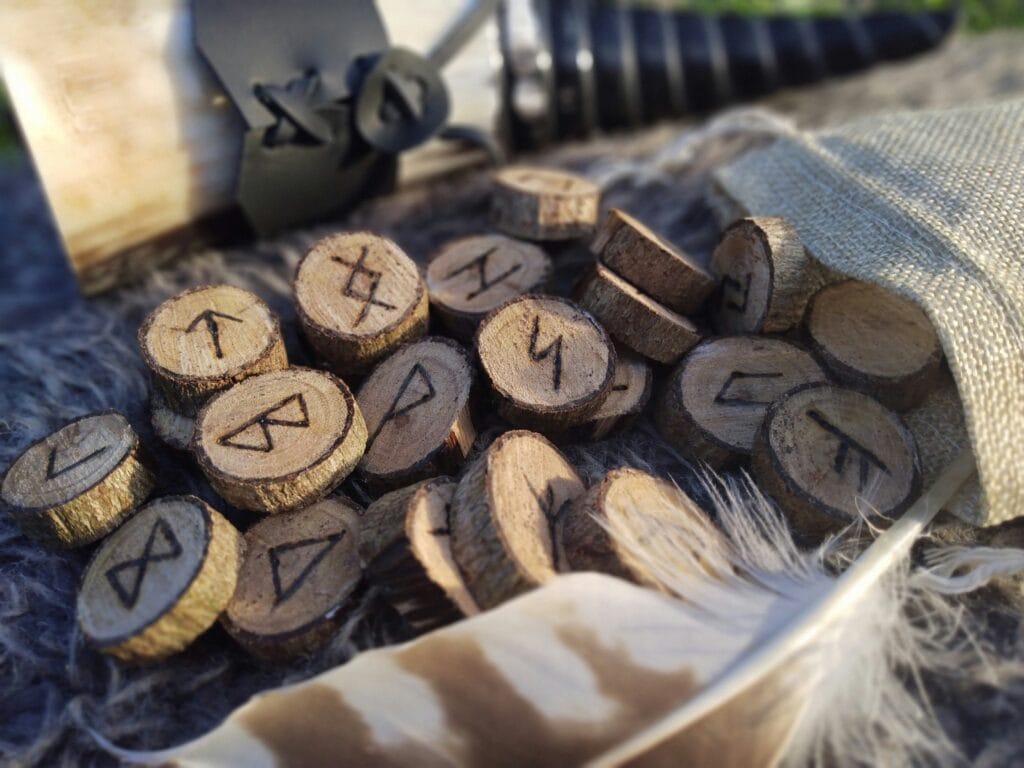
Runes are among the most enduring symbols in European history. What began as a functional writing system used by Germanic and Norse peoples evolved over centuries into something far more layered: a system of magic, a tool of commemoration, a target of ideological appropriation and finally a living practice reclaimed by modern spiritual communities. Understanding that full arc is what separates runic knowledge from runic mythology.
What Are Runes?
The word rune comes from the Proto-Germanic rūnō, meaning secret or whisper. This etymology matters because it tells us something important about how early Germanic peoples understood these symbols. Runes were not simply letters in the way we think of an alphabet today. They were considered to carry inherent power, to name and invoke the forces they represented. To know a rune was to know something hidden.
In practice runes served overlapping purposes simultaneously. They were a writing system, a magical tool and a symbolic language all at once, and the people who used them did not draw sharp lines between these functions. A rune carved onto a weapon was both an inscription and an act of magic.
How Old Are Runes?
The oldest confirmed runic inscriptions date to approximately 150 CE. These early examples appear on weapons, jewelry, amulets and small objects across a wide region of northern and central Europe. The Elder Futhark, the oldest complete runic alphabet, was in active use from around 150 CE to 800 CE.
The origins of the runic script are still debated among scholars. The most widely supported theory traces it to Old Italic scripts, particularly North Italic alphabets such as Etruscan or Rhaetic variants used in the Alpine regions, which Germanic peoples may have encountered through trade and contact. A minority view holds that the Latin alphabet itself was the primary model. What is clear is that runes were not borrowed wholesale but developed into something distinctly Germanic in both form and use.
The Three Runic Alphabets
The runic tradition did not remain static. It evolved across different regions and centuries into three distinct systems.
The Elder Futhark is the oldest, containing 24 symbols arranged into three groups of eight called aettir. The name Futhark comes from the first six runes in sequence: Fehu, Uruz, Thurisaz, Ansuz, Raidho and Kenaz. During its period of use it was largely restricted to a literate elite, with only around 350 surviving inscriptions known from this era.
The Younger Futhark emerged during the Viking Age and reduced the alphabet from 24 symbols to 16. This happened as Proto-Norse evolved into Old Norse and the alphabet was reformed to match the new sound system. The reduction is counterintuitive given that the language was actually becoming more phonetically complex, but the Younger Futhark became far more widely used than its predecessor. Around 3,000 Viking Age runestones survive, compared to the 350 Elder Futhark inscriptions, reflecting a genuine democratization of runic literacy.
The Anglo-Saxon Futhorc developed among Germanic peoples who had migrated to Britain and expanded the alphabet rather than contracting it, growing from 24 symbols to between 28 and 33 to accommodate the sounds of Old English. The Old English Rune Poem, one of the primary surviving texts for understanding runic symbolism, comes from this tradition.
What Is the Difference Between Elder and Younger Futhark?
The simplest answer is age, size and purpose. The Elder Futhark has 24 runes and was used from roughly 150 to 800 CE, primarily by a specialist elite for both writing and magic. The Younger Futhark has 16 runes and was used during the Viking Age from roughly 800 to 1100 CE, becoming widespread enough for everyday communication. The Elder Futhark is the system most commonly used in modern runic practice and divination because its larger set of symbols offers more nuance.
Did Odin Invent Runes?
According to Norse mythology, yes. But the story is more interesting than simple invention. The Hávamál, preserved in the Poetic Edda, describes Odin hanging himself from Yggdrasil, the great ash tree at the center of Norse cosmology, for nine days and nine nights. He was pierced by his own spear and refused all food and water. At the end of the ninth night, peering downward into the Well of Urd below the tree, the runes revealed themselves to him and he seized them.
The story is framed as sacrifice: Odin offered himself to himself, because there was no higher deity he could sacrifice to. The runes in this mythology were not invented but discovered, forces woven into the fabric of reality that could only be earned through suffering. This framing established runes as something fundamentally different from ordinary writing, symbols that carried cosmic weight and demanded proportional respect.
Runes in the Ancient World
In actual historical use, runestones were the most visible form of runic inscription. Families erected them to honor the dead, document significant deeds or mark land ownership. Some of the most elaborate examples, like the Jelling stones in Denmark raised by King Harald Bluetooth in the 10th century, served as public monuments with both personal and political significance.
Everyday runic use was also common, particularly during the Viking Age. The Bryggen inscriptions found in Bergen, Norway, number over 650 and include trade records, personal letters, love notes and religious texts. These are evidence that runic literacy in medieval Scandinavia was genuinely widespread and applied to mundane purposes as much as ceremonial ones.
The magical dimension was systematic rather than random. The Sigrdrífumál, another poem from the Poetic Edda, provides specific instructions for victory runes, healing runes, birth runes and speech runes, indicating that runic magic had an organized character. Specific runes or combinations were carved onto objects to invoke protection, healing, success in battle or safe travel.
Why Did the Nazis Use Rune Symbols?
The Nazi appropriation of runic symbolism is the most significant reason certain runes carry political weight today and it requires direct explanation.
The chain of transmission runs through an Austrian occultist named Guido von List, who in 1902 claimed to have received a vision of a new runic system during a period of temporary blindness. He called these the Armanen runes, presenting them as the original secret alphabet of an ancient Aryan priest-caste. The Armanen runes were not a historical alphabet. They were an invention, loosely inspired by historical runes but with no actual scholarly basis.
Von List’s ideas fed into a broader ideology called Ariosophy, combining occultism with racial pseudoscience and Germanic nationalism. These ideas eventually influenced figures within the Nazi movement. Heinrich Himmler was particularly drawn to them, and runic symbols were used from the 1920s onward on SS flags, uniforms and insignia. The SS double lightning bolt insignia was designed in 1933 by Walter Heck, based on von List’s version of the historical Sowilo rune.
The critical point is that the symbols used by the SS were based on von List’s invented Armanen system, not on the historical Elder Futhark or Younger Futhark. The contamination was real but it was built on a fabrication layered over genuine history. The historical runic tradition predates the Nazi period by nearly two thousand years.
Are Runes Still Used Today?
Yes, and with genuine depth. The Asatru and Norse pagan revival that emerged in the 1970s approached runes as a spiritual and divinatory system grounded in actual historical practice, explicitly distinguishing authentic runology from von List’s invented tradition. Scholars working within this revival, including Stephen Flowers writing as Edred Thorsson, produced serious research on the Elder Futhark and its practical applications.
Today runes are used for divination, drawn or cast to gain insight into a situation in a way comparable to tarot. They are carved into amulets and talismans for protective and empowering purposes, combined into bindrunes for specific magical intentions and incorporated into meditation and ritual practice. Practitioners who engage seriously with runic work generally do so with full awareness of the history, including the appropriation, and with deliberate connection to the authentic pre-Christian tradition the symbols actually come from.
That tradition is rich enough to stand entirely on its own terms.
The Runes and Their Modern Meanings
Frequently Asked Questions
What is the oldest runic alphabet?
The Elder Futhark is the oldest known runic alphabet, consisting of 24 symbols and used from approximately 150 CE to 800 CE across northern and central Europe.
How many runes are there?
It depends on the system. The Elder Futhark has 24 runes, the Younger Futhark has 16 and the Anglo-Saxon Futhorc has between 28 and 33. Most modern practitioners work with the Elder Futhark.
What language were runes used to write?
Elder Futhark inscriptions were written in Proto-Norse and early Germanic dialects. Younger Futhark was used for Old Norse. The Anglo-Saxon Futhorc was adapted for Old English.
Can anyone learn to use runes?
Yes. Runic divination and runic magic are open practices with no initiatory requirements. Most people begin with the Elder Futhark, learning each rune individually before working with combinations or casting spreads.
Are some runes considered dangerous?
Some runes are associated with disruptive or destructive forces, Hagalaz for example represents hail and chaos, but no rune is inherently dangerous to work with. Context, intention and knowledge matter more than the symbol itself.
Divination Basics: Exploring the Art of Self-Reflection and Insight
Photo by Carla Santiago on Unsplash
[…] For the history and mythology behind the runic tradition, see Runes: A Historical Overview. […]