

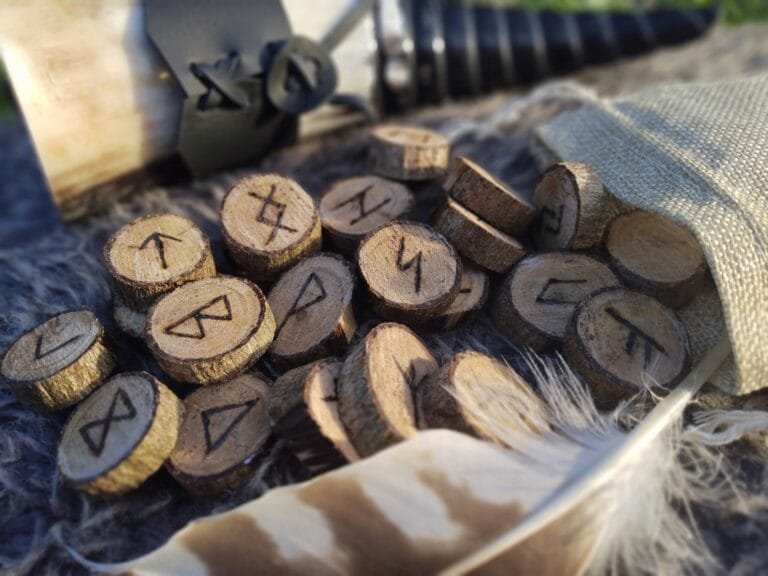
Runes have been used as magical tools for nearly two thousand years. Today they function as a divination system, a spellwork ingredient and a source of symbolic power for protection, intention-setting and ritual work. This guide covers all 24 runes of the Elder Futhark with their modern meanings, reversed meanings where applicable and practical uses in contemporary witchcraft.
For the history and mythology behind the runic tradition, see Runes: A Historical Overview.
Can You Combine Runes?
Yes. Combining two or more runes into a single design is called a bindrune. The individual meanings merge and amplify each other, creating a focused talisman or sigil for a specific purpose. A bindrune for protection in the home might combine Algiz and Othala. One for business success might merge Fehu and Sowilo. There are no strict rules for how runes are combined visually, the intention behind the design matters more than the exact overlap.
Do Runes Have Reversed Meanings?
Some do. When a rune is drawn or cast upside down it can indicate a blockage, warning or weakened version of its core energy. Not every rune has a distinct reversed meaning because some are visually symmetrical and cannot be reversed. These are noted below.
The 24 Runes of the Elder Futhark
Fehu ᚠ
Wealth, abundance, fertility, energy in motion
Fehu is the rune of movable wealth and vital force. In the ancient world it referred specifically to cattle, the primary measure of wealth, but its energy is the flow of resources in any form. It is one of the most frequently used runes in prosperity work and is particularly effective for spells involving financial growth, business success and attracting new opportunities.
In spellwork Fehu can be carved into a green candle for money spells, inscribed on a wallet or purse, or used in bindrunes alongside Sowilo for sustained success. It is also connected to fertility in the broader sense of generative energy, making it useful for creative projects and new ventures.
Reversed: financial loss, stagnation, blocked energy or resources draining away.
Uruz ᚢ
Strength, vitality, primal force, health
Uruz represents raw physical power and the untamed life force. Its name originally referred to the aurochs, the wild ancestor of domestic cattle, an animal of enormous strength that could not be controlled. The energy of Uruz is not polished or domesticated. It is the strength that comes from deep within.
In modern practice Uruz is used for healing work, particularly for physical recovery and rebuilding strength after illness or exhaustion. It is also used to add raw force to any working where you need more power behind your intention, and for courage in situations that require endurance rather than cleverness.
Reversed: weakness, lack of motivation, illness, or strength being misused or wasted.
Thurisaz ᚦ
Protection, defense, directed force, disruption
Thurisaz is the rune of the thorn and the giant. Its energy is not gentle. It represents a force that can protect fiercely or cause serious disruption depending on how it is directed. In Norse mythology the Thurses were the giants, primordial forces of chaos that the gods held in constant tension rather than defeated outright.
In spellwork Thurisaz is used primarily for protection and banishment, particularly when stronger measures are needed. It creates a hostile boundary that repels unwanted influences. It can also be used to direct force deliberately against something, making it one of the few runes that appears in offensive magical workings. Use it with clear intention and awareness of what you are directing it toward.
Reversed: vulnerability, uncontrolled aggression, or a protection that has turned back on you.
Ansuz ᚨ
Communication, wisdom, divine inspiration, the spoken word
Ansuz is Odin’s rune, connected to breath, speech and the transmission of wisdom. It governs communication in all its forms and is associated with the kind of insight that arrives fully formed, the inspiration that feels like it comes from somewhere beyond ordinary thinking.
In practice Ansuz is used to enhance communication skills, improve writing, aid in any form of teaching or speaking and open channels for intuitive knowledge. It is useful before important conversations, job interviews, negotiations or any situation where words carry significant weight. It is also a strong choice for anyone working with divination who wants to deepen their receptivity.
Reversed: miscommunication, deception, blocked inspiration or manipulation through words.
Raidho ᚱ
Journey, movement, right action, rhythm
Raidho is the rune of the ride and the wheel. It governs physical travel but also the broader concept of moving in right alignment with the natural order of things. Its energy is about momentum and direction rather than speed alone.
In spellwork Raidho is used for protection during travel, for spells intended to get things moving when a situation has stalled and for help in finding the right path when a decision point is unclear. It is also useful in rituals focused on justice and right action, as its traditional associations include the concept of cosmic order alongside physical movement.
Reversed: delays, obstacles, a journey that goes wrong or movement in the wrong direction.
Kenaz ᚲ
Knowledge, creativity, illumination, controlled fire
Kenaz is the rune of the torch. Where some fire runes deal with wild or transformative flame, Kenaz is controlled light, the kind that reveals what was hidden and enables focused creative work. It is connected to craft in the broadest sense, the skilled application of knowledge to make something.
In modern practice Kenaz is used to spark creative inspiration, to gain clarity on something confusing and to support any work involving skill-building or learning. It is particularly useful for artists, writers and craftspeople and for anyone working through a problem that requires insight rather than force. It can also be used in healing work for its association with warmth and light.
Reversed: creative blocks, ignorance, a light going out, or knowledge being withheld.
Gebo ᚷ
Gift, exchange, partnership, balance
Gebo represents the sacred principle of exchange. In the Norse world a gift always implied a return. No gift was truly free because giving and receiving were understood as two halves of a single act that created a bond between the parties involved.
In spellwork Gebo is used for strengthening relationships, deepening partnerships and any working that involves bringing two forces into balanced exchange. It is useful in love magic when the intention is mutual connection rather than one-sided attraction and in any situation where you want to formalize or strengthen an agreement. Gebo has no reversed meaning because of its symmetrical form.
Wunjo ᚹ
Joy, harmony, success, belonging
Wunjo is the rune of joy and the satisfaction that comes from being in right relationship with your life, your community and yourself. Its energy is not the excitement of something new but the deeper happiness of things being as they should be.
In practice Wunjo is used to attract happiness and harmony into a home or relationship, to lift the energy of a space and to support spells focused on emotional wellbeing. It works well in combination with Fehu for prosperity workings that include emotional flourishing alongside material abundance.
Reversed: conflict, sorrow, disharmony or joy that has been blocked or delayed.
Hagalaz ᚺ
Disruption, hail, transformation through chaos
Hagalaz is the rune of hail, the storm that destroys crops without warning or mercy. Its energy is not comfortable but it is not purely negative either. Disruption clears what has become stagnant. The destruction that Hagalaz brings tends to be the kind that makes room for what needs to grow next.
In modern practice Hagalaz is used in workings that intentionally break up a stuck situation, clear away something that has outlived its use and force a necessary change. It is not a rune to use carelessly. Its energy does not allow you to specify exactly what gets disrupted. It is useful when you know something needs to end but are not sure how to make it happen, and you are prepared for the process to be messy. Hagalaz has no reversed meaning.
Nauthiz ᚾ
Need, hardship, resistance, inner strength
Nauthiz is the rune of necessity. It represents the friction between what is and what is needed, and the strength that develops from enduring that friction. In the ancient world Nauthiz was associated with the need-fire, fire generated by friction alone, which was used in times of crisis when ordinary means had failed.
In spellwork Nauthiz is used for workings that build resilience, help you endure difficult periods and reveal what is truly necessary versus what is merely desired. It can also be used to identify and work through blockages and constraints, particularly the internal kind. It is not a rune of quick results but of developing the capacity to sustain effort over time.
Reversed: excessive restriction, compulsion, inability to meet genuine needs.
Isa ᛁ
Stillness, ice, pause, inward focus
Isa is the rune of ice. Its energy is stillness, suspension and the kind of enforced pause that comes when everything freezes over. In the Norse worldview winter was not a time of death but of waiting, of the world held in a state of suspended potential until conditions changed.
In practice Isa is one of the most useful runes for freezing spells, binding workings and any magic intended to halt or slow a process. It is also used deliberately in meditation work to create a state of internal stillness. It is worth knowing that Isa can appear in life circumstances as a signal to stop pushing forward and wait. Isa has no reversed meaning.
Jera ᛃ
Harvest, natural cycles, reward for effort, timing
Jera is the rune of the year and the turning of seasons. Its essential teaching is that harvest follows planting in its own time and that trying to force results before conditions are ready is as futile as trying to harvest in spring.
In spellwork Jera is used for workings focused on bringing long-term projects to fruition, for patience work when results are slow to arrive and for aligning with natural timing rather than pushing against it. It is a strong choice for any spell that is about deserved reward and the proper completion of something you have genuinely worked toward. Jera has no reversed meaning.
Eihwaz ᛇ
Protection, endurance, connection between worlds, the yew tree
Eihwaz is the rune of the yew tree. The yew is one of the oldest living organisms in the European world, toxic and yet immortal, growing for thousands of years, its roots and branches connected in a way that mirrors Yggdrasil. Eihwaz stands at the axis between life and death and draws its protective power from that position.
In practice Eihwaz is used for protection over longer periods and in situations involving significant transitions or thresholds. It is particularly associated with protection during spiritual work where you are moving between states or working with forces that require a solid energetic container. It is also used for workings related to endurance, perseverance through extended difficulty and the kind of strength that outlasts opposition rather than overpowering it.
Reversed: confusion, weakness, instability or a protection that has broken down.
Perthro ᛈ
Mystery, fate, the hidden, chance
Perthro is one of the most debated runes in terms of original meaning. It is associated with fate, chance and hidden knowledge, often linked to the casting cup from which lots or dice were thrown, and to the Well of Urd where the Norns, the Norse fates, weave destiny. Its energy is fundamentally uncertain and that uncertainty is its point.
In modern practice Perthro is used in divination work to deepen receptivity and access hidden information. It is also used in workings that engage directly with fate and probability, particularly when you want to shift the odds of something in your favor or when you are working with a situation where much is unknown.
Reversed: bad luck, hidden dangers or the revelation of something that was better left hidden.
Algiz ᛉ
Protection, warding, connection to higher forces
Algiz is one of the most commonly used runes in modern protective magic. Its shape, which resembles a hand raised in a warding gesture or the spread antlers of an elk, makes it visually intuitive. It creates a boundary that harmful forces cannot easily cross.
In spellwork Algiz is used for personal protection, warding a home or space, protecting loved ones and strengthening the energetic container around any ritual work. It is frequently combined with other runes in protective bindrunes. Unlike Thurisaz, whose protective energy is aggressive and retaliatory, Algiz functions more as a shield, deflecting rather than attacking.
Reversed: vulnerability, lowered defenses, a warning to be cautious.
Sowilo ᛋ
Success, solar energy, victory, clarity, life force
Sowilo is the sun rune, one of the most unambiguously positive symbols in the runic system. Its energy is radiant, direct and vitalizing. It is connected to achievement, clarity of vision and the kind of success that comes from operating fully in your own power.
In practice Sowilo is used in virtually any working where you want to add energy, confidence and forward momentum. It amplifies other runes in bindrune combinations and is frequently paired with Fehu for prosperity or Tiwaz for victory in a specific contest or challenge. It is also useful in any working focused on self-confidence, visibility and stepping into a larger version of yourself. Sowilo has no reversed meaning.
Tiwaz ᛏ
Justice, victory, sacrifice, honor
Tiwaz is the rune of the god Tyr, who sacrificed his hand to bind the wolf Fenrir so that the worlds could be protected. The rune carries his specific energy: the willingness to accept personal cost for the sake of something larger, and the authority that comes from genuine integrity.
In spellwork Tiwaz is used for victory in legal matters, competitions and conflicts where the outcome depends on who is genuinely in the right. It supports courage in difficult situations and the kind of leadership that earns rather than demands respect. It is also used in bindrunes for justice when you believe you have been wronged and want to invoke fair resolution.
Reversed: defeat, injustice, a battle lost or a sacrifice that went unrecognized.
Berkano ᛒ
Growth, new beginnings, fertility, nurturing
Berkano is the rune of the birch tree, one of the first trees to grow in disturbed ground. Its energy is gentle but persistent, the kind that quietly establishes itself and creates conditions for other things to grow. It is associated with birth, new phases and the careful tending that new things require.
In practice Berkano is used for fertility in all its forms, new beginnings, nurturing projects or relationships that are in early stages and protective workings focused on vulnerable new growth. It is useful in spells around pregnancy, new creative work, new relationships and any situation where something tender needs support to establish itself fully.
Reversed: stagnation, neglect, something that is not being properly tended.
Ehwaz ᛖ
Partnership, trust, movement, loyalty
Ehwaz is the rune of the horse and the specific relationship between horse and rider, a partnership built on mutual trust rather than dominance alone. Its energy is about working in true collaboration with another force, whether that is another person, an animal, a spirit or your own unconscious self.
In modern practice Ehwaz is used for strengthening bonds of trust and cooperation, for workings focused on travel and movement alongside another and for any situation where you need two forces to work in genuine alignment rather than parallel. It is also useful in spirit work and shamanic practice where the relationship between practitioner and spirit helper is central.
Reversed: broken trust, miscommunication in a partnership, or movement that is pulling in two directions.
Mannaz ᛗ
Humanity, community, the self in relation to others
Mannaz represents the human being in full, both as an individual and as a social creature embedded in community. Its energy involves self-awareness and the recognition that who you are is always partially defined by your relationships and context.
In spellwork Mannaz is used for workings focused on social situations, group dynamics, building community and improving how you are perceived and received by others. It is useful before entering situations where you need to make a positive impression or work effectively with a group. It also has applications in self-work focused on developing greater self-knowledge and psychological clarity.
Reversed: isolation, betrayal, conflict within a community or a distorted self-image.
Laguz ᛚ
Water, intuition, flow, the unconscious
Laguz is the rune of water in all its forms, the sea, rivers, rain, the fluid and the deep. Its energy is intuitive, receptive and connected to the emotional and psychic layers of experience that lie beneath rational analysis.
In practice Laguz is used to enhance intuition and psychic receptivity, to deepen emotional clarity and to support any working involving water as an element. It is a natural companion to divination work, meditation and dream work. It is also useful in workings focused on adaptability and navigating fluid or uncertain situations.
Reversed: confusion, emotional overwhelm, being pulled under rather than flowing.
Ingwaz ᛝ
Fertility, inner growth, stored potential, completion
Ingwaz is the rune of the god Ing, associated with the land itself and its fertility. Its energy is about potential gathered and concentrated before release, the seed before it breaks open, the intention held quietly until the right moment. It is a rune of internal work reaching a point of readiness.
In spellwork Ingwaz is used to mark the completion of an internal process or cycle, to seal a working so that its energy is contained and concentrated and for workings focused on fertility in the creative or generative sense. It is a strong closing rune for any ritual where you want to lock in the energy before releasing it. Ingwaz has no reversed meaning.
Dagaz ᛞ
Breakthrough, transformation, dawn, clarity after darkness
Dagaz is the rune of the day and specifically the moment of transition between darkness and light. It represents the threshold itself rather than what lies on either side of it. Its energy is the sudden shift, the breakthrough, the moment when something that was invisible becomes completely clear.
In practice Dagaz is used for workings intended to catalyze a breakthrough, to mark a significant transition and to invite rapid positive change after a period of difficulty or stagnation. It is one of the most powerful runes for beginning a new phase with full awareness that the old phase is genuinely complete. Dagaz has no reversed meaning.
Othala ᛟ
Home, heritage, inheritance, belonging
Othala is the rune of inherited land and ancestral connection. Its energy involves everything that is passed down through lineage, both physical inheritance and the deeper inheritance of patterns, gifts and burdens that come through family and culture.
In modern practice Othala is used for protective workings focused on the home, for spells involving family and ancestral connections and for any working related to claiming or protecting what is rightfully yours. It is also used in ancestral work when you want to connect with family heritage or address inherited patterns. Note that Othala has been misappropriated by white nationalist groups in the same vein as certain other runic symbols. Working practitioners in neopagan and Heathen communities generally address this directly by reaffirming the rune’s legitimate historical and spiritual context.
Reversed: loss of stability, disconnection from roots, conflict over inheritance or belonging.
Frequently Asked Questions
Which runes are best for protection?
Algiz is the most widely used rune for general protection. Thurisaz creates a more aggressive defensive boundary. Eihwaz is suited to protection during spiritual work and major transitions. Combining Algiz and Othala in a bindrune is a strong choice for home protection specifically.
Which runes are best for love spells?
Gebo is the most appropriate rune for love magic focused on genuine mutual connection. Wunjo supports harmony and emotional happiness in a relationship. Berkano nurtures new or developing connections. Ehwaz strengthens trust and partnership.
Can runes be used in candle magic?
Yes. Carving a rune into a candle before burning it is one of the most common methods of runic spellwork. Match the rune to your intention and the candle color to reinforce the working. Fehu on a green candle for prosperity, Algiz on a white candle for protection and so on.
How do you charge a rune?
Common methods include holding the rune and breathing your intention into it, passing it through incense smoke, leaving it in moonlight or sunlight according to its energy and speaking or chanting the rune’s name while holding your intention clearly in mind.
Do you need to memorize all 24 runes before using them?
No. Many practitioners begin with three to five runes and work with those consistently before expanding. A smaller set learned deeply is more useful than a full set understood only superficially. Start with runes whose energy resonates immediately with what you are working on.
Runes: A Historical Overview
Divination Basics: Exploring the Art of Self-Reflection and Insight
Photo by petr sidorov on Unsplash
[…] The Runes and Their Modern Meanings […]
[…] bindrune specifically for home warding. For a full reference on working with individual runes, Runes: Modern Meanings and Uses covers each of the Elder Futhark runes and their practical […]