
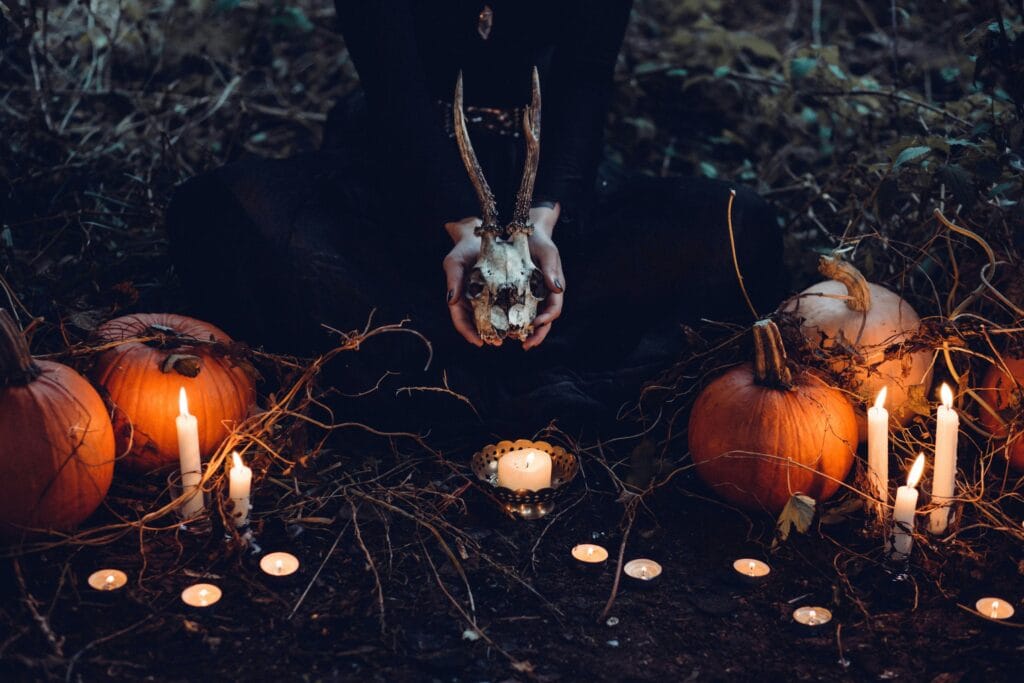
Every October 31st, millions of people carve pumpkins, sort candy into bowls and dress up as witches or superheroes. Meanwhile, practitioners of witchcraft and earth-based spirituality are lighting ancestor altars, pulling tarot cards by candlelight and honoring the dead. Both groups are observing the same night. What connects them and what separates them is a story that spans three thousand years, two continents and the full sweep of how a sacred festival becomes a commercial holiday.
The short answer is that Samhain and Halloween share common roots but are fundamentally different in purpose and practice. Samhain is an ancient Gaelic spiritual festival centered on death, ancestor work and the thinning of the veil between worlds. Halloween is the secular and commercial holiday that grew out of its Christianization, emigration to North America and gradual transformation into entertainment. Understanding how one became the other helps explain why witches and pagans often feel a particular frustration when their most sacred observance gets reduced to candy and costumes and why some find ways to hold both at once.
The Ancient Festival: What Samhain Actually Was
Samhain is a Gaelic word meaning summer’s end, pronounced sow-en. It marked the end of the harvest season and the beginning of the dark half of the year in the Celtic calendar, observed from the eve of October 31st into November 1st. It was one of the four great fire festivals alongside Imbolc, Beltane and Lughnasadh and by most accounts the most significant of the four.
The festival had three central qualities that shaped everything about it. First, it was a threshold moment: the end of one year and the beginning of the next dark half, a time when the ordinary rules of the world were suspended. Second, the boundary between the living and the dead was understood to genuinely thin at this time, allowing the souls of the dead to return and requiring practical responses from the living. Third, it was a communal obligation. Early Irish texts describe Samhain as a mandatory gathering where communities presented themselves to local kings, contracts were renewed, disputes settled and the social order was reaffirmed.
Livestock that could not be fed through winter were slaughtered at Samhain and the meat preserved. All household fires were extinguished. A new communal fire was lit, traditionally from which each household carried a flame home to relight their hearths, binding the community to a shared source of warmth. Offerings of food and drink were left out for the returning dead. Disguises were worn not for fun but for protection, to move unrecognized among the spirits that walked freely on this night.
The Samhain that survives in modern pagan practice is a direct engagement with this original intention: ancestor work, divination, releasing what has ended and sitting honestly with mortality as part of the cycle rather than as something to avoid.
Step One: The Church Absorbs the Festival
The transformation of Samhain into Halloween began in the 8th century. Pope Gregory III moved the feast of All Saints to November 1st, a date that coincided with the period when Samhain was observed. All Souls’ Day was placed on November 2nd. The three days together became Allhallowtide and the night before All Saints’ Day became All Hallows’ Eve, contracted over time into Halloween.
Whether this was a deliberate attempt to absorb an existing pagan festival or a coincidence has been debated by historians. What is clear is that the existing Celtic practices of honoring the dead, leaving food offerings for returning souls and gathering communally mapped closely enough onto Christian prayers for the departed that they survived the transition largely intact in Ireland, Scotland, Wales and the Isle of Man. Each region kept its own version of the festival under local names: Calan Gaeaf in Wales, Hop-tu-Naa on the Isle of Man, Allantide in Cornwall.
Step Two: Immigration Brings the Festival to America
Halloween as North Americans know it was largely created by Irish and Scottish immigrants. A first wave arrived in the early 19th century. A much larger wave arrived during and after the Great Famine of the 1840s. These immigrants brought their October 31st folk traditions with them, including food customs, divination games, community gatherings and the practice of carving lanterns from turnips.
In America, turnips were scarce but pumpkins were abundant and far easier to carve. The carved vegetable lantern tradition merged with the local harvest context and by the mid-1800s carved pumpkin jack-o-lanterns had become a recognizable feature of the autumn season. Their firm association specifically with Halloween rather than the harvest in general developed through the latter half of the 19th century.
The jack-o-lantern’s folk origin lies in the Irish legend of Stingy Jack, a trickster who twice outwitted the Devil and secured a promise that his soul would never be taken to hell. When Jack died, heaven rejected him for his sins and hell refused him by prior agreement. He was left to wander the earth with only a piece of burning coal placed in a hollowed turnip to light his way. People carved turnips with frightening faces to represent wandering spirits and later to ward them off at the door.
Step Three: The Community Holiday and Its Problems
By the late 19th century Halloween in North America had become a community event celebrated with parties, pranks and neighborhood activities. Alongside the festive elements there was a significant mischief problem. Pranks escalated from harmless tricks to genuine property damage and the disruption of whole neighborhoods. American civic institutions responded by trying to redirect Halloween energy into organized, community-centered activities for children. This is the direct origin of trick-or-treating as a structured practice: a way to give children a sanctioned and social outlet that would replace unsupervised pranking.
The custom of going door to door asking for food has older roots. Medieval souling, practiced in England, Wales and parts of continental Europe, involved poor people and children going house to house on All Souls’ Day collecting soul cakes in exchange for praying for the dead. This is the likeliest ancestor of trick-or-treating, though the modern form consolidated in North America in the 1930s and 1940s. During World War II, sugar rationing disrupted candy distribution and children collected coins, nuts and other items instead. After the war ended, candy manufacturers recognized an extraordinary opportunity and actively promoted the idea of giving out candy to trick-or-treaters. By the 1950s the candy-based trick-or-treating format was firmly established and Halloween had become a children’s holiday.
Step Four: Full Commercialization
The transformation from community celebration to commercial holiday accelerated through the second half of the 20th century. Candy companies, costume manufacturers, card companies and seasonal decoration retailers all recognized Halloween as a major annual sales opportunity. Costumes expanded from community-made to mass-produced to a billion-dollar global industry. Decorations followed the same arc. Halloween is now consistently one of the largest retail holidays of the year in the United States, generating billions in spending on costumes, candy and decoration annually.
The costumes themselves underwent a complete shift in meaning in this process. In Samhain practice, wearing a disguise was a protective act: you wore an animal skin or a frightening face to move unrecognized among the spirits that could harm you. In modern Halloween, costumes are entertainment, self-expression and social performance. The protective intention has been entirely emptied out. What remains is the form: the mask, the costume, the night of the year when you appear as something you are not.
The Key Differences
Intention. Samhain is a spiritual observance centered on the dead, on the threshold between worlds and on honest engagement with mortality and endings. Halloween in its modern form is secular entertainment. The night is the same; the relationship to it is entirely different.
The dead. Samhain places ancestor work at its center. The dead are honored, welcomed, fed and communicated with. Modern Halloween engages with death as aesthetic and entertainment through horror costumes, spooky decorations and fictional monsters, while systematically removing the actual dead from the picture.
Timing and energy. The veil genuinely thins at this time of year in a way that experienced practitioners recognize across decades of practice. That energetic reality is present regardless of whether someone is celebrating Samhain, Halloween or neither. Halloween captures the atmosphere of the season without engaging the substance of it.
Costumes. Celtic disguise at Samhain was protective magic. Halloween costume is identity play and entertainment.
The orientation of fear. Samhain does not avoid the reality of death. It faces it directly as part of the wheel, necessary and meaningful. Modern Halloween aestheticizes fear and death into something safely thrilling, which requires keeping actual mortality at a comfortable distance.
Can You Celebrate Both?
Many witches and pagans do exactly this. Halloween’s party energy, the costumes, the community, the children trick-or-treating, the general cultural permission to enjoy darkness and strangeness for a night, can coexist with a sincere Samhain practice. The two observances are not in conflict as long as the practitioner is clear about what they are doing and why.
A common approach is to hold the outer, festive Halloween celebration during the evening and the more inward Samhain work later in the night or over the following days. Samhain energy is present for the full three days of Allhallowtide, October 31st through November 2nd, giving ample time for ancestor work alongside the secular celebration.
What becomes harder to hold simultaneously is the commercial Halloween’s relationship to death as entertainment and the Samhain practitioner’s relationship to the actual dead. The difference is not that one is fun and one is serious; Samhain gatherings have historically included feasting, community, storytelling and celebration alongside the ancestor work. The difference is whether the dead are genuinely present in what you are doing.
If you want to use the power of this night for actual magical work, ancestor connection and divination, see Witchy Halloween Rituals for Celebrating Samhain for rituals that work whether you have a full uninterrupted evening or just fifteen quiet minutes after the Halloween activity winds down.
The Same Night Around the World
One of the most striking things about the Samhain season is how many cultures independently arrived at the same conclusion: the dead must be honored in late autumn and this particular window of time is when that work is possible. The practices below are not derivations of Samhain but parallel traditions that grew from the same human response to the same astronomical moment.
Día de los Muertos (Mexico and Latin America) falls on November 1st and 2nd, deliberately overlapping with All Saints’ and All Souls’ Day. Its roots are in Aztec traditions of honoring the dead which were later shaped by Spanish Catholic influence after colonization. Families build ofrendas, elaborate altars covered in marigolds, photographs, food offerings and candles, to welcome the souls of the dead home for their annual visit. The marigold’s scent is believed to guide the dead back. Día de los Muertos is a joyful and elaborate festival, not a solemn one, but the underlying logic is identical to Samhain: the dead return at this time and the living have an obligation to welcome them properly.
Pyhäinpäivä in Finland (All Saints’ Day, observed on the first Saturday of November) is one of the most visually powerful expressions of ancestor honoring in the northern world. Finnish families visit cemeteries on this day and place candles on the graves of their dead. As darkness falls across Finland, cemeteries throughout the country fill with thousands of small flames burning against the November dark. It is one of the most attended collective observances in the Finnish calendar, outstripping many formally religious holidays in participation. The date and the custom are formally Christian but the impulse, lighting candles for the dead at the turning of the dark season, is as old as the season itself.
The deeper Finnish layer is Kekri, a pre-Christian harvest and ancestor festival that predates both Pyhäinpäivä and any Germanic influence and was observed around the same time of year. Kekri marked the end of the agricultural year, the slaughter of livestock that could not be fed through winter and the return of ancestral spirits to the home. A man dressed as the Kekripukki, the Kekri goat, wearing a birch bark mask and a sheepskin coat and went from house to house demanding food and hospitality, a direct parallel to both the Celtic guising tradition and the later Halloween trick-or-treat. Kekri was eventually absorbed into and replaced by the Christian Pyhäinpäivä, but its timing and themes show that the Finnish response to the autumn threshold was functionally identical to the Celtic one: the dead return, the harvest is done, the dark half begins and the living must respond accordingly.
Allerheiligen in Germany and Austria follows the same pattern: candles on graves, family visits to cemeteries and the general observation of November 1st as a day of remembrance for the dead. In Catholic regions of Germany this is a public holiday.
Zaduszki in Poland falls on November 1st and 2nd and matches Pyhäinpäivä almost exactly: families cover graves with candles and flowers until entire cemeteries glow against the November dark. It is one of the most widely observed collective events in the Polish year.
Pitru Paksha (India) is a 16-day Hindu ancestor festival timed to the autumnal equinox, when the sun moves from the northern to the southern celestial hemisphere, a transition that Hindu tradition designates as ancestral time. The dead reside in Pitru-Loka between heaven and earth, governed by Yama the god of death. Descendants perform Shraddha rituals with food and water offerings to help ancestors ascend toward liberation. The timing falls slightly earlier than Samhain, in September and October, but the underlying astronomy and intention are strikingly parallel.
Chuseok (Korea) falls on the full moon of the eighth lunar month, typically late September or October. Korea’s largest holiday combines harvest celebration with ancestor honoring. Families travel home, clean the graves of their dead and perform charye, a ritual table offering of food to ancestors.
Obon in Japan (observed in August rather than autumn) is a Buddhist festival during which the souls of ancestors return to visit their living families. Families light lanterns to guide the dead home and perform the Bon Odori dance in their honor. The timing differs from the Celtic tradition but the structure is identical: a designated window when the dead come home and the living are expected to welcome them.
What the global pattern shows is not that all these traditions derive from Samhain but that the human understanding of autumn as a time for the dead runs across cultures that developed entirely independently of each other. The veil thins in late autumn everywhere, not only in the Celtic world. The consistency across traditions separated by thousands of miles is itself a form of evidence that the seasonal thinning is real.
Frequently Asked Questions
Is Halloween pagan?
Halloween has pre-Christian roots through Samhain but modern Halloween is largely secular and bears little resemblance to its pagan ancestor in practice or intention. The Christian Allhallowtide calendar, Irish and Scottish immigration to North America and 20th-century commercialization each transformed the original festival into something quite different. Calling modern Halloween pagan would be like calling Christmas a Roman festival because it absorbed elements of Saturnalia.
Did the Church invent Halloween to replace Samhain?
Pope Gregory III placed All Saints’ Day on November 1st in the 8th century, which coincided with Samhain. Whether this was a deliberate replacement or a coincidence is debated by historians. What is documented is that existing Celtic folk practices of honoring the dead survived the Christianization process largely intact in Ireland and Scotland, absorbed into the All Saints and All Souls’ observances rather than replaced by them.
Why do witches celebrate Samhain instead of Halloween?
The distinction is about intention and engagement. Samhain is the original festival with a coherent spiritual framework: ancestor work, divination, releasing endings, acknowledging the thinning of the veil. Modern Halloween shares the date but has emptied out those practices. Practitioners who take the ancestor work and the energetic significance of the season seriously tend to prefer the framework that was built to hold those intentions.
When is Samhain exactly?
Traditionally October 31st at sunset into November 1st, following the Celtic reckoning that days began at dusk. In modern practice many observe the full three days of Allhallowtide: October 31st, November 1st and November 2nd, which corresponds to the original three-day communal gathering described in early Irish sources. Some practitioners observe the astronomical cross-quarter point, which falls a few days after October 31st, as the moment of maximum thinning.
Where did trick-or-treating come from?
The practice has multiple ancestor traditions. Medieval souling involved the poor going door to door on All Souls’ Day to collect soul cakes in exchange for prayers for the dead. In Celtic areas, guising and mumming, going door to door in costume, was practiced at various seasonal festivals. The modern North American form consolidated in the 1930s and 1940s as a community strategy to give children an organized alternative to Halloween pranking. Candy companies promoted the candy-giving format heavily after World War II rationing ended, establishing the version we know today.
Photo by freestocks on Unsplash
[…] look at how Samhain and Halloween relate to each other and where Halloween actually came from, see Samhain vs Halloween: What’s the Difference?. For specific rituals suited to October 31st including ancestor candle work, the dumb supper, […]
[…] What follows is a collection of rituals and practices specifically suited to October 31st, whether you are marking the night purely as Samhain or weaving your spiritual practice through a Halloween that also includes costumes, candles and children at the door. The practices range from simple single-candle observances to more involved rituals and from purely solitary work to things that work in the middle of a gathering. If you want to understand how Samhain and Halloween differ and where the modern holiday actually came from, see Samhain vs Halloween: What’s the Difference?. […]