
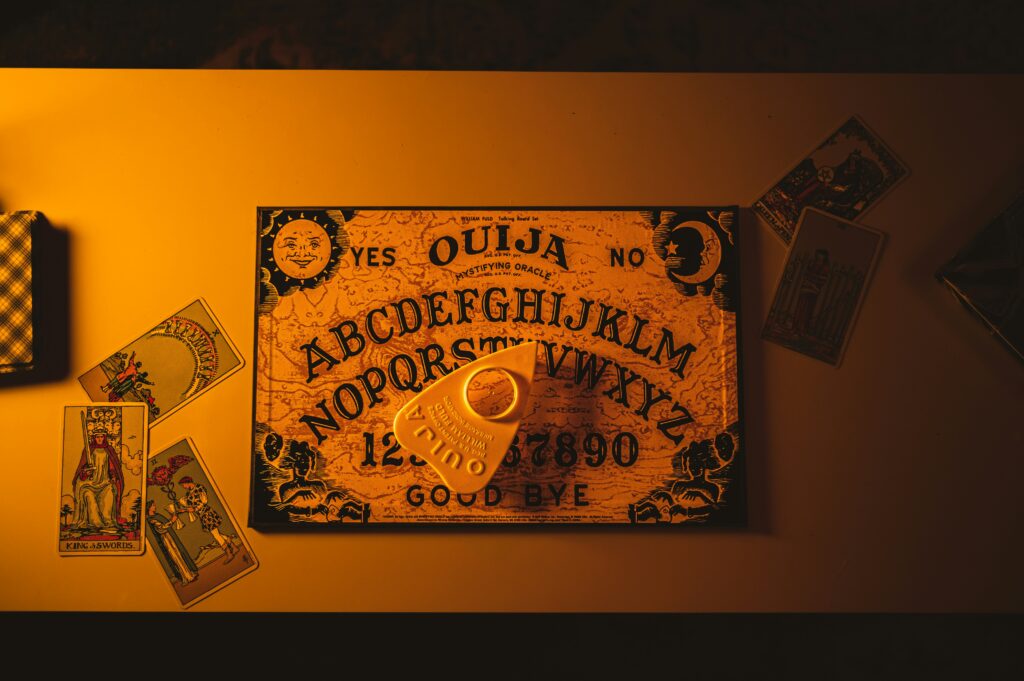
The Ouija board is one of the most misunderstood objects in Western spiritual culture. Horror films have spent decades establishing it as a portal to demonic possession and malevolent forces. The reality is more interesting and considerably less sensational: it is a tool with a documented history, a scientifically studied mechanism and a genuine place in Samhain practice when approached with honesty about what it is and what it is not.
Using a spirit board at Halloween or Samhain is not arbitrary. The thinning of the veil at this cross-quarter point is the same seasonal reality that makes ancestor work, divination and all forms of spirit communication more available at this time of year than at others. The collective cultural attention directed toward the unseen on Halloween night adds a further resonance that a practitioner can work with. If you want context for why Samhain carries this specific quality, Samhain: Honoring the Cycle of Life and Death covers the full picture.
What Is the History of the Ouija Board?
The Ouija board is not an ancient tool. It is a Victorian commercial product with a specific and well-documented origin and that origin is more nuanced than most people realize.
Talking boards of various forms had been circulating in Spiritualist communities in the United States since at least 1886, when newspapers reported the phenomenon spreading through Spiritualist camps in Ohio. Spiritualism had grown significantly in the aftermath of the American Civil War, when the catastrophic death toll left enormous numbers of people grieving and seeking contact with the recently dead.
The formal Ouija board as a commercial product was patented on February 10 1891. The patent was filed by Elijah Bond, a Baltimore attorney, with his sister-in-law Helen Peters, a spiritual medium, playing a central role in the process. According to accounts of the patent demonstration, Peters used the board to spell out the chief patent officer’s name, which he claimed was unknown to the demonstrators. This convinced the reluctant official to grant the patent. Charles Kennard formed the Kennard Novelty Company to manufacture the boards, which were selling at a rate of around 2,000 per week by 1892.
The name Ouija has several claimed origins. The most commonly repeated is that it combines the French oui and the German ja, both meaning yes. The most likely explanation, according to talking board historian Robert Murch, is that Helen Peters suggested the name from a locket she was wearing, which bore the word Ouija. The “ancient Egyptian word for good luck” origin is a later invention with no historical basis.
The board’s popular reputation as a dangerous occult object developed primarily through the 20th century. Aleister Crowley experimented with Ouija boards as a magical tool from the early 1900s onward, which contributed to its association with ceremonial magic. The 1973 film The Exorcist, in which a child’s Ouija use triggers demonic possession, cemented the board’s horror film identity so thoroughly that it has never fully recovered. Parker Brothers purchased the rights to the Ouija board from the Fuld family in 1967. In that same year, Ouija board sales surpassed those of Monopoly for the first time.
The board’s creators were not Spiritualists. Kennard was a businessman and Bond was a lawyer. They recognized a commercial opportunity in an existing spiritual practice and professionalized it. This does not invalidate the tool’s use in genuine spirit work but it does clarify what the Ouija board actually is: a modern format for a practice of directing unconscious attention toward received information that has existed in various forms across many traditions.
How Does the Ouija Board Actually Work?
This is the question that most guides avoid because the honest answer is: we are not certain. Two frameworks have serious evidence behind them and they are not necessarily mutually exclusive.
The first is the ideomotor effect, a well-documented phenomenon in which the body makes unconscious muscular movements that the conscious mind does not register as volitional. Michael Faraday first described this in 1853 while investigating table-turning at séances. Under laboratory conditions, blindfolded Ouija users continue to move the planchette meaningfully and when one user believes their partner is guiding the movement, both users typically move it unconsciously. This establishes clearly that the conscious mind is not directing the planchette when the experience feels externally guided.
A 2012 study at the University of British Columbia found something more interesting: when participants answered challenging questions using the Ouija board while believing a spirit was guiding the responses, they scored approximately 65 percent correct compared to roughly 50 percent when answering the same questions directly. This suggests the board may function as a channel for unconscious knowledge that exceeds what conscious recall can access. The participants were convinced the board was making the answers, which may have been what allowed their unconscious processing to surface without the filtering effect of the ego.
What this does not rule out is the possibility that the unconscious mind is itself connected to something beyond the individual, whether you understand that as the collective unconscious in the Jungian sense, genuine contact with external intelligence or spirits or simply a deeper layer of perception than ordinary waking consciousness accesses. The ideomotor explanation describes the mechanism. It does not determine what information that mechanism is accessing.
The practical implication is that the Ouija board is a tool for accessing information through a channel that bypasses normal rational filtering. This is also how scrying works and how divination functions more broadly. The board provides a visible, physical output for impressions that otherwise remain below the threshold of ordinary conscious awareness.
How to Use a Ouija Board on Samhain
Preparation and protective measures are worth more time than most guides give them. The same thinning of the veil that makes Samhain receptive for this work also means that the usual energetic friction that screens unwanted influences is reduced. Establishing a clear container before you begin is practical rather than superstitious.
Before the session:
Cleanse your space thoroughly. Smoke from sage, rosemary or cedar clears residual energy and signals an intentional shift from ordinary to ritual space. If you have a regular protective practice, this is the time to use it fully. The full approach to space cleansing and protective work is covered in Ultimate Halloween Protection Guide: Keep Yourself Safe on Samhain.
Place protective stones near the board: black tourmaline to ground and deflect, amethyst for spiritual clarity. Salt at the threshold of the room you are working in maintains an energetic boundary around the space. Remove metal jewelry if you find it affects your sensitivity.
Set a candle near the board, not so close as to be a fire hazard but present as a focal source. Candlelight at this time of year carries its own resonance with Samhain practice.
Setting your intention:
State clearly, aloud, who or what you are open to communicating with. Specificity matters. “I welcome contact with my grandmother” is a cleaner invitation than “I welcome any spirit who wants to communicate.” Open invitations attract open responses, which is not always what you want.
If you are using the board for ancestor work at Samhain specifically, connect it to the broader ancestor practice. Light a candle for the dead you are calling. Speak their names before you begin. Place a photograph or an object belonging to them near the board. The board becomes one part of a wider context of welcome and respect rather than a standalone device.
During the session:
Rest your fingers lightly on the planchette. Do not apply pressure. The movement you are looking for is subtle and if you grip or push you will produce nothing useful. Allow the planchette to rest motionless for a minute before expecting anything to move.
Ask open questions rather than yes or no questions when possible. “What do you want me to know” produces more from the unconscious channel than “Is there something here” which is easily answered by the expectation of a yes.
Take notes. Write down every letter the planchette moves to rather than trying to interpret while the session is active. Messages through the Ouija frequently need to be read as a complete sequence rather than letter by letter.
Remain calm when the planchette moves. The most common response to the board actually moving is to startle and lose the receptive state. If this happens, pause, settle and begin again.
Closing the session:
Move the planchette to Goodbye deliberately and speak a clear closing: “I thank you for communicating. The connection is now closed.” This is not theater. It is the same principle as closing any ritual working: you opened something and you close it equally deliberately. Do not leave the session without a formal close.
Ground yourself after the session. Eat something, drink water or step outside briefly. Any of these returns attention firmly to the physical present. Extended Ouija work in particular can produce a floaty quality of attention that benefits from grounding.
Storing the board:
Keep a Ouija board used in regular practice wrapped in cloth when not in use, stored separately from casual objects. This is the same principle as keeping a scrying mirror covered: you are maintaining the quality of a dedicated tool rather than allowing it to accumulate ambient energy from its environment.
What Are the Different Types of Spirit Boards?
The Ouija is the trademarked version but talking boards have existed in many forms. Any board with an alphabet, numbers and a movable indicator functions on the same principle. Some practitioners make their own by writing letters on a piece of paper and using a glass or coin as the indicator. Handmade boards carry your own energy from their creation, which some practitioners find produces cleaner responses.
Pendulum boards offer an alternative format: a circular board with the same elements navigated by a pendulum rather than a planchette held by multiple people. These work well for solitary practice since the Ouija’s planchette format is awkward with one person. Pendulum Divination: A Guide to Tools, Usage and Free Printable Boards covers pendulum work in full.
FAQ
Is the Ouija board dangerous?
The honest answer is that most negative experiences with Ouija boards appear to be psychological in nature rather than genuinely dangerous external contact. Anxiety, suggestibility and the lowered rational filtering that the board’s mechanism produces can combine with the power of expectation to produce frightening experiences. The horror film reputation of the Ouija creates a powerful nocebo effect: you expect something terrifying and your unconscious mind generates material that matches that expectation.
That said, any practice that opens receptivity to the unconscious and to potential external influences benefits from protective measures, clear intentions and a deliberate close. This is not specific to the Ouija. It applies to all spirit communication work.
Can one person use a Ouija board alone?
Yes, though the planchette format is easier with two or more people because the weight distribution produces smoother movement. For solitary practice, a pendulum board works on the same principle with a format better suited to a single user. Some practitioners use a Ouija board alone by placing both hands on the planchette, which is lighter contact but functional.
What does it mean when the planchette moves to specific letters?
The planchette spells out letters that combine into words and phrases. Interpretation requires reading the complete sequence rather than reacting to individual letters. Some sessions produce clear, coherent messages. Others produce fragments or apparent nonsense that becomes meaningful in retrospect. Recording exactly what comes through and reviewing it after the session is more useful than trying to interpret in real time.
Should I use a Ouija board if I am new to spirit work?
Building some foundation in other forms of divination and protective practice before working with spirit boards is a reasonable approach. Tarot or oracle work develops the interpretive skills that Ouija requires. Establishing a regular protective practice before adding spirit communication is practical. If you want to start with less direct methods, Halloween Tarot Reading: How to Read Cards on Samhain Night is a gentler starting point for Samhain divination.
What happens if we do not say goodbye?
The formal close is worth doing because it completes the working. Whether or not something genuinely remains open without it is a question different traditions answer differently. What is consistent across frameworks is that practitioners who close their sessions report cleaner experiences than those who leave them open-ended. The close is also a grounding act in itself: the deliberate statement that the connection is complete helps return your attention to ordinary consciousness.
Photo by Colton Sturgeon on Unsplash




[…] at Samhain including historical context, the ideomotor effect and step-by-step session guidance, Halloween Ouija Board Guide: Spirit Communication on Samhain covers it in […]