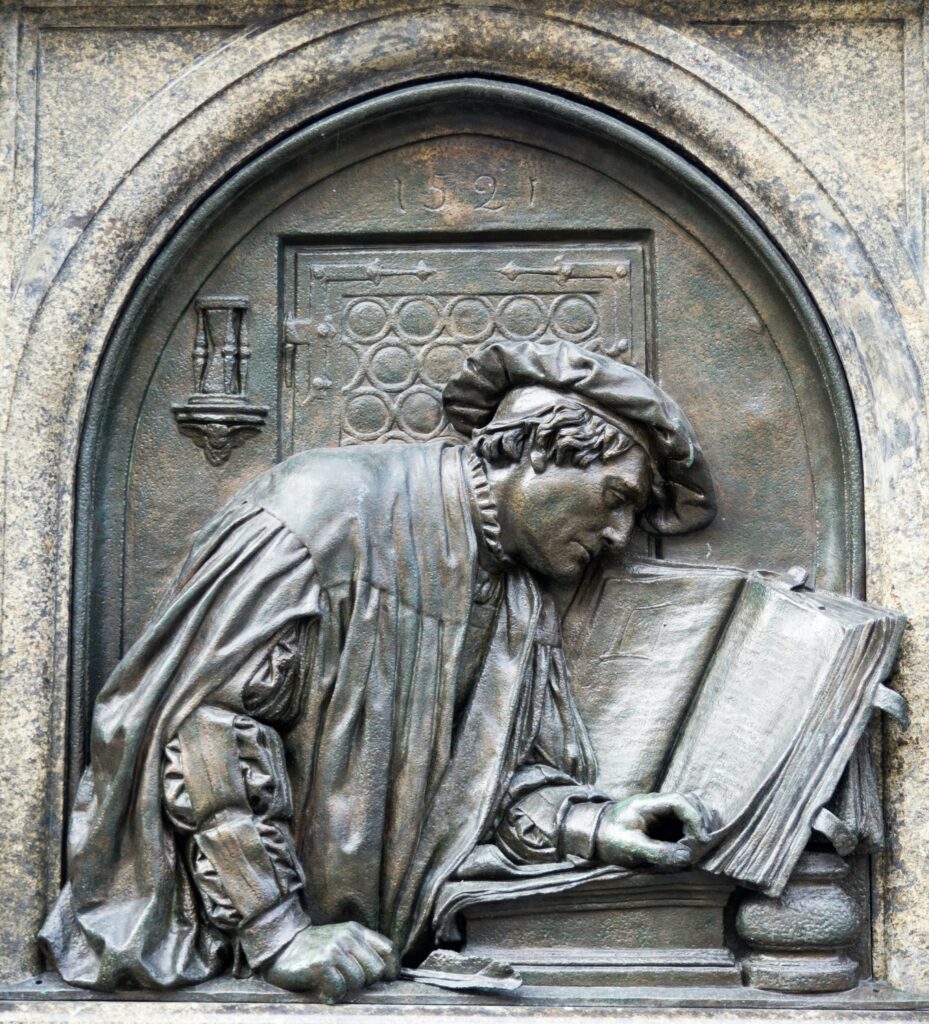
Name: Martin Luther
Born: November 10, 1483, Eisleben, Saxony (modern-day Germany)
Died: February 18, 1546, Eisleben, Saxony
Lived in: The Holy Roman Empire (mostly in present-day Germany)
Active Period: Early 1500s, especially from 1517 onward
Occupation: Theologian, monk, professor, reformer
– Starting the Protestant Reformation in 1517
– Posting the 95 Theses on the church door in Wittenberg, criticizing the Catholic Church’s sale of indulgences
– Translating the Bible into German, making it accessible to ordinary people
– Challenging the authority of the Pope and Church traditions
What Did His Propaganda Target?
Luther’s propaganda criticized church practices that he considered corrupt or superstitious, including:
- The sale of indulgences, which he framed as a commercialized, almost magical transaction for salvation.
- Rituals involving relics, pilgrimages, and sacraments that had become intertwined with folk beliefs or magical expectations.
- Clerical authority that relied on elaborate rituals rather than direct faith in God.
Through sermons, pamphlets and woodcuts, Luther presented these practices as dangerously close to superstition or magic, appealing to ordinary people who were accustomed to both church ritual and folk traditions.
How Did Luther’s Propaganda Affect the Relationship Between Church Ritual and Magic?
Luther’s influence created a cultural shift in several key ways:
- Purification of Ritual: Church rituals were increasingly defined by scripture and faith, not by folk customs or perceived magical effects. Practices that had been tolerated as part of everyday piety were scrutinized or condemned.
- Separation of Worlds: By demonizing superstitious practices within the church, Luther indirectly pushed folk magic and ritual outside the official religious sphere, creating a sharper divide between institutional religion and popular superstition.
- Public Perception: Using vernacular media and striking visuals, Luther made it clear that salvation and piety were incompatible with what he called magical or superstitious acts, reinforcing the idea that the “true church” avoided these practices.
In effect, his propaganda helped establish a cultural boundary: formal church ritual aligned with faith and scripture, while folk magic, superstition, and magical thinking were increasingly seen as marginal or even dangerous.
Was This a Turning Point?
Yes. Before the Reformation, many Christian communities had a blended religious experience: official rituals coexisted with folk magic, charms, and local superstitions. Luther’s campaigns helped define a new religious order, where church ritual was purified and folk magic was distanced or demonized. This separation influenced subsequent attitudes toward witchcraft, superstition, and ritual in Protestant Europe, shaping centuries of cultural and religious perspectives.
Why Is This Historically Significant for Understanding Ritual and Magic?
Luther’s propaganda campaign marked a turning point in how European societies defined the boundaries between religion, superstition, and magic. By challenging the legitimacy of rituals rooted in folk belief and emphasizing faith grounded in scripture, Luther helped reshape cultural norms around spiritual practice.
This shift matters because it:
- Reveals how religious reform can redefine what is considered sacred, acceptable or dangerous.
- Shows how media and messaging were used to influence public perception of ritual and supernatural belief.
- Explains why folk magic, charms, and occult traditions were increasingly marginalized or demonized in Protestant Europe.
For modern scholars and practitioners of ritual, witchcraft, or folk spirituality, Luther’s legacy offers crucial context. It helps explain the historical roots of religious exclusion, the stigmatization of magical practices, and the enduring tension between institutional faith and personal spiritual expression.
Photo by Wim van ‘t Einde on Unsplash