
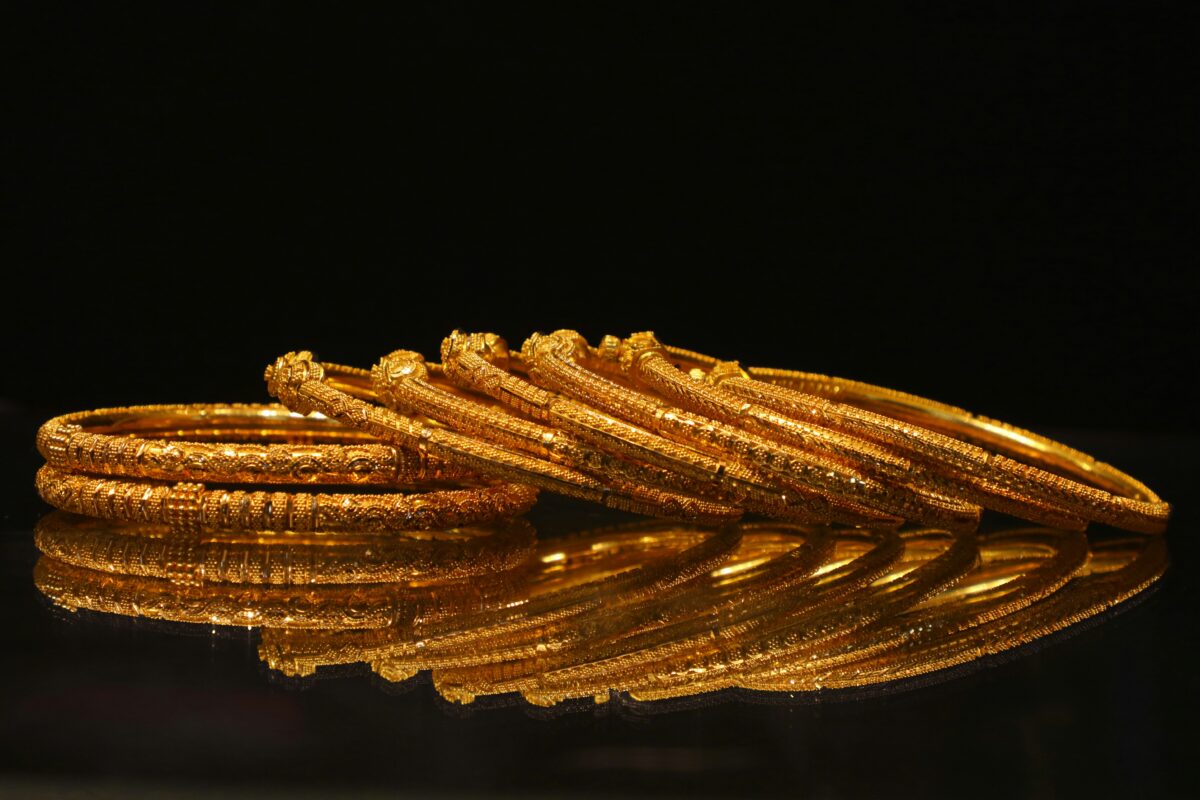
There is no metal on earth that has been called divine by more cultures, across more centuries, than gold. It does not tarnish. It does not corrode. It looks exactly the same on the day it is pulled from the earth as it does a thousand years later. Ancient people understood this immediately and drew the only logical conclusion available to them: this metal does not belong entirely to the mortal world.
In Egypt gold was the flesh of the gods. In the Andes it was the sweat of the sun. In the Norse Bronze Age it was hammered into great disks and pulled across the sky in ritual procession. In modern witchcraft it sits on altars, goes into prosperity jars and charges under the noon sun on Sundays. The thread connecting all of these uses is unbroken. Working with gold in magic means stepping into one of the oldest, most globally consistent spiritual traditions in human history.
Where Gold Comes From: A Brief Fact Worth Knowing
Gold is not terrestrial in origin. The heavy elements, everything heavier than iron, are formed in the cores of dying stars and scattered through the universe in supernova explosions. The gold on this planet arrived in meteorite impacts billions of years ago, long before complex life existed. When ancient people said gold came from the sun or the gods, they were not wrong in any way that matters. It came from deep in the cosmos, from processes far older than the earth itself. This is a fact worth holding when you work with it.
The Seven Sacred Metals
Medieval alchemists inherited a system from classical antiquity that assigned each of the seven known metals to a planet. This system remains one of the most coherent frameworks for working with metals in magic.
| Metal | Planet | Day | Primary Magic |
|---|---|---|---|
| Gold | Sun | Sunday | Vitality, success, solar deity work, authority, manifestation |
| Silver | Moon | Monday | Intuition, psychic work, lunar magic, protection |
| Iron | Mars | Tuesday | Protection, banishing, strength, boundaries |
| Mercury | Mercury | Wednesday | Communication, travel, wit, change |
| Tin | Jupiter | Thursday | Abundance, expansion, luck, growth |
| Copper | Venus | Friday | Love, harmony, creativity, prosperity |
| Lead | Saturn | Saturday | Binding, time, endings, deep transformation |
Gold holds the solar position in this system: the most radiant, the most commanding and the one most connected to the self, the will and the drive toward success. In Western occultism the Sun is typically described as masculine and gold carries that designation. The full picture, as we will see, is more interesting than that.
Egypt: The Flesh of Ra
The ancient Egyptians called gold “the flesh of the gods,” and specifically the flesh of Ra, the solar deity who drove his barque across the sky by day and navigated the underworld at night. Gold was not symbolic of Ra; it was understood as the physical substance of his body made available on earth.
The implications for ritual use were immediate and literal. Pharaohs were buried in golden sarcophagi because they were believed to be the earthly embodiment of Ra. Gold returned them to divine substance at death and guaranteed their continuation in the solar afterlife described in the Amduat. The alignment of temples such as Karnak to the rising sun, combined with golden altar fittings and ceremonial objects, created a theology in which the architecture itself participated in solar magic. To stand in a gold-adorned temple at dawn was to stand inside the body of the god.
For ordinary Egyptians who could not afford solid gold, gilding, gold leaf and gold paint served the same function at a smaller scale. The principle was the same: applying gold to an object or a surface linked it to the solar current and placed it within Ra’s protection.
Mesopotamia: Gold and the Justice of the Sun
In the Akkadian tradition of Mesopotamia, the sun god was Shamash, whose name meant “sun” and whose domain was justice, law and the exposure of hidden things. Gold was his metal not primarily because it was beautiful but because it was indestructible and self-evident. You could not hide gold. It gleamed even in shadow. For Shamash, who saw everything and under whose gaze no deception was possible, this was the correct material correspondence.
The Code of Hammurabi was inscribed on a stele showing the king receiving law directly from Shamash. Gold was used in offerings to him and in seals and oaths sworn in his name. Working with gold under the auspices of Shamash carries this dimension: it is not only a metal of abundance but of clarity, accountability and the kind of success that is built on solid ground rather than concealment.
The Nordic Bronze Age: Sól and the Trundholm Chariot
Here is where gold becomes specifically relevant to a Scandinavian or Finnish practitioner. Roughly 1400 BCE, somewhere in what is now Denmark or southern Sweden, an artist or a group of artisans created one of the most remarkable ritual objects ever found in northern Europe: the Trundholm sun chariot. It is a bronze disk coated in gold leaf on one side, mounted on wheels, pulled by a bronze horse. It was clearly designed to be moved as part of ritual, rolling in procession to represent the sun’s daily journey.
The disk is gold on the east-facing side, representing the bright, living sun that crosses the sky. On the west-facing side, the reverse, it is plain bronze: the sun in the underworld, the dark passage from which it returns each morning. This is a complete solar theology encoded in a single ritual object. Light and dark, life and death, the cycle that repeats and sustains everything.
By the time Norse mythology was recorded in writing, the sun deity was Sól, also called Sunna, and she was unmistakably female. In Germanic languages the word for the sun is grammatically feminine, and when the sun is personified in Norse sources she is a goddess who drives her chariot across the sky, chased by the wolf Sköll who will eventually swallow her at Ragnarök. Her daughter will survive and continue the solar journey into the new world that follows.
Sunna appears by name in the Merseburg Incantations, Old High German healing spells recorded in the 9th or 10th century and the only surviving pagan Germanic incantations in that language. The second incantation describes a healing working over Balder’s foal’s sprained foot, in which Sinthgunt chants the spell with Sunna named as her sister, followed by Friia, Volla and finally Wodan. Sunna is present in the divine family of this magical working as a named figure, not only a cosmological backdrop.
This matters for practitioners working in a Norse or broader Scandinavian framework. The solar energy associated with gold in this tradition is not masculine. Sol is female. The sun in Germanic and Norse languages has always been female. The same is true of the Baltic goddess Saulė, who is one of the most important deities in Lithuanian and Latvian folk religion, and of Amaterasu in Japan, who is the ruler of the heavens and arguably the most powerful deity in the Shinto pantheon. The association of solar energy with masculinity is a feature of the Latin and Mediterranean alchemical tradition, not a universal truth.
The Incas: Sweat of Inti
The Inca civilization of the Andes built what was arguably the most comprehensive gold-based solar theology in history. Inti, the sun god, was understood as the divine ancestor of the Inca emperors. The rulers were called Sapa Inca, literally “the only Inca,” and their claim to authority rested on their direct descent from Inti himself.
Gold was not a symbol of the sun. It was the sun’s sweat, made material on earth. The Coricancha in Cusco, the Temple of the Sun, was sheathed in gold plate. Its interior walls were covered with golden panels. Life-size gold statues of former emperors were kept there, their presence understood as continuous. When the Spanish conquistadors stripped the Coricancha of its gold in the 1530s they were not merely stealing wealth; they were dismantling a living solar machine that had sustained the connection between the heavens and the earth for generations.
The Inti Raymi, Festival of the Sun, was celebrated at the winter solstice in the Southern Hemisphere and involved elaborate offerings, procession and ceremony to honor Inti and ensure the continuation of the sun’s warmth for the coming agricultural year. The relationship between gold and actual, physical sustenance of life could not have been more direct.
Scythian Shamans and Royal Gold
The Scythians, nomadic Iranian-speaking peoples who dominated the Eurasian steppe from roughly 700 to 300 BCE, left some of the most extraordinary goldwork in archaeological history. Their tombs, kurgans, contain golden ornaments, weapons, animal figures and ritual objects of astonishing quality and complexity. This gold was not decorative in a secular sense. The Scythian kings held a specific charismatic power that was understood to take physical form as gold. Gold was the royal metal, and the king’s authority was visibly expressed and ritually sustained through his control over sacred golden objects.
The Scythian clergy included shaman-priests who performed pan-tribal rituals and maintained sacred knowledge. The Anarya, a third-gender group of Scythian priests, were considered to have special access to prophetic and magical power. The connection between ritual authority, altered states and golden objects runs throughout Scythian religion. Working with gold in a context that draws on older steppe shamanic traditions connects to this lineage: gold as a marker of spiritual power that carries its own charge.
Native American Traditions and Solar Gold
Among many Native American cultures, gold was associated with the power of the sun and used in ceremonial objects and healing rituals. The Aztec sun deity Tonatiuh required offerings to sustain his journey across the sky, and golden objects featured in the ritual complex of the great temple at Tenochtitlan. Huitzilopochtli, Aztec god of the sun and war, was honored with gold as part of the broader solar cult that understood the continuation of the sun’s movement as the central obligation of human religious life.
The understanding that gold carries solar energy and that this energy must be respected, reciprocated and worked with carefully is common across traditions that developed independently of each other. This is not coincidence. It reflects a consistent human perception of what gold actually does in the world.
Gold in Modern Witchcraft
In contemporary practice gold functions primarily through four modes: as a physical presence on the altar, as jewelry and talisman, as a charging medium and as a material for intention-setting in prosperity and success magic.
Altar work
A gold-colored cloth, a gold candle, a small gold disk or coin, or any object genuinely made of gold placed on an altar during solar or prosperity workings connects the space to the Auric current. Gold maintains a low-level solar charge in any space where it is present. Altar tools with gold finishes or genuine gold content are particularly suited to magic involving self-assertion, clarity, success and work with solar deities.
Candles
Gold candles are used for manifestation, success, abundance and solar deity work. Sunday is the correct day for this work, and noon is the most potent time, when the sun is at its peak. A gold candle anointed with frankincense or cinnamon oil and lit at noon on a Sunday with a clear statement of intention is one of the simplest and most historically grounded forms of gold magic available.
Jewelry and talismans
Gold jewelry worn with intention becomes a solar talisman. A gold ring, pendant or chain consecrated under the midday sun on a Sunday and charged with a specific intention carries that intention actively. Gold near the sternum connects to personal power and confidence. Gold on the hands amplifies creative and practical work.
Prosperity and manifestation
Gold coins or gold-tipped objects placed in prosperity jars work similarly to copper but with a different quality: where copper attracts and harmonizes, gold commands and expands. This distinction matters in spellwork. If you are drawing something gently toward you, copper suits the working. If you are asserting your right to something and directing your will toward a specific outcome, gold is the correct metal.
Sun water and charging
Placing water in a gold-rimmed or gold vessel in direct sunlight at noon charges it with solar energy for use in workings, ritual bathing or anointing. Objects placed in sunlight on a clear Sunday absorb solar energy regardless of the container, but gold vessels amplify this considerably.
Solar Timing for Gold Work
The most important timing considerations for gold magic are these:
Sunday is the day of the Sun in every tradition that has a planetary week. All gold magic is strengthened by being performed on Sunday. Within Sunday, the period from mid-morning to noon carries the most upward, expansive solar energy. Noon itself, when the sun stands at its highest point, is the peak moment for charging and commanding workings. Afternoon is better suited to workings involving completion and integration.
The summer solstice is the most powerful single day in the solar calendar for gold work, particularly in Scandinavian and Celtic contexts. Litha marks the peak of the sun’s strength, the longest day and the fullest expression of solar energy available in the yearly cycle. Inti Raymi in the Andean tradition falls at the winter solstice of the Southern Hemisphere, which is the same principle expressed in a different latitude.
Working during a waxing sun, that is, from Yule to Litha as the days lengthen, amplifies attraction and growth magic. Working from Litha to Yule as the days shorten is better suited to integrating gains and completing long-term workings.
Is Gold Masculine or Feminine?
In Western occultism the Sun is assigned masculine polarity and gold carries this designation. This is a specific cultural and historical position, not a universal fact.
In Norse and Germanic tradition the sun is female: Sól, Sunna. In the Merseburg Incantations she chants healing spells alongside other goddesses. In Baltic tradition the sun goddess Saulė is one of the most important and actively venerated deities in folk religion, associated with spinning, weaving and the wellbeing of women. In Japan, Amaterasu rules the heavens. In ancient Ireland the sun goddess Áine and the fire goddess Brigid both carry solar qualities. In Aztec tradition there were both male and female solar deities functioning within the same cosmological system.
The practical conclusion is that solar energy and gold are neither inherently masculine nor feminine. They carry qualities, not a fixed gender. Vitality, clarity, authority, the will to act, the drive toward growth: these are what gold carries. A practitioner of any gender working with gold is not working against the energy of the metal. They are working with its actual qualities, which have been recognized across thousands of years and dozens of independent traditions.
Deities Associated with Gold
Gold connects you to a wide network of solar deities across traditions. Among the most frequently worked with in modern practice:
Ra and Ra-Hoor-Khuit (Egypt): solar power, authority, the will and the eye that sees everything. Gold offerings and gold altar items are appropriate.
Sol/Sunna (Norse/Germanic): warmth, healing, consistency, resilience, hope. A practitioner in a Norse context can approach her directly with gold and gold-colored objects, greeting the sunrise or working at noon on Sunday.
Inti (Inca/Andean): abundance, agriculture, the sustaining solar force that feeds everything. Gold offerings, corn, and solar imagery are traditional.
Helios and Apollo (Greek): Helios embodies the physical sun and its seeing quality; Apollo governs reason, music, prophecy and healing that comes through light. Frankincense, gold and bay laurel are appropriate for Apollo in particular.
Amaterasu (Shinto/Japanese): the ruler of the heavens, a goddess of extraordinary power whose return from the cave brought the world back to life. Gold and mirrors are among her traditional associations.
How to Cleanse and Consecrate Gold
Gold is the most stable of all metals and requires the least physical maintenance. It does not tarnish or corrode under normal conditions. A simple wash with warm water and mild soap is sufficient for physical cleaning.
Energetically, gold accumulates and holds solar charge efficiently, which also means it accumulates whatever has been worked into it. If you acquire gold that has significant history or that has been in the possession of others, energetic cleansing before use is worth doing.
To cleanse gold energetically: leave it in sunlight for a full day, pass it through frankincense smoke or bury it briefly in clean earth. Salt is effective but can scratch soft gold alloys; use dry salt buried around the object rather than in direct contact if the piece is delicate.
To consecrate: hold the gold in sunlight if possible, set a clear intention and anoint with frankincense, cinnamon or heliotrope oil. State the purpose of the piece. Return it to sunlight or leave it on an altar aligned with the south, the direction of solar power in the Northern Hemisphere.
Frequently Asked Questions
What is gold used for in witchcraft?
Gold is used in magic associated with success, manifestation, personal authority, vitality, healing and work with solar deities. It appears in altar tools, jewelry and talismans, prosperity workings, candle magic and as a charging medium for solar water. It is the metal of the Sun in the classical seven-metal system and carries the qualities of that planetary force: clarity, will, the drive toward growth and the kind of abundance that comes through strength rather than attraction.
Which planet rules gold?
The Sun rules gold in the classical Western alchemical and astrological system. This assignment is consistent across Greek, Roman, Arabic and medieval European sources and remains the standard in modern Western occultism. Sunday is therefore the primary day for gold workings and noon on Sunday the peak moment.
Is solar energy in witchcraft masculine?
In the Western occult tradition, yes. In the Norse, Germanic, Baltic, Japanese and Irish traditions, the sun is feminine. Sól in Norse mythology is a goddess. Saulė in Baltic tradition is one of the central deities in folk religion. Amaterasu rules the Japanese heavens. Solar energy and gold carry qualities of vitality, authority and will, but those qualities are not inherently gendered. The masculine designation is a specific cultural position, not a universal fact.
Can gold-plated or gold-colored items be used instead of solid gold?
Yes, with the understanding that gold content matters for potency but not for validity. A gold-plated item carries less of the physical material than solid gold but still carries the correspondence and the intention. Pure gold is more potent in the same way that a fresh herb is more potent than a dried one: the principle is the same, the concentration differs. Work with what you have. Consecrate it properly and it will serve.
What is the difference between working with gold and working with copper in magic?
Copper and gold both work with prosperity and abundance but through different mechanisms and qualities. Copper is Venus: it attracts, harmonizes and draws things gently toward you through affinity and receptivity. Gold is the Sun: it commands, expands and asserts. In practical terms, use copper when you want to draw love, harmony or gentle abundance into your life. Use gold when you are asserting your will, building toward a specific goal, working with authority or claiming something you believe is yours. Both are valid. They are simply doing different things.
What deities can I work with using gold?
Ra, Horus and Ra-Hoor-Khuit in Egyptian tradition; Sol/Sunna in Norse and Germanic tradition; Inti in Andean tradition; Helios and Apollo in Greek tradition; Amaterasu in Shinto; Brigid and Áine in Irish tradition; Lugh in Celtic tradition. Any solar deity across any tradition can be approached with gold as an offering material or as a talisman material. The metal carries a planetary current that most solar deities will recognize regardless of their specific cultural context.
Photo by Zayed Ahmed Zadu on Unsplash


[…] Gold […]