Of all seven sacred metals, tin is the least visible in everyday life. You will not find a tin coin in your wallet or a tin ring in a jewelry shop. Yet tin made the ancient world possible. Without it there would have been no Bronze Age, no bronze weapons or tools, no ceremonial vessels buried with the dead across thousands of years. Tin is half of one of the most historically significant alloys in human history. Its absence would have changed the course of civilization.
In the alchemical and magical system that assigns each metal to a planet, tin belongs to Jupiter, the largest planet in the solar system and the one classical astrology called the Greater Benefic. Greater because its influence expands, amplifies and opens doors. Where Mars enforces boundaries and Saturn contracts, Jupiter extends. In magical practice tin carries this quality directly: it is a metal of growth, abundance, wisdom, legal favor and the kind of luck that comes from being in alignment with something larger than yourself.
The Seven Sacred Metals
Medieval alchemists inherited from classical antiquity a system linking each of the seven known metals to a planet, a day of the week and a set of spiritual qualities.
| Metal | Planet | Day | Primary Magic |
|---|---|---|---|
| Gold | Sun | Sunday | Vitality, success, solar deity work, authority, manifestation |
| Silver | Moon | Monday | Intuition, psychic work, lunar magic, protection, dream work |
| Iron | Mars | Tuesday | Protection, banishing, strength, boundaries, justice |
| Mercury | Mercury | Wednesday | Communication, travel, wit, change |
| Tin | Jupiter | Thursday | Abundance, expansion, luck, wisdom, legal matters, growth |
| Copper | Venus | Friday | Love, harmony, creativity, prosperity |
| Lead | Saturn | Saturday | Binding, time, endings, deep transformation |
Tin and the Bronze Age: The Metal That Made History
The Bronze Age is named after an alloy, not a single metal. Bronze is approximately nine parts copper to one part tin and that ratio is what makes it harder and more durable than either metal alone. Copper was widely available across the ancient world. Tin was not. The scarcity and uneven distribution of tin deposits shaped ancient trade networks, political alliances and the movement of peoples across thousands of years.
The most significant tin deposits available to the ancient Mediterranean world were in Cornwall in southwest Britain. Cornish tin was traded across Europe long before the Romans arrived. The Greek explorer Pytheas of Massalia visited Cornwall around 325 BCE and described the locals mining tin in underground tunnels, smelting it into ingots and trading it with Mediterranean merchants. His account, though the original is lost, was widely quoted in antiquity. Ancient Greek and Roman writers referred to the mythical Cassiterides, the Tin Islands, somewhere in the far west of Europe, as the source of tin reaching the Mediterranean, though the precise location was debated even then and has never been conclusively identified. What is certain is that Cornish tin reached ancient Mediterranean markets and sustained bronze production for centuries.
This means that the Bronze Age, with all its ceremony, ritual deposition, sacred metalwork and funerary offerings, was built on a material connection between the Atlantic far north and the civilizations of the Mediterranean and Near East. Tin moved through trading relationships that crossed languages, religions and cultures. Its Jovian quality of expansion and connection was literally built into its history before anyone assigned it to a planet.
Jupiter: The Greater Benefic
In classical astrology and its descendant traditions, Jupiter is called the Greater Benefic, meaning the planet that brings the greatest blessings. Venus is the Lesser Benefic. Mars and Saturn are the malefics. Jupiter is the one that opens, expands and favors. It rules abundance, legal matters, higher education, philosophy, long-distance travel, authority and the wisdom that comes through experience rather than book learning.
The Key of Solomon, one of the most influential grimoires in Western occultism and likely compiled in its current form between the 14th and 17th centuries, states specifically that the days and hours of Jupiter are proper for obtaining honors, acquiring riches, contracting friendships, preserving health and arriving at all that one desires. This is the Jovian promise in its most direct form.
Jupiter’s glyph in alchemy is also the alchemical symbol for tin, which is where the correspondence between the two became fixed in Western magical practice. Tin embodies the qualities Jupiter carries: it is not the shining authority of gold or the pure beauty of silver, but something more useful and less obvious. It expands the strength of what it combines with. It makes what it touches more durable. This is Jupiter’s quality in practical terms.
Greece and Rome: Zeus, Jupiter and the Thunder Father
Zeus is the king of the Greek Olympians, the father of gods and humanity and the wielder of the thunderbolt. His Roman equivalent is Jupiter, from whose name the planet and therefore the metal takes its designation. Both are sky gods, thunder gods and figures of supreme authority in their respective pantheons.
Jupiter in Roman religion was not only the king of gods but the protector of Rome itself. He was Jupiter Optimus Maximus, Best and Greatest and his temple on the Capitoline Hill was one of the most sacred sites in the city. Generals returning from victorious campaigns sacrificed to him there. Legal oaths were sworn in his name. The fasces, the symbol of legitimate authority, was associated with his priests. Working with tin under the auspices of Jupiter brings this dimension into the magic: not merely luck but legitimate authority, the kind of success that is recognized and protected by law and by the natural order.
Zeus’s attributes in Greek tradition include the eagle, the oak tree and the thunderbolt. All of these recur across Jupiter correspondences in magical practice. The oak is one of the most traditional trees associated with Thursday workings. The eagle appears in many traditions as a solar-Jovian symbol.
Mesopotamia: Marduk and the King of Heaven
Marduk is the chief deity of Babylon, whose rise to supremacy in the Mesopotamian pantheon was narrated in the creation epic Enuma Elish. He defeated the chaos dragon Tiamat and from her body formed the earth and sky. His reward was supreme authority among the gods. In the cuneiform tradition he was associated with the planet Jupiter and carried the same qualities: expansion, wisdom, legal authority and the power to order chaos into something livable.
Marduk’s patronage extended over justice, healing and magic as well as war. He was invoked in healing incantations and in rituals seeking his protection over legal and commercial matters. The color associated with him in ceremonial contexts was blue and lapis lazuli was his stone, both of which recur in Jupiter correspondences across Western magical practice.
The Norse and Germanic Tradition: Thor’s Day
Thursday is Thor’s day in every Germanic language. The name comes directly from the Old Norse Þórsdagr and the Old English Þunresdæg, both meaning the day of the thunder god. When the Germanic peoples adapted the Roman seven-day planetary week, they substituted their own gods for the Roman ones and Thor was placed at Thursday because the Romans saw him as their equivalent of Jupiter.
This is a considered correspondence. Both are thunder gods. Both are defenders of cosmic order against the forces of chaos. Both are connected to the welfare of the common people and to the hallowing of important life events. The Roman Jupiter was called in times of legal and political crisis. Thor was called in times of famine, disease and supernatural threat. Both protect the social fabric.
The Mjölnir pendants worn by Norse practitioners served a specific ritual function. They were used to consecrate marriages, bless the newborn, hallow burial grounds and protect against harmful forces. This hallowing quality, the capacity to make something sacred and secure, is directly Jovian. The Key of Solomon says Jupiter’s hours are for contracting friendships and preserving health. Thor’s hammer blessed marriages and protected communities. The resonance is exact.
Thor was the most widely worshiped deity in Viking Age Scandinavia. Adam of Bremen, writing in the 11th century, describes the great temple at Uppsala in Sweden with Thor placed in the center flanked by Odin and Freyr, given the highest position among the three. He was the god called upon in times of famine and disease. He was the protector of the common people. In magical practice within a Norse framework, Thursday workings, abundance rituals and any magic related to protection of community and the blessing of important undertakings can legitimately call on Thor as the Jovian patron.
The Finnish equivalent is Ukko, the supreme sky deity in Finnish mythology whose name means “old man” and who rules thunder, rain, sky and the fertility of the earth. He is invoked in agricultural magic and for protection. Ukko shares the same Indo-European root as Thor as a sky and thunder deity and fills the same functional role in Finnish folk religion.
The Celtic Tradition: The Dagda and the Cauldron
The Dagda is one of the most important deities of the Tuatha Dé Danann in Irish mythology, often described as a father figure and a chieftain. His most famous attribute is his cauldron, the Coire Ansic, from which no one ever leaves hungry. It is always full. It cannot be emptied. This is Jovian abundance in its most literal and mythological form.
The Dagda also possesses a great club with two ends: one end kills the living and the other revives the dead. He is simultaneously a fertility deity, a war god and a keeper of time. His Jovian quality is the abundance and nurturance: the cauldron that provides without end, the father who ensures that his people are fed.
Modern Celtic practitioners working with Jovian energy can orient their practice toward the Dagda through the imagery of the cauldron, through Thursday workings and through any magic involving communal sustenance and abundance.
Casting Molten Metal as Divination
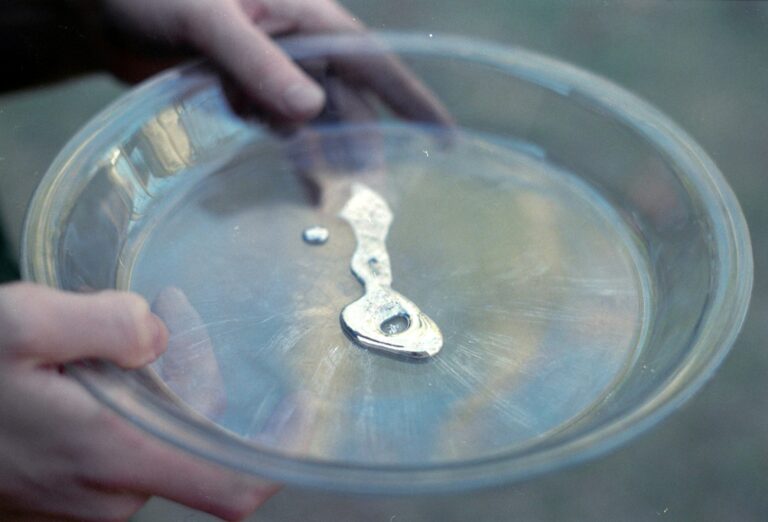
One of the most distinctive uses of tin in magic is molybdomancy, divination through molten metal poured into cold water. The word comes from the Greek molybdos meaning lead and manteia meaning divination. Historically the metal used was almost always lead. Tin has become the modern safe replacement, which is why this practice now belongs in a tin article rather than a lead one.
New Year divination
The practice is best known as a New Year’s Eve tradition across northern and central Europe. In Finland it was known as tin casting but the horseshoe-shaped pieces sold for the purpose were made of up to 95 percent lead. In 2018 the EU banned lead-containing consumer products and the old kits were discontinued. The tradition continues today using lead-free tin, beeswax or sugar.
The same tradition is alive in Germany, Austria, Switzerland and the Czech Republic where it is called Bleigießen. Small metal figures are melted in a spoon over a flame and poured into cold water on New Year’s Eve. The resulting shape is read for the coming year.
The method is the same across all these traditions: the material is melted over heat, poured in one motion into cold water and the solidified shape is read. Shapes can also be held to a candle flame so their shadow falls on a wall, which often reveals forms not visible in the metal itself.
Common symbols and their traditional readings: a horseshoe for luck, a ring for commitment or partnership, a ship for travel or change, an anchor for stability, a heart for love, an egg for new beginnings, a rough surface for money and a smooth surface for an uneventful year.
Diagnostic and protective use
In Norwegian trolldom the practice called støyping was used for healing rather than New Year divination. Lead scraped from church windows or bells, considered particularly potent, was poured through a hole pierced in a piece of barley flatbread into cold water. This was done by the signekjerring, the blessing crone, primarily to diagnose illness in children and determine whether a supernatural cause was involved.
Similar diagnostic use appears in Turkey and across the Balkans, where molten lead was poured near or over a person to identify the source of fear-based illness or harmful spiritual influence. These are distinct folk healing traditions that used lead as the working material. Tin is not traditionally connected to this healing use and is not a substitute for it in magical terms.
Safety note: Lead should never be used for any of these practices today. Lead fumes are toxic. Lead-free tin is the correct material for contemporary divination work of this kind.
Tin in Modern Witchcraft: Working with Jupiter’s Metal
Tin is rarely used as a physical material in modern practice and this is worth acknowledging honestly. Pure tin is uncommon as a finished object. Pewter, which is predominantly tin with small amounts of copper and antimony, is far more available and carries the same correspondence effectively.
Jewelry and talismans
Pewter jewelry, rings, pendants and bracelets charged on a Thursday and consecrated with a clear intention around abundance, legal matters or professional growth functions as a Jovian talisman. Pewter near the throat supports truthful and authoritative communication. A pewter ring on the right hand is traditional for workings involving leadership and recognition.
Altar tools
A pewter cup or chalice on the altar works well for Jupiter workings, particularly when filled with water or mead during Thursday rituals. Pewter candleholders for blue or purple candles carry Jovian resonance. A pewter dish for offerings to Thor, Zeus or the Dagda creates a fitting material connection.
Spell jars
Tin or pewter pieces added to prosperity jars work differently from copper. Copper attracts through warmth and affinity. Tin expands what is already there. A spell jar combining copper and tin brings both dimensions: copper draws the initial flow and tin builds it over time. Herbs suited to Jovian spell jars include nutmeg, sage, dandelion root, bay leaf and cinnamon.
Thursday workings
Any magic performed on a Thursday benefits from Jovian alignment. Prosperity candles in blue or purple lit on Thursday carry Jupiter’s expansive quality. Setting intentions for growth, legal matters, travel or education on Thursday aligns the working with the planetary current regardless of whether physical tin is present.
Legal and professional matters
Jupiter is specifically associated with legal proceedings, contracts, professional recognition and authority. A working designed to support a job application, a legal case or a professional presentation is well suited to Thursday and to Jovian metals including tin and pewter.
Abundance rituals
Jupiter is the planet of expansion. Abundance magic aligned with Jupiter tends toward sustainable growth over time rather than the immediate attraction of copper or the commanding assertion of gold. A tin or pewter coin placed on an altar with an intention set at a waxing Jupiter hour on Thursday supports steady long-term prosperity.
Wisdom and study
Jupiter governs higher learning, philosophy and the kind of wisdom that accumulates through experience. Students, researchers and writers can align their work with Thursday and with Jovian correspondences including tin.
Timing for Tin and Jupiter Work
Thursday is the day of Jupiter and the natural day for all workings with tin and Jovian energy. Jupiter’s hours can be calculated for any day of the week using a planetary hours table.
The waxing moon amplifies Jupiter’s expansive quality and is the best lunar phase for growth and abundance workings. The full moon in Sagittarius, the sign Jupiter rules, is a particularly strong time for Jupiter magic.
Spring is the most expansive Jovian season as the days lengthen and growth resumes. The period from the spring equinox through midsummer carries Jovian energy for workings involving growth and expansion.
Is Tin Masculine or Feminine?
In the Western alchemical tradition Jupiter is masculine and tin carries that designation. Zeus, Jupiter, Thor, Marduk and the Dagda are all male deities and the Jovian current as expressed through these figures is one of paternal authority and expansive generosity.
This does not mean tin’s qualities belong exclusively to masculine practitioners. Expansion, wisdom, abundance, legal protection and the capacity to grow beyond current limitations are qualities available to anyone. The masculine designation reflects the cultural framing of these deities in their source traditions. The qualities themselves are not gendered.
Chakra Connections
Tin and Jupiter are primarily associated with the solar plexus chakra, Manipura, the center of personal will, confidence and the capacity to expand beyond self-imposed limits. Jupiter’s quality of growth and authority expresses through this center.
There is also a secondary connection to the crown chakra, Sahasrara, through Jupiter’s association with wisdom, higher learning and the connection to philosophical and spiritual understanding that exceeds ordinary knowledge.
Deities Associated with Tin
Zeus (Greek): king of the Olympians, god of thunder, sky, law and justice. The supreme Olympian patron of authority and legitimate power.
Jupiter (Roman): the Roman equivalent of Zeus, protector of Rome, patron of legal oaths and political authority. Jupiter Optimus Maximus.
Thor (Norse/Germanic): thunder, protection, hallowing and the welfare of the common people. The Norse Jovian patron. Thursday takes his name in every Germanic language.
Ukko (Finnish): supreme sky and thunder deity, patron of rain, agriculture and the fertility of the earth. The Finnish Jovian equivalent.
Marduk (Babylonian): king of the gods, patron of justice, healing and the ordering of chaos. Associated with the planet Jupiter in the Mesopotamian tradition.
The Dagda (Irish Celtic): the father deity of the Tuatha Dé Danann, keeper of the inexhaustible cauldron. Patron of abundance, community sustenance and Jovian generosity.
Indra (Vedic/Hindu): king of the devas, god of thunder, rain and sky. The Vedic equivalent of the Jovian sky-father archetype, carrying the same qualities of expansive sky authority and the protection of cosmic order.
How to Cleanse and Consecrate Tin
Tin and pewter can be cleaned with warm water and mild soap. Avoid abrasive cleaners that can scratch the soft surface. Dry carefully as tin and pewter can water-spot.
Energetically, tin cleansing is best done with Jupiter-aligned incense: cedar, frankincense, nutmeg or sage. Pass the object through the smoke with a clear intention to clear previous energies. Leaving tin objects under the open sky on a clear Thursday, particularly in natural light, is an effective alternative.
Consecration: hold the tin or pewter object and set the intention clearly. Jupiter responds to directness and to the honest statement of what growth you are seeking. Anoint with cedar oil, clove oil or a Jupiter oil blend. State the working aloud if possible. Place on the altar facing south in the Northern Hemisphere, the direction of solar and Jovian warmth.
Frequently Asked Questions
Why is tin associated with Jupiter?
The correspondence between tin and Jupiter was established in the medieval alchemical system of seven metals and seven planets. Jupiter’s symbol in that system was also the alchemical symbol for tin, fixing the two in relationship. The qualities that tin carries, expansion, combination, the capacity to make what it joins with stronger and more durable, align with Jupiter’s nature as the planet of growth, abundance and beneficial expansion.
Can I use pewter instead of tin?
Yes. Pewter is predominantly tin, typically 85 to 99 percent, with small additions of copper and antimony. It carries the tin correspondence effectively and is far more available as a finished material. Pewter cups, bowls and altar objects are practical choices for Jupiter workings. Note that older pewter sometimes contained lead, which shifts the correspondence toward Saturn. Modern pewter is lead-free.
What is the best day to work with tin?
Thursday, the day of Jupiter in every tradition that uses a planetary week and Thor’s day in Norse tradition. Jupiter hours on any day of the week, calculable with a planetary hours table, provide additional timing. The waxing moon in combination with Thursday is the strongest available alignment for growth and abundance workings.
What is tin magic good for?
Abundance and prosperity over time, legal matters and contracts, professional advancement and recognition, higher learning and wisdom, long-distance travel and expansion into new territory, the blessing and protection of a community or household and any working where the goal is growth rather than immediate attraction or forceful assertion.
How is tin different from copper in abundance workings?
Copper draws through affinity and attraction. It is Venus working through warmth and resonance. Tin expands what is already present. It is Jupiter working through growth and the opening of opportunity. Copper is better for attracting something new. Tin is better for expanding something you already have. Both are legitimate metals for prosperity work and they can be combined in the same working with effective results.
Photo by Yana Gorbunova on Unsplash