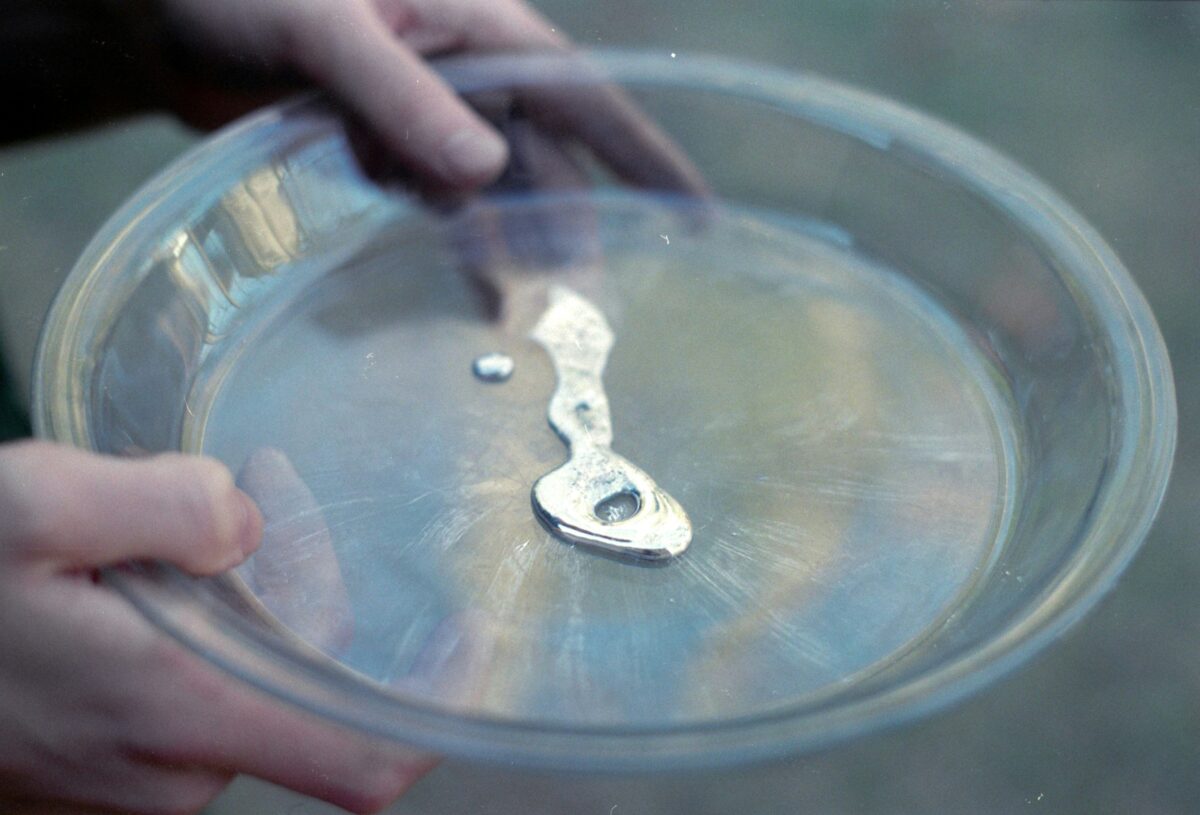
Mercury is the only metal that is liquid at room temperature. Every other metal on earth must be heated before it flows. Mercury flows always, pooling and dividing and rejoining, catching light from every surface, impossibly heavy for something so quick. The Romans called it argentum vivum, living silver. Medieval alchemists called it mercurius vivens, living mercury. The name is the same in both languages because the observation was the same: this substance is alive in a way that no other metal is.
It is also the most dangerous of the seven sacred metals. Mercury vapor is toxic. Liquid mercury absorbed through skin causes neurological damage. The phrase mad as a hatter comes from the hat industry, where mercury was used in felt processing and workers developed tremors and personality changes from chronic exposure. Working with mercury in witchcraft today requires clarity about what this means for practice and that clarity is part of what this article provides.
The metal is named for the planet and the planet for the god. Mercury, Hermes, Odin, Thoth: the same figure appearing across cultures, the messenger who moves between worlds, the trickster who sees what others miss, the one whose intelligence is so quick it becomes dangerous. His metal matches him exactly.
The Seven Sacred Metals
Medieval alchemists inherited from classical antiquity a system linking each of the seven known metals to a planet, a day of the week and a set of spiritual qualities.
| Metal | Planet | Day | Primary Magic |
|---|---|---|---|
| Gold | Sun | Sunday | Vitality, success, solar deity work, authority, manifestation |
| Silver | Moon | Monday | Intuition, psychic work, lunar magic, protection, dream work |
| Iron | Mars | Tuesday | Protection, banishing, strength, boundaries, justice |
| Mercury | Mercury | Wednesday | Communication, travel, wit, change, magic itself |
| Tin | Jupiter | Thursday | Abundance, expansion, luck, wisdom, legal matters |
| Copper | Venus | Friday | Love, harmony, creativity, prosperity |
| Lead | Saturn | Saturday | Binding, time, endings, deep transformation |
Mercury occupies a unique position in this system. Every other metal is solid and shaped. Mercury is liquid and formless. Every other metal holds what you put into it. Mercury moves. In alchemical theory this made it the most fundamentally magical of the seven metals, the one that could not be contained by ordinary categories, the one that carried the principle of transformation itself.
Hermes and Mercury: The Messenger Between Worlds
Hermes is the Greek god of boundaries and of the crossing of boundaries. He is the messenger of the gods, the only Olympian who moves freely between the realm of the gods, the world of mortals and the underworld. He carries the souls of the dead to Hades, leads the newborn into life and delivers messages that no other god can carry. He is called the psychopomp, the guide of souls and this function places him at the center of any magic that involves crossing from one state to another.
He is also a trickster. On the day he was born he crawled from his cradle, stole Apollo’s cattle, invented the lyre from a tortoise shell and was back in his cradle pretending to be an innocent infant before anyone noticed. When challenged he talked his way out of punishment so cleverly that Apollo gave him the caduceus, the staff of healing, in admiration. Hermes is not merely quick. He is the intelligence that operates in the space between established rules.
His Roman equivalent is Mercury, who inherited all of Hermes’ functions but added a particular emphasis on commerce and trade. Mercury’s temple on the Aventine Hill in Rome, dedicated in 495 BCE, was associated with a guild of merchants. In Celtic Gaul, the Romans encountered such enthusiasm for Mercury that Julius Caesar remarked he was the most venerated deity in the whole of Gaul. The Celtic Mercury was paired with the goddess Rosmerta, a deity of abundance and fertility, which shifted his character toward prosperity and healing in ways not present in his original Roman form.
Egypt and the Foundation of Western Magic: Thoth and Hermes Trismegistus
In Egypt the equivalent deity was Thoth, the ibis-headed god of writing, wisdom, magic and the moon. When the Greeks encountered Egyptian religion they identified Thoth with Hermes and the figure who emerged from this meeting, Hermes Trismegistus, Hermes the Thrice Great, became one of the most influential figures in the entire history of Western occultism.
The Hermetic texts attributed to Hermes Trismegistus, the Corpus Hermeticum, form the foundation of Hermeticism, a philosophical and magical tradition that shaped alchemy, ceremonial magic, Renaissance occultism and much of modern magical practice. The texts were believed in medieval and Renaissance Europe to be older than the pyramids and to contain the most ancient wisdom available to humanity. Modern scholarship dates them to the 2nd and 3rd centuries CE, but their influence was so profound that the dating barely matters. The Key of Solomon, the Greater and Lesser Keys, the works of Cornelius Agrippa, the magical philosophy of John Dee: all trace their roots in part to the Hermetic current that flows from Thoth through Hermes Trismegistus.
Thoth in Egyptian religion was the scribe of the gods, present at the weighing of the heart in the Hall of Ma’at to record the judgment of the dead. He invented writing, mathematics, astronomy and magic. He was the keeper of divine law and the one who could speak things into existence. This is the current that runs through Mercury in witchcraft: not merely communication but the creative and magical power of language itself.
The Norse and Germanic Tradition: Odin as Mercury
Wednesday is Odin’s day in the Norse and Germanic tradition. The Old Norse Óðinsdagr became the Old English Wōdnesdæg and eventually Wednesday. The Romans identified Mercury with Odin because the resemblance was too clear to ignore. Both are travelers. Both wear disguises. Both are associated with wisdom obtained through sacrifice and trickery. Both are connected to the dead and to the boundaries between worlds.
But the identification is not complete and the differences matter. Odin is older, darker and more willing to pay terrible prices. He sacrificed one eye at the well of Mimir to gain wisdom. He hung himself from Yggdrasil for nine days and nine nights to obtain the runes. He sends his ravens Huginn and Muninn, thought and memory, across the world each day to gather intelligence. He is a god of poetry, of battle frenzy, of shamanic journeying and of the dead in a way that Mercury never quite is.
The identification between Mercury and Odin is documented from the 1st century CE onward and appears consistently through the medieval period. Geoffrey of Monmouth, writing in the 12th century, equates the two explicitly. In the Germanic magical tradition this means that Wednesday work and Mercury work can draw on Odin as patron, but practitioners working within a Norse or Heathen framework should understand that Odin is substantially more demanding and more complex than the mercurial trickster of Greek mythology.
Mercury in Alchemy: The Central Principle
No other metal occupies the position mercury holds in alchemy. It is not simply one of seven planetary metals but the fundamental principle through which all metals and all transformation are understood. To grasp mercury’s role in alchemy is to grasp what alchemy actually is.
The Arabic alchemist Jabir ibn Hayyan, writing in the 8th century and sometimes called the father of Arabic chemistry, proposed that all metals are formed from two principles: sulphur and mercury. These are not the ordinary substances but philosophical principles. Sulphur is the principle of combustibility, heat and soul. Mercury is the principle of fluidity, volatility and spirit. Every metal in existence is a different combination of these two principles. Lead is impure sulphur and impure mercury poorly combined. Gold is perfect sulphur and perfect mercury in perfect balance. The alchemist’s task is to understand and correct the imperfect combinations.
This made the physical metal mercury uniquely important. As the only liquid metal it was the visible, touchable manifestation of the mercury principle itself. Working with it was working with the principle of transformation at its most direct. The other six metals expressed the planetary principles through their solid forms. Mercury expressed its principle through its nature: flowing, shapeless, impossible to grasp, capable of becoming part of any other metal through amalgamation and then separating again unchanged.
In the 16th century the Swiss physician and alchemist Paracelsus expanded Jabir’s two principles into three, adding salt as a third principle alongside sulphur and mercury. His tria prima, three primes, became one of the most influential frameworks in Western alchemy. Salt is the body, the fixed principle. Sulphur is the soul, the animating principle. Mercury is the spirit, the volatile principle that gives life and enables change. Paracelsus illustrated this with burning wood: the flames are sulphur, the smoke is mercury and the ash left behind is salt. Applied to the human being: salt is the physical body, sulphur is the emotions and desires and mercury is the higher mind, imagination and moral judgment.
The word hermetic, meaning sealed or pertaining to occult knowledge, comes from Hermes Trismegistus, the patron deity of alchemy. This is not a coincidence but an identity. Mercury the metal, Mercury the planet, Hermes the god and the mercury principle in alchemical theory are understood as expressions of the same underlying force. Alchemy is Hermetic in the literal sense: it operates within the current that mercury carries.
The alchemical wedding, the coniunctio or sacred marriage, describes the union of mercury as feminine principle with sulphur as masculine principle. Their union produces the Philosopher’s Stone. Carl Jung interpreted this as the integration of the unconscious with the conscious, the feminine with the masculine within the psyche. Whether understood literally, spiritually or psychologically, the central drama of alchemy is the relationship between these two principles and mercury is always one of the two primary participants.
The Magnum Opus, the Great Work of alchemy, traditionally proceeds through four stages: nigredo (blackening), albedo (whitening), citrinitas (yellowing) and rubedo (reddening). Mercury is present throughout as the spirit that enables transformation between stages. The physical process of sublimation, in which mercury is heated and condensed in a different form, was understood as a material demonstration of spiritual transformation: the base substance dying and being reborn in a purer state.
The Celtic Tradition
Julius Caesar, writing in the 1st century BCE, stated that Mercury was the most venerated deity among the Gauls, with more images than any other god. The Celtic Mercury appears across Gaul in hundreds of dedicatory inscriptions and sculptures. He is frequently shown with the caduceus, the winged hat and the purse of commerce, but is often paired with a native goddess rather than standing alone as in the Roman tradition.
The most significant of these pairings is with Rosmerta, a Gaulish goddess of abundance, fertility and the hearth. She carries a bucket or barrel associated with sustenance and plenty. The combination of Mercury and Rosmerta in a single shrine is documented across Gaul and Roman Britain. In this pairing Mercury takes on qualities not present in his standard Roman form: prosperity, healing and the care of the household alongside his roles as messenger and traveler. Practitioners working in a Celtic or Gaulish reconstructionist framework can draw on this tradition for workings that combine Mercurial swiftness with Venusian abundance.
Safety: Sealed vs Open Mercury
Mercury appears in three forms that are relevant to magical practice and understanding the difference between them matters both practically and historically.
Liquid mercury, called quicksilver in older English, is elemental mercury in its metallic state. It is the only metal that is liquid at room temperature. The ancients who built the seven-metals system were working from direct observation: gold, silver, copper, iron, tin and lead were solid metals they could smelt and shape. Mercury was something else entirely. It was metal that flowed like water, that pooled and divided and rejoined, that was impossibly heavy for something so quick. They classified it as a metal because it behaved like one in every other way: it had metallic luster, it conducted heat, it combined with other metals to form amalgams. The idea that a metal must be solid is a modern definition. In antiquity mercury was simply the seventh metal, the one that did not follow the rules the others followed. This is exactly why it became associated with the planet and deity of transformation, travel between states and the crossing of boundaries.
Cinnabar is the natural mineral ore of mercury: mercury sulfide (HgS), bright scarlet to brick red. It has been mined and used for thousands of years across the ancient world. In Spain, the oldest confirmed evidence of cinnabar use dates to the 6th millennium BCE at the site of Cova de l’Or in Valencia, where it was found in burial contexts. By the Copper Age, roughly 3000 to 2300 BCE, cinnabar use in Iberia had become pervasive and ritualized on a remarkable scale. Archaeological analysis of 370 individuals from 23 sites in Spain and Portugal found elevated mercury levels in human bone, indicating that people were being covered in or buried with cinnabar so extensively that it caused mercury poisoning in the living population. In ancient China it was central to Taoist alchemy and linked to immortality. The tomb of the Emperor Qin Shi Huang is said to contain rivers of liquid mercury and cinnabar lacquerwork was among the most prized objects in Han dynasty China. In the Mesoamerican traditions of the Maya and Aztec cinnabar was used in funerary rites and in the painting of sacred objects. Japanese Buddhist and Shinto temples were painted vermilion in part because mercury was understood to repel decay and evil.
In Indian Tantric tradition mercury, called rasa or parada, was understood as the seed of Shiva and was central to Tantric medicine. The alchemical tradition of rasayana, transformation through mercury, is one of the oldest continuous alchemical systems in the world and predates the European alchemical tradition.
Vermilion is cinnabar ground into pigment. Chemically it is identical to cinnabar. It was the dominant red pigment in European art from antiquity through the Renaissance, appearing in Egyptian wall paintings, Roman frescoes, medieval illuminated manuscripts and Renaissance oil paintings. The process for making synthetic vermilion by heating mercury with sulfur was documented by Persian alchemist Jabir ibn Hayyan in the 9th century and became widespread in Europe from that point. In medieval European manuscripts vermilion was so expensive it was used only in the most important illuminations, while red lead was used for ordinary decoration.
The key distinction for practice: cinnabar and vermilion are mercury sulfide in solid mineral or powder form. The mercury is chemically bound to sulfur and does not vaporize at room temperature. This makes them substantially safer than liquid mercury, though they should not be heated, burned or ground and hands should be washed after contact.
Safety: Sealed vs Open Mercury
Liquid mercury has been used in Hoodoo and Santería for generations, primarily for luck, protection and drawing money. The traditional format is a small amount sealed inside a glass vial or ampule, carried, placed in shoes or kept on an altar. In this sealed form mercury does not vaporize and does not contact skin.
The problems arose when people opened vials, poured mercury onto floors or rolled it in their palms. Mercury vapor in an enclosed space reaches toxic concentrations quickly. The US Environmental Protection Agency documented serious contamination cases where mercury had been used this way indoors, with children in affected households showing elevated blood mercury levels. This is not a condemnation of the tradition but a description of what caused harm within it.
The practical distinction is clear: a permanently sealed glass vial of mercury on an altar poses no meaningful risk. Open mercury in any enclosed space is dangerous and should not be used.
Mercury Mirrors and Scrying
From the 16th century to roughly 1900, mirrors were made using a process that placed them directly in the Mercury current. The reflective backing was a tin-mercury amalgam: thin tin foil was flooded with liquid mercury, glass was laid over it and the two metals bonded to the glass surface. The resulting mirror was slightly different in character from modern silver-backed glass. Mercury mirrors reflect less light and have a bluish appearance, while silver mirrors appear more yellow. In direct light they produce a sparkling, crystalline surface as the tin-mercury crystals catch the light differently than a smooth silver coating.
Antique mirrors of this kind carry a genuine Mercury-Hermes quality. The same metal that belonged to the psychopomp, the guide between worlds, was literally present in every reflective surface through which people looked at themselves for four hundred years. Scrying through one is working with a material that has always been a threshold, a boundary object.
How to identify a mercury amalgam mirror
Identifying whether an antique mirror contains mercury amalgam rather than silver is not straightforward without laboratory testing, but several practical methods help.
The most reliable visual test: place a pen or fingertip against the mirror surface. If the tip appears to touch its reflection directly with no gap, the glass is modern and thin. If there is a visible gap between the tip and its reflection, the glass is older and more likely to be mercury amalgam. If the point touching the mirror looks like it is directly touching its reflection, the glass layer is thin enough and the mirror is probably modern. On the other hand, if the point is separate from its reflection, then it is probably mercury.
Additional signs: mercury silvered mirrors age with a distinctive sparkling effect that almost looks like crystals when lit directly. The back of a mercury mirror has a silvery-blue slightly grainy appearance. Foxing and dark patches, particularly along the bottom edge where liquid mercury pools over time, are characteristic. Wavy or subtly imperfect glass indicates pre-industrial manufacture.
Age is the most reliable guide: mirrors made before 1835 are almost certainly tin-mercury amalgam. Those made between 1835 and 1900 may be either, as the two processes overlapped. Most mirrors made after 1900 are silver-backed.
Safety with antique mercury mirrors
Antique mercury mirrors release small amounts of mercury vapor as they age, particularly from damaged or deteriorating areas. The condition of mercury mirrors can be deceptive; they may seem to be in good condition even if they are actively deteriorating and releasing mercury. A mirror in good condition displayed in a well-ventilated room poses minimal risk. A badly deteriorating mirror or one being moved, cleaned or repaired should be handled wearing gloves and worked with in ventilated conditions. Do not scrape or disturb the backing.
Using mercury mirrors for scrying
A mercury amalgam mirror, particularly one that has aged to a dark and partially obscured surface, is among the most historically appropriate tools for scrying work. The darkening of the surface creates natural depth. The traces of visible foxing become part of the visual field rather than a defect. The material itself sits at the Mercury threshold.
For practitioners who cannot acquire an authentic mercury mirror, a black scrying mirror made from glass painted on the reverse with flat black paint carries the intention without the material. It is a practical modern alternative rather than a historical one and should be understood as such.
Mercury in Modern Witchcraft
Communication spells
Any working designed to improve communication, resolve a misunderstanding, support a difficult conversation or remove a block in the flow of information between people is suited to Wednesday and to Mercurial correspondences. An orange or yellow candle on Wednesday with a clear statement of what needs to be communicated is one of the simplest forms of Mercury work.
Writing and creative work
Mercury governs the written word, the spoken word, mathematics and all forms of symbolic language. Writers, translators, teachers, speakers and anyone whose work depends on clear and effective communication can align their practice with Wednesday, with Hermes or Thoth and with the Mercurial current.
Travel and crossroads magic
Hermes protects travelers and governs crossroads. Any working for safe travel, for clarity about which direction to take at a moment of decision or for protection while in transit is suited to Mercury. Crossroads magic, the practice of working at physical or symbolic crossroads to access transformative energy, belongs to the Mercury current across multiple traditions.
Trickster magic and glamour
Hermes operates in the space between rules. He sees through pretense and he is himself a master of it. Magic designed to reveal hidden truths, to see through deception or to project a particular image or presentation into the world draws on the Mercurial current. The Tarot’s Magician card is associated with Mercury in most systems and the Magician’s power is the capacity to make things appear differently than they are while knowing exactly what is actually present.
Study and mental clarity
Mercury governs learning and mental agility. Before examinations, presentations or any situation requiring quick thinking and articulate expression, Wednesday workings and Mercurial correspondences support the mental faculties involved.
Timing for Mercury Work
Wednesday is the day of Mercury in every tradition that uses a planetary week and Odin’s day in the Norse and Germanic naming system.
Mercury retrograde, the apparent backward motion of the planet as seen from earth, is traditionally understood as a period when Mercurial functions become unreliable. Communication breaks down, technology fails, travel encounters delays, contracts go wrong. Whether this is understood literally or as a cultural frame for noticing patterns, the traditional advice is to avoid signing contracts, making major purchases or beginning new projects during retrograde periods and to focus instead on revision, review and anything involving the prefix re.
Mercury direct, when the planet resumes apparent forward motion, is a good time to launch communication-dependent projects and to perform workings that require speed and clarity.
Is Mercury Masculine or Feminine?
Mercury and Hermes are male in the Greek and Roman tradition. But Mercury is the most androgynous of the seven planetary figures and his androgynous quality is documented in the ancient sources. The caduceus as a symbol combines masculine and feminine elements. Hermes in some traditions takes female form. The planet Mercury in astrology rules both Gemini and Virgo, one masculine and one feminine sign.
In the alchemical tradition mercury as a principle, as distinct from the planet or the metal, is feminine and sulfur is masculine. The union of mercury and sulfur produces gold, which is why the alchemical wedding is often depicted as a marriage of feminine mercury and masculine sulfur.
Thoth in Egyptian tradition is male but carries qualities that in the Western system would be coded feminine: wisdom through inner knowing, the keeping of records, the careful observation of truth.
Chakra Connections
Mercury is primarily associated with the throat chakra, Vishuddha, the center of communication, expression and the authentic voice. The capacity to say what is true, to be heard and to receive what others are communicating clearly all belongs to this center.
There is also a connection to the third eye chakra, Ajna, through Mercury’s association with intelligence, quick thinking and the capacity to perceive connections that are not immediately visible. Hermes sees what others miss. This quality of perception lives at the third eye.
Deities Associated with Mercury
Hermes (Greek): messenger of the gods, psychopomp, trickster, inventor of language and music, patron of travelers and thieves. The primary deity of the Mercurial current in Western magic.
Mercury (Roman): messenger, patron of commerce and travelers, the most venerated deity in Celtic Gaul according to Julius Caesar. In Celtic contexts paired with Rosmerta and associated with prosperity and healing beyond his standard Roman functions.
Thoth (Egyptian): god of writing, wisdom, mathematics, magic and the judgment of the dead. The scribe of the gods. Through his identification with Hermes he became Hermes Trismegistus, the foundation of the Hermetic tradition.
Odin (Norse/Germanic): traveler, shapeshifter, god of wisdom obtained through sacrifice, of poetry, of the dead and of shamanic journeying. The Norse patron of Wednesday. More complex and demanding than Hermes but carrying the same fundamental current.
Loki (Norse): the Norse trickster par excellence. Not a direct Mercury equivalent but carrying the mercurial quality of intelligence operating outside established categories. Working with Loki is a separate and specific undertaking from working with Odin and should be approached with its own research and respect.
Nabu (Babylonian): god of writing, wisdom and scribal arts in the Mesopotamian tradition. The Babylonian equivalent of Thoth and a figure through whom the Mercurial current flows in that tradition.
Legba (Vodou): the lwa who stands at the crossroads and opens the way between the human and spirit worlds. All communication with the lwa passes through him first. The most direct functional equivalent of Hermes in the Vodou tradition.
How to Cleanse and Consecrate Mercury Correspondences
Since physical mercury is not used in practice, cleansing and consecration applies to representations: Hermes images, caduceus symbols, cinnabar pieces, crystals associated with Mercury and written petitions or sigils.
Cleanse with air: pass through incense smoke associated with Mercury, lavender, fennel, anise or lemon verbena. Leave in a high or exposed place where wind can move over it.
Consecrate on a Wednesday during a Mercury hour. Hold the object and speak the intention clearly and precisely. Mercury responds to exact language. Vague intentions receive vague results with this planet. State specifically what you need: not “better communication” but “clarity in my conversation with this specific person about this specific matter.”
Frequently Asked Questions
Can I use liquid mercury in my practice?
Only in a permanently sealed glass container that you never open. Liquid mercury in a sealed glass vial placed on an altar does not release vapor and does not contact skin, which is why this has been a traditional practice in Hoodoo and Santería. The danger comes from opening vials, from spilled mercury in enclosed spaces and from rolling it in the palm of the hand, all of which have caused documented poisonings. A sealed vial left on an altar is materially different from open or handled mercury. If you choose to use it this way, never open it, never handle the mercury directly and dispose of it through a hazardous waste facility rather than down a drain.
What can I use instead of physical mercury?
Cinnabar, mercury sulfide, is the most historically grounded alternative. It carries the mercury correspondence through its material composition and was used across Chinese, Mesoamerican and Western alchemical traditions for thousands of years. It is substantially safer than liquid mercury as long as it is not heated, ground or burned, which would release mercury vapor. Handle with care, wash hands after contact and keep away from children. The planet’s glyph, images of Hermes, the caduceus symbol and written sigils all carry the Mercurial correspondence without any material risk.
What is the difference between Hermes and Odin?
Both are associated with Wednesday and both carry the Mercurial current, but they are distinct figures with different characters. Hermes is quick, light, amoral in the best sense: he carries messages between all parties without taking sides and he moves through every boundary. Odin is heavier, more willing to suffer for wisdom and more interested in death, battle and the accumulation of occult knowledge over time. Hermes tricks his way to advantage. Odin sacrifices his eye and hangs himself on the World Tree. Working with Hermes requires wit and precision. Working with Odin requires longer-term commitment and an understanding of what his tradition actually involves.
Why is Mercury associated with magic itself?
In alchemical theory mercury was understood as the fundamental principle of metallic transformation, the substance that allowed change between states. This placed it at the heart of the alchemical great work. Hermes Trismegistus, the figure who emerged from the identification of Hermes with Thoth, became the patron of all Western magical and alchemical tradition. The word hermetic comes from his name. The Hermetic texts form the foundation of ceremonial magic. In this way the Mercury current came to be associated not only with communication and travel but with the practice of magic as a discipline.
Photo by Joseph Hoffman on Unsplash