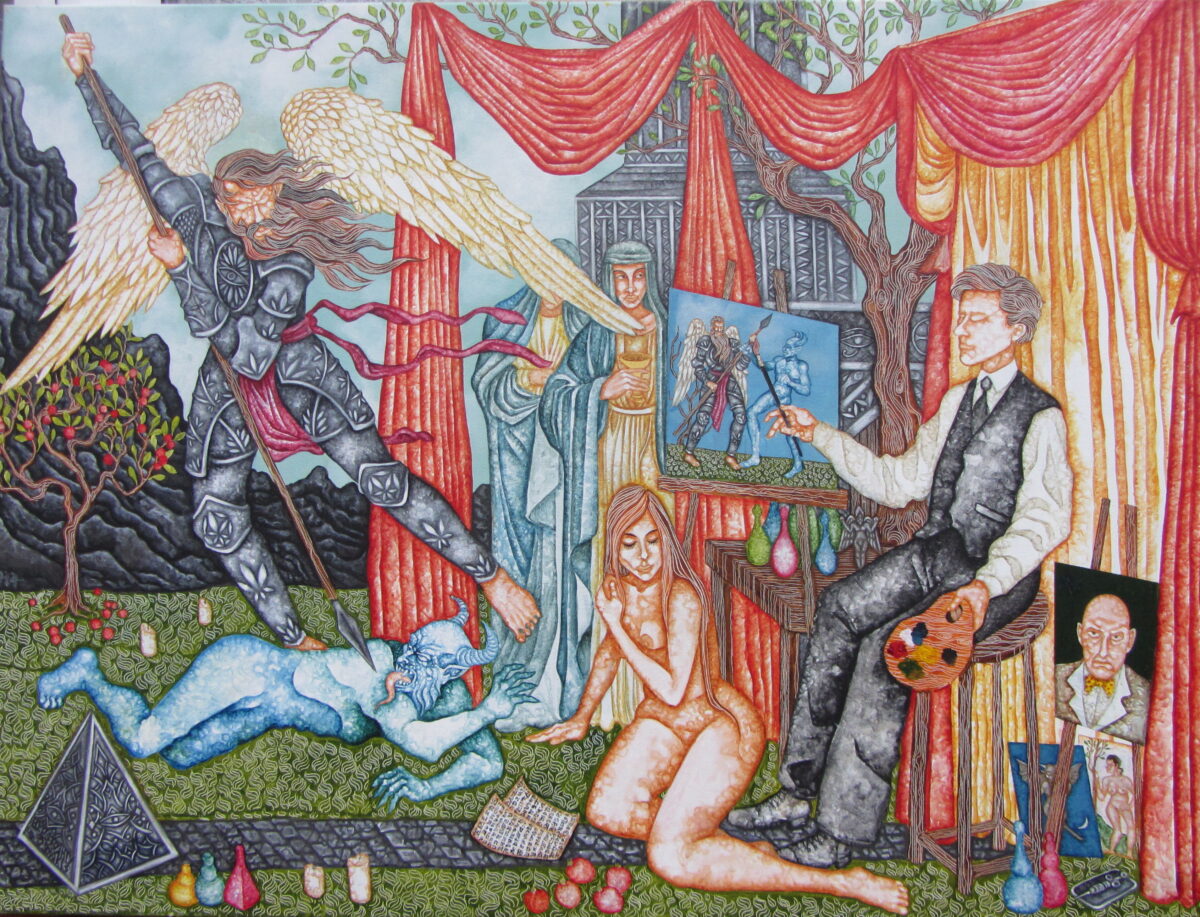
Austin Osman Spare was an English artist and occultist whose work laid the foundation for modern sigil magic and directly influenced the development of Chaos Magic decades after his death. Born on 30 December 1886 and dying on 15 May 1956, he spent almost his entire life in London and remained largely outside the mainstream of both the art world and organized occultism. He is one of the most important figures in 20th century magical practice and one of the least recognized outside of it.
Early Life and Artistic Talent
Spare was born into a working-class family in Snow Hill, London, and grew up in Smithfield and then Kennington. His artistic ability was evident from childhood. He was the youngest person to exhibit at the Royal Academy in London and at seventeen won a scholarship to the Royal College of Art. John Singer Sargent reportedly called him a genius. Critics compared him to Aubrey Beardsley and his early exhibitions attracted considerable attention, with one reviewer describing his work as having an “inventive faculty that is stupendous and terrifying in its creative flow.”
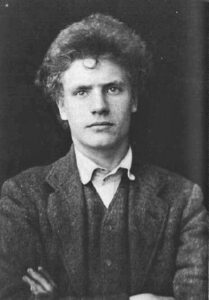
His art was influenced by Symbolism and Art Nouveau and known for its clear use of line and its depiction of monstrous and sexual imagery. Alongside painting and illustration he worked as a war artist and his works are now held in collections including the Victoria and Albert Museum in London and the Metropolitan Museum of Art in New York.
His early promise did not translate into lasting mainstream success. His refusal to compromise artistically left him vulnerable to the shifting cultural zeitgeist and from the early 1920s onward he retreated from the gallery system, eventually holding exhibitions in South London pubs rather than West End galleries. He lived his last days in poverty in Brixton, where he kept a brood of stray cats and survived on food donations from the public until his death in 1956.
The Relationship with Aleister Crowley
Having met Aleister Crowley in around 1907, Spare was introduced to ceremonial magic, which he eventually rejected in order to develop his own personal spiritual system. For a time Crowley was a patron of Spare’s work, showcasing it in his Equinox publication series and inviting Spare to join his magical order the Argenteum Astrum. The relationship eventually soured. Spare came to dislike Crowley’s emphasis on strict hierarchy and organization and became heavily critical of the practice of ceremonial magic, finding it full of unnecessary theatrical complexity. Crowley for his part continued to hold Spare in high regard while believing he had become too inward-focused.
This break was philosophically significant. Where Crowley built elaborate hierarchical systems, Spare moved in the opposite direction, stripping magic down to its simplest and most direct form: a single practitioner, a focused intention and a symbol.
Zos Kia Cultus: Spare’s Magical Philosophy
Spare developed his own magical philosophy which came to be known as the Zos Kia Cultus, a term later coined by his friend and supporter Kenneth Grant. The system was built around two central concepts.
Zos represented the body and the hand as a magical instrument, the physical vehicle through which magical will is expressed. Kia represented the atmospheric self, the limitless primal consciousness that underlies individual identity. The aim of Spare’s practice was to dissolve the barrier between conscious intention and the deeper Kia, allowing magical work to proceed without the interference of the thinking mind.
This framework is the direct ancestor of the modern Chaos Magic understanding of gnosis: the state of consciousness in which the conscious mind steps aside and allows magical intention to reach the subconscious. Spare arrived at this understanding decades before Chaos Magic formalized it.
Sigil Magic: Spare’s Lasting Contribution
Spare’s most influential practical contribution was his method of sigil creation, outlined most clearly in The Book of Pleasure, published in 1913. The method involves encoding a magical intention into a symbol through letter reduction and visual abstraction, then charging that symbol through focused attention in an altered state and subsequently forgetting it to allow the subconscious to act on the embedded intention.
This technique is now the most widely practiced form of individual magic in the world. Every sigil guide, every Chaos Magic manual and every online tutorial on magical symbol creation traces its lineage directly to Spare’s work. He developed the complete method independently, working from his own theories about the relationship between conscious and unconscious mind, years before psychoanalytic ideas became widely known.
Spare also pioneered automatic drawing as a magical technique, producing drawings in an unfocused meditative state to access subconscious imagery directly. This approach predated the Surrealists’ use of automatic writing and drawing by years and led to him being retrospectively identified as a forerunner of Surrealism, though he operated entirely outside that movement.
Key Works
Earth Inferno (1905): Spare’s first published book, combining art and text in a mystical and provocative exploration of his emerging worldview.
The Book of Pleasure (1913): His most important magical text and the foundational document of modern sigil magic. It outlines his complete theory of magical practice including the sigil method, the concept of Kia and the role of the subconscious in magical work.
The Focus of Life (1921): A dream-like narrative with voluptuous illustrations, representing the peak of his mature artistic style.
Anathema of Zos (1927): His final published book, a confrontational and difficult text that was poorly received at the time.
Legacy and Influence
Spare’s influence on contemporary magical practice is enormous though often unacknowledged. His beliefs regarding sigils provided a key influence on the Chaos Magic movement and on groups like Thee Temple ov Psychick Youth. Peter J. Carroll and Ray Sherwin, who formalized Chaos Magic in the 1970s, drew directly on Spare’s techniques and theoretical framework. Carroll’s Liber Null & Psychonaut is unthinkable without Spare’s prior work.
Today Spare is both forgotten and famous, a cult figure whose modest life has been much mythologized since his death. The world’s largest Spare collection is held by Jimmy Page of Led Zeppelin. Graphic novelist Alan Moore has described him as one of the most overlooked figures in British art history.
His art has experienced several revivals, most recently in connection with renewed interest in occultism and magical practice across contemporary culture. For practitioners working with sigils, egregores, servitors or Chaos Magic in any form, Spare is the point of origin.
To explore the sigil techniques Spare developed read our complete guide to sigil magic. To understand the broader movement his work gave rise to read our guide to Chaos Magic. For the extended creative application of sigil principles read our guide to hypersigils.
http://fulgur.co.uk/artists/austin-osman-spare/, Public domain, via Wikimedia Commons
ACFA 2023, CC BY-SA 4.0 https://creativecommons.org/licenses/by-sa/4.0, via Wikimedia Commons