Most people who discover Vedic astrology come from Western astrology. They know their sun sign, maybe their rising sign and have read enough birth chart interpretations to feel somewhat comfortable. Then they open a Vedic chart for the first time and feel like they are looking at a completely different language.
That disorientation is normal. Vedic astrology, known in Sanskrit as Jyotish, which translates roughly as “science of light,” is built on a different philosophy than Western astrology. Once you understand that philosophy, the chart stops being confusing and starts being extraordinarily precise.
This guide walks you through the four foundational layers of a Vedic birth chart. By the end you will know what to look at first, what the key terms mean and how to begin drawing real meaning from your chart.
Why Does Vedic Astrology Feel So Different From Western Astrology?
The difference is not just technical. It is philosophical.
Western astrology is primarily psychological. It describes who you are: your personality, your emotional patterns, your inner landscape. Your sun sign is central because the sun represents the ego and conscious self. When someone says “I am a Scorpio” in Western astrology, they mean something about their character.
Vedic astrology is primarily karmic and temporal. It describes what you are here to experience and, crucially, when. It is less concerned with your psychological profile and more concerned with the terrain of your life: which periods will bring expansion or challenge, when is the right time to build something new, when to consolidate and when to push forward.
This is why Vedic astrology is so well suited to timing. If you have ever felt you were working incredibly hard toward something and getting nowhere, or that everything suddenly fell into place at once, Vedic astrology often has a direct explanation for that. The dasha system maps out planetary time periods across your entire life and shows which planet is activating which area of your chart right now. Knowing your current dasha can tell you whether this is a period to plant seeds or to harvest, to focus on inner work or to step into visibility.
Western astrology can tell you who you are. Vedic astrology can tell you what is coming and when to act.
Neither system is wrong. They are simply looking at different things and many people find it valuable to use both.
What Are the Four Key Terms You Need to Know?
Before you look at any specific placement, you need to understand four terms. These are the foundation of everything else.
Lagna: Your Rising Sign and the Entire Chart Structure
In Vedic astrology, the rising sign is called the Lagna. It refers both to the zodiac sign that was on the eastern horizon at the moment of your birth and to the entire chart structure built around it.
The Lagna is considered the most important single point in a Vedic chart. It represents your physical body, your overall life path, your temperament and the lens through which all other planetary energies express themselves. Where Western astrology treats the rising sign as one piece among many, Vedic astrology treats it as the foundation of everything.
Every house in your chart is counted from your Lagna. If your Lagna is Taurus, then Taurus is your first house, Gemini is your second, Cancer is your third and so on around the wheel. This means that the same planet can have a completely different meaning depending on which Lagna you have.
Rashi: Your Moon Sign
Your Rashi is your Moon sign. In Vedic astrology this is considered almost as important as your Lagna and in many traditional interpretations it is used as the primary reference point for reading both personality and life events.
The Moon changes signs roughly every two and a half days, which means it captures something deeply personal and specific to the moment of your birth. Your Rashi describes your mind, your emotional world, your instinctive responses and the quality of your inner experience.
If you have ever felt that your Western sun sign description fits you only partially, check your Vedic Moon sign. Many people find it far more accurate as a description of how they actually feel and function day to day.
Nakshatra: The Lunar Mansion
A Nakshatra is a lunar mansion. The zodiac in Vedic astrology is divided into 27 Nakshatras, each spanning 13 degrees and 20 minutes of arc. They are ancient star clusters that the Moon passes through over the course of a month.
Your birth Nakshatra is determined by the exact position of your Moon at the moment of birth. It adds extraordinary nuance to your Moon sign interpretation. Two people with the Moon in Scorpio can be quite different from each other depending on which of the three Scorpio Nakshatras their Moon falls in: Vishakha, Anuradha and Jyeshtha each carry very different energies.
The Nakshatra also determines which planetary dasha period you were born into, which leads to the fourth and perhaps most remarkable element of Vedic astrology.
Dasha: Planetary Time Periods
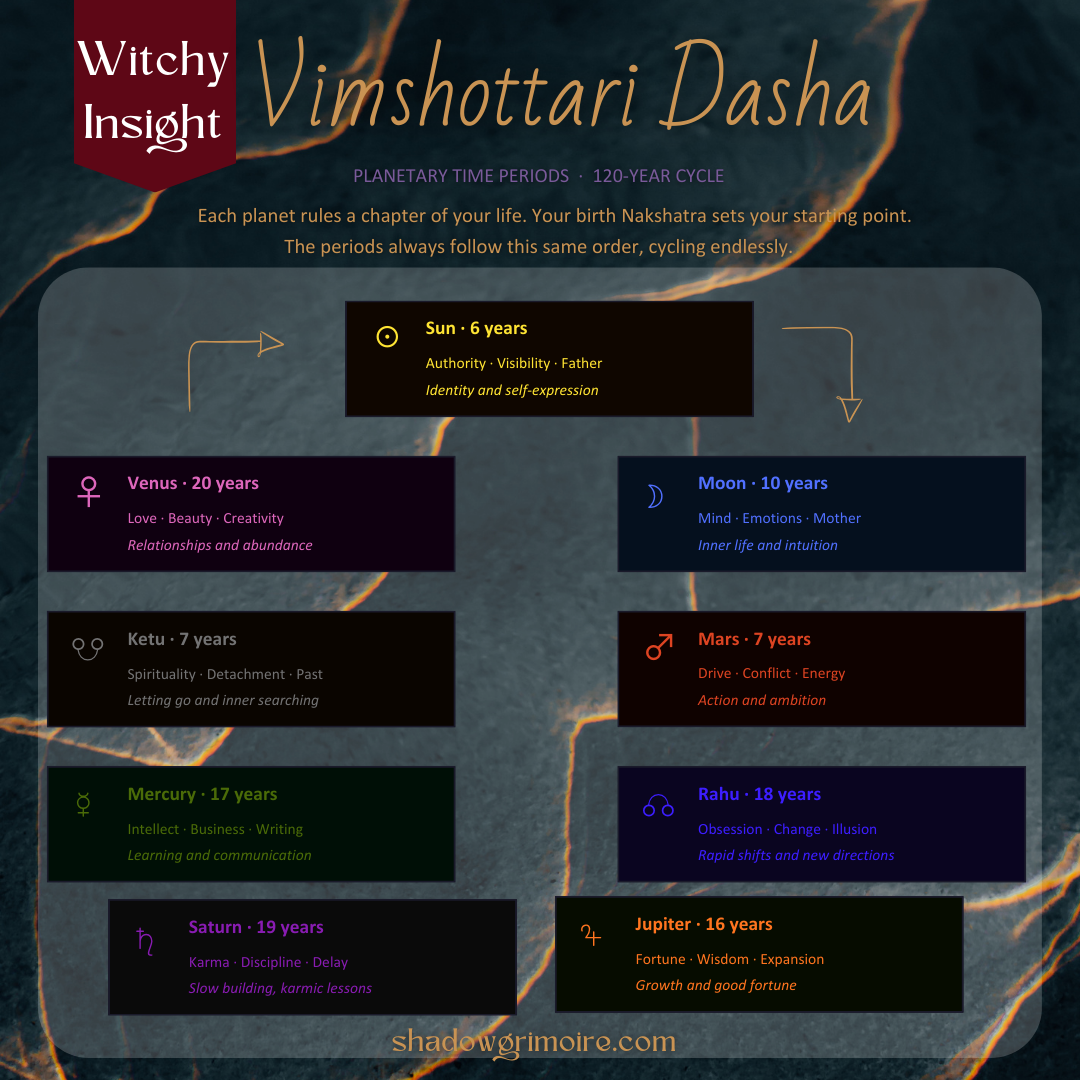
The Dasha system is a sequence of planetary time periods that unfolds across your entire life. Each planet rules a specific block of years and the sequence you experience is determined by your birth Nakshatra.
The most commonly used system is called Vimshottari Dasha. It runs on a 120-year cycle across nine planets. The Sun rules 6 years, the Moon 10 years, Mars 7 years, Rahu 18 years, Jupiter 16 years, Saturn 19 years, Mercury 17 years, Ketu 7 years and Venus 20 years.
Within each main period, called a Mahadasha, there are sub-periods called Antardashas that refine the timing even further. The planet ruling your current Mahadasha acts as the dominant energy of that phase of your life. A Venus Mahadasha tends to bring themes of love, beauty, creativity and material comfort to the foreground. A Saturn Mahadasha is often the most demanding and structuring period, bringing long-term work, karmic reckoning and the slow building of something lasting.
This is why Vedic astrology is so powerful for timing. You are not just reading static placements. You are reading which planetary energy is running your life right now and what that planet represents in your unique chart.
Where Do You Get Your Vedic Chart?
The most accessible free tool is Astro-Seek (astro-seek.com). When generating your chart, look for the option to select “Vedic” or “Jyotish” and use the Lahiri ayanamsha, which is the standard setting. The site will also show your Dasha timeline directly.
You will need your exact birth time, date and location. Vedic astrology is more sensitive to birth time than Western astrology because the Lagna changes approximately every two hours. Even a difference of 15 to 20 minutes can shift your chart meaningfully.

What Should You Look at First in Your Chart?
Start With Your Lagna
Find which sign is marked as the first house. This is your Lagna. Write it down and note which planet rules that sign. That ruling planet becomes your chart ruler and its placement colors your entire life.
Also note whether any planets sit in your first house. Planets in the Lagna have an outsized influence on your physical presence and overall life direction. A person with Jupiter in the Lagna tends toward optimism, expansion and visibility. A person with Saturn in the Lagna often carries themes of discipline, delay and serious purpose throughout their life.
Then Find Your Moon Sign and Nakshatra
Look at where the Moon sits in your chart. Note the sign and the degree. Your chart should display the Nakshatra name alongside it but if not, a simple search for “Nakshatra calculator” will give you the answer from your Moon’s degree.
Read about your Moon sign from the Vedic perspective rather than the Western one. Then read your Nakshatra. Pay particular attention to the planet that rules your Nakshatra, called the Nakshatra lord, and notice how strong or well-placed that planet is in your chart. The Nakshatra lord has significant influence over the quality of your mind and emotional life.
Then Check Your Current Dasha
Look for a section labeled “Dasha” or “Vimshottari Dasha” in your chart. Find the current date in the timeline. Note which planet is running your Mahadasha and which planet is running the Antardasha within it.
Now ask yourself: what does that planet represent in my chart? Which house does it sit in and which houses does it rule from my Lagna? That planet is the active energy shaping the current chapter of your life.
Most people who map their Dasha periods against their actual life history find the correlations striking. If you are in a period that has felt unusually demanding and slow-moving, check whether Saturn is involved. If the last few years have brought unexpected change and intensity, Rahu or Ketu may be active. If things have been expanding rapidly and you have felt unusually fortunate, look for Jupiter.
Putting It Together: An Example
Imagine someone born with a Gemini Lagna, Moon in Scorpio at 14 degrees, placing the Moon in Anuradha Nakshatra, which is ruled by Saturn.
The Gemini Lagna tells us the chart ruler is Mercury and the life themes involve communication, learning and adaptability. The Moon in Scorpio tells us the inner emotional world is intense, perceptive and private, often at odds with the quick social surface of Gemini. Anuradha Nakshatra adds themes of deep loyalty, devotion and the capacity to sustain commitment through difficulty. The Nakshatra lord Saturn then becomes worth examining closely: a well-placed Saturn in this chart suggests genuine resilience and the ability to build lasting things over time. A challenged Saturn may bring recurring themes of restriction or delayed recognition.
From just three data points, a coherent and nuanced portrait begins to emerge.
Is It Normal for Your Vedic Signs to Differ From Your Western Signs?
Yes, and this surprises many people at first. Because Vedic astrology uses the sidereal zodiac, aligned with the actual star positions rather than the seasonal tropical zodiac used in Western astrology, your signs will typically shift back by roughly 23 degrees. Many people who are Aries in Western astrology are Pisces in Vedic astrology. Your sun sign especially will often change.
This does not mean one system is wrong. It means they are measuring different things. Many people find that their Western sun sign captures something true about their conscious personality while their Vedic Moon sign and Lagna capture something truer about their interior world and lived experience.
Where Do You Go From Here?
These three layers, your Lagna, your Moon sign and Nakshatra and your current Dasha, will give you more insight than most introductory readings offer. Once you are comfortable with them, natural next steps include understanding how each planet rules and interacts with your specific houses, learning about planetary strength through concepts like exaltation and debilitation and exploring how transits layer over your Dasha periods to refine the timing even further.
Vedic astrology rewards patience. The chart is not meant to be read all at once. It is a map you return to across years and each time you bring more lived experience to it, it gives you more in return.
Photo by Laura Cleffmann on Unsplash