
If the planets in your Vedic birth chart are the actors, the houses are the stage. Each of the twelve houses governs a specific area of life and when a planet sits in a particular house, its energy expresses itself through that area. Understanding the houses is essential for moving beyond surface-level interpretation and reading a chart as a living, unified whole.
In Vedic astrology the houses are called Bhavas. They are counted from your Lagna, your rising sign, which forms the first house. Every other house follows in order from there, moving clockwise around the chart.
How the Houses Are Divided
The twelve houses cover the full spectrum of human experience from the self and body in the first house through to liberation and the dissolution of the ego in the twelfth. They are organized into four categories that reflect the four aims of life in Vedic philosophy.
The Dharma houses, one, five and nine, relate to life purpose, creative intelligence and higher wisdom. The Artha houses, two, six and ten, relate to material security, work and career. The Kama houses, three, seven and eleven, relate to desire, relationship and the fulfillment of wishes. The Moksha houses, four, eight and twelve, relate to liberation, transformation and the unseen dimensions of existence.
Knowing which category a house belongs to adds another layer of meaning when interpreting planetary placements.
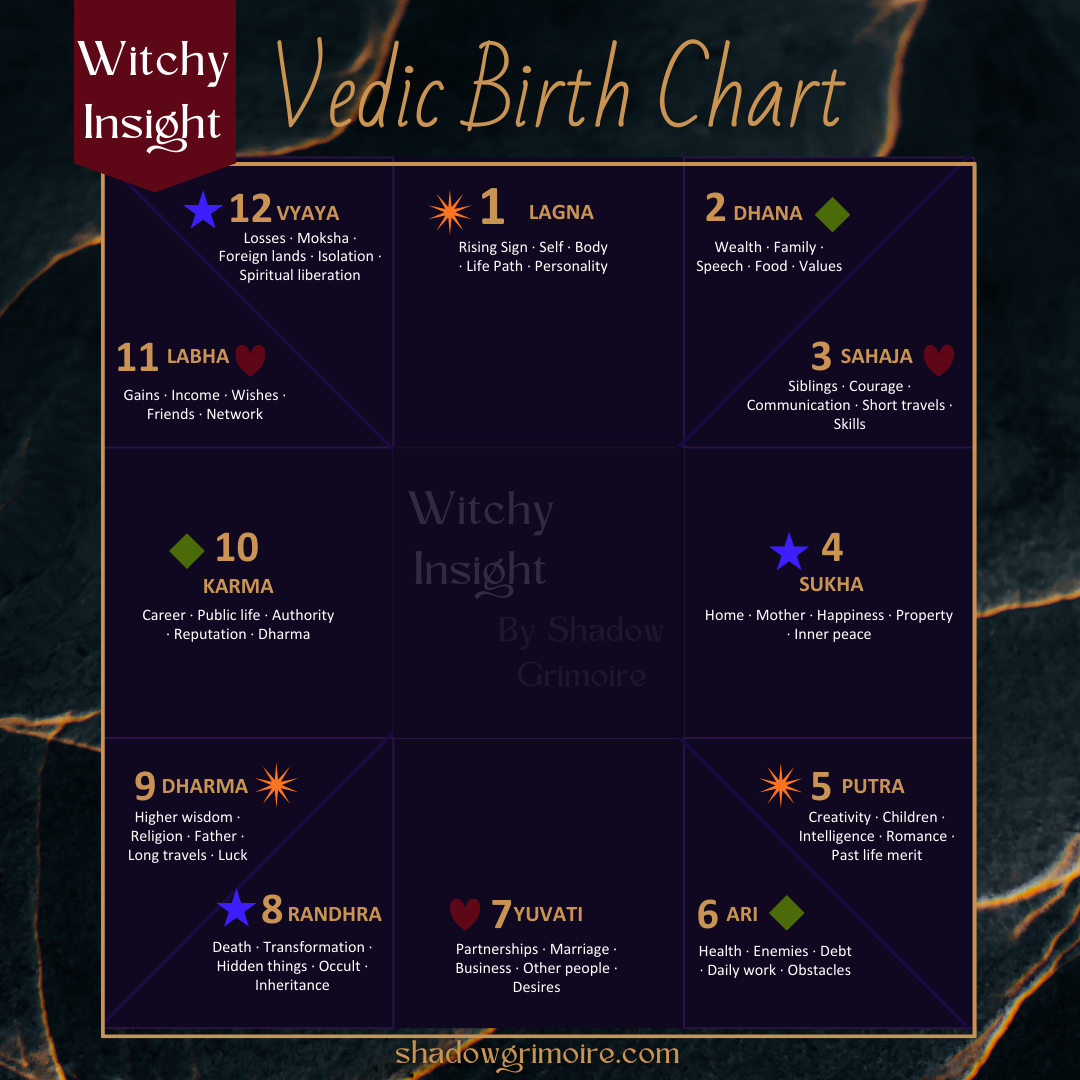
The Twelve Houses
House 1 — Lagna — The House of Self
The first house is the foundation of the entire chart. It represents your physical body, your overall constitution, your personality as it presents itself to the world and the general direction of your life. The sign on the first house is your rising sign and the planet that rules that sign becomes your chart ruler, one of the most important placements in the chart.
Any planet sitting in the first house has a particularly strong and direct influence on your life. It colors your appearance, your temperament and the way others perceive you before you have said a word.
House 2 — Dhana — The House of Wealth
The second house governs everything you accumulate and everything that sustains you. This includes money and material wealth but also family, food, speech and the values you carry from your upbringing. It describes your relationship to security and what you consider truly yours.
Speech is a second house matter in Vedic astrology, which means the second house also reflects how you communicate on a fundamental level, the tone and quality of your voice and whether your words tend to bring nourishment or difficulty.
House 3 — Sahaja — The House of Courage
The third house governs courage, effort, communication and everything close to home. Younger siblings, short journeys, writing, the hands and the immediate environment all belong here. It is the house of what you can reach from where you stand.
There is an underappreciated strength to the third house. It describes your willpower and your capacity to act on your own initiative. A strong third house often produces people who make things happen through sheer persistence and adaptability.
House 4 — Sukha — The House of Home
The fourth house governs home, mother, inner happiness, property and your sense of roots. It describes where and how you feel at peace and what kind of domestic life you build. The condition of the fourth house speaks to the quality of your childhood home and to the inner emotional foundation you carry into adulthood.
The fourth house also governs land and vehicles in Vedic astrology, both of which represent a kind of stable ground or mobility that the person can rely on.
House 5 — Putra — The House of Creativity
The fifth house is one of the most auspicious in the chart. It governs children, creative intelligence, romance, speculation and the accumulated merit of past lives. The fifth house describes your capacity to create, whether through art, ideas, children or inspired work.
It also governs the mind’s higher functions including education, mantra and the ability to receive intuitive insight. A strong fifth house often indicates a person with natural gifts, good fortune and a genuine joy in creative expression.
House 6 — Ari — The House of Enemies
The sixth house governs health, enemies, debt, daily work, service and obstacles. It is one of the Dusthana houses, meaning it is considered difficult, though not without value. The sixth house shows where you will face opposition and what kind of adversity you are built to overcome.
Planets in the sixth house often produce people who are skilled at solving problems, managing conflict or working in fields related to health and service. The sixth house also governs your capacity for discipline and the daily effort through which you sustain your life.
House 7 — Yuvati — The House of Partnership
The seventh house governs marriage, business partnerships, open enemies and the way you relate to others as equals. It sits directly opposite the first house and in many ways describes what you attract into your life through relationship, both what you seek in others and what others see in you.
The seventh house is not only about romantic partnership. Any significant one-to-one relationship, including business partnerships and known adversaries, belongs here. The condition of the seventh house and its ruler tells you a great deal about the nature and timing of significant partnerships.
House 8 — Randhra — The House of Transformation
The eighth house is one of the most complex in the chart. It governs death, transformation, hidden things, the occult, inheritance, sudden events and the deep psychological processes that operate beneath the surface of conscious life. It is a Dusthana house but also one of the most spiritually significant.
Planets in the eighth house often give a person a profound connection to the hidden dimensions of life, a natural affinity for research, psychology, healing or esoteric knowledge. The eighth house also governs the resources of others, including inheritance and the financial dimensions of partnership.
House 9 — Dharma — The House of Luck
The ninth house is considered one of the most auspicious in Vedic astrology. It governs higher wisdom, religion, philosophy, the father, long journeys, teachers and the accumulated grace of past lives. It describes your relationship to meaning, to the larger patterns of existence and to what you believe in.
A strong ninth house often indicates a person who is genuinely fortunate, guided by a sense of purpose and drawn to expand their understanding of the world through travel, study or spiritual inquiry. The ninth house is also closely linked to the quality of one’s relationship with teachers and guides.
House 10 — Karma — The House of Career
The tenth house governs career, public life, authority, reputation, status and dharma in action. It is the most visible house in the chart, sitting at the top of the wheel, and it describes how you are seen by the world through your work and your public role.
The condition of the tenth house and its ruler describes the quality of your professional life, the kind of authority you can build and the legacy you leave through your actions in the world. Planets in the tenth house are highly visible and influential, both for the person and for those they affect.
House 11 — Labha — The House of Gains
The eleventh house governs income, gains, the fulfillment of wishes, friendships, networks and elder siblings. It describes what flows toward you as a result of your efforts and the quality of your social world.
The eleventh house is considered one of the most favorable houses for planets to occupy because it supports increase and the manifestation of goals. It also governs your relationship to community and collective endeavors, the circles you move in and the networks that support your aspirations.
House 12 — Vyaya — The House of Liberation
The twelfth house governs losses, expenditure, foreign lands, isolation, sleep, the subconscious and spiritual liberation. It is a Dusthana house in the sense that it is associated with what is hidden, removed or surrendered, but it is also a Moksha house and one of the most spiritually significant in the chart.
Planets in the twelfth house often operate in hidden or invisible ways. They may describe time spent abroad, periods of retreat or isolation, or a deep inner life that is largely invisible to others. At its highest expression the twelfth house describes the capacity to release the ego and connect with something larger than personal identity.
The Dusthana Houses
Houses six, eight and twelve are called Dusthana houses, meaning they are considered difficult or inauspicious in classical Vedic astrology. Planets placed here are said to struggle to express their best qualities easily.
This does not mean these houses are simply bad. The sixth house builds resilience through opposition. The eighth house deepens through transformation. The twelfth house liberates through surrender. Some of the most spiritually evolved charts have significant planetary activity in these houses. The difficulty is real but so is the depth.
How to Use the Houses in Chart Reading
When you look at a planet in your chart, always ask two questions. Which house does this planet sit in and which houses does it rule from your Lagna? Both pieces of information are needed for a complete picture.
A planet in the fifth house will express its energy through creativity, children and intelligence. But if that planet also rules your tenth house of career, it creates a link between creative self-expression and professional life. The planet becomes a bridge between two areas of experience.
This is how Vedic astrology builds meaning, not from isolated placements but from the relationships between houses, planets and their rulers working together as a unified map of a human life.
Photo by petr sidorov on Unsplash