

Samhain is pronounced sow-en and falls on the night of October 31st into November 1st. It is one of the four great Celtic fire festivals alongside Imbolc, Beltane and Lughnasadh and by most accounts the most significant of the four. It marks the end of the harvest season and the beginning of the dark half of the year, the point when the boundary between the living world and the realm of the dead was understood to be at its thinnest.
For modern witches and pagans it remains the most powerful sabbat of the year: a time for ancestor work, divination, releasing what has ended and sitting honestly with mortality as part of the cycle of life rather than as its opposite.
The Origins of Samhain
Samhain is a Gaelic word meaning summer’s end. It appears in the earliest surviving Irish literature from the 9th century as one of the great seasonal festivals, described as a time of mandatory communal gathering lasting three days and three nights. Early texts record it as an occasion when communities were required to present themselves to local kings and chieftains, when contracts were renewed, disputes settled and new alliances formed. Failure to participate was considered an offense serious enough to incur divine punishment.
The festival’s roots run deeper than the Celtic period. Some Neolithic passage tombs in Ireland, including the Mound of the Hostages at the Hill of Tara and sites at Slieve na Calliagh, are aligned to capture the sunrise specifically at the time of Samhain, indicating that the people who inhabited Ireland before the Celts already regarded this astronomical moment as significant. The sacred site of Tlachtga, the Hill of Ward in County Meath, was the location of the great Samhain fire festival and remains a ceremonial gathering point to this day.
The bonfires of Samhain were not simply celebratory. According to the 17th-century Irish historian Geoffrey Keating, all household fires were extinguished at the start of the festival. Druids then lit a new communal fire, into which the bones of slaughtered livestock were cast. From this central fire, people carried flames home to relight their hearths, binding every home’s warmth to the community and the blessing of the season. The word bonfire is commonly said to derive from this bone-fire practice, though etymologists debate whether this folk etymology is accurate.
Samhain is frequently described as the Celtic New Year and while this framing captures something true about the festival’s position in the annual cycle, it is worth knowing that historians including Ronald Hutton have noted the evidence for Samhain being a formal pan-Celtic New Year is not as solid as popular accounts suggest. What is clear is that many significant customs, the renewal of contracts, the beginning of new sagas and stories and the formal assembly of communities, clustered around Samhain in a way that gave it a genuine new-year quality in practice even if it was not universally labeled as such.
The Christianization of Samhain
When Christianity spread through Celtic lands the Church placed All Saints’ Day on November 1st, a date that Pope Gregory III established in the mid-8th century, coinciding with the period when Samhain was observed. All Souls’ Day followed on November 2nd. The existing Celtic practices of honoring the dead, setting places at the table for ancestors and leaving food offerings, mapped closely onto Christian prayers for the souls of the departed and the veneration of saints. The night before All Saints’ Day became All Hallows’ Eve, preserving the older festival’s name in the form of Halloween.
Many of the folk practices associated with Samhain continued under the Christian calendar in Ireland, Scotland, Wales and the Isle of Man. Each of these regions had its own version of the festival: Calan Gaeaf in Wales, Allantide or Kalan Gwav in Cornwall, Kalan Goañv in Brittany and Hop-tu-Naa on the Isle of Man, which may be the oldest unbroken version of the tradition. The persistence of these regional variants across Celtic lands independently supports the genuine antiquity and cultural importance of the festival.
The Thinning of the Veil
The belief that the boundary between the living and the dead grew thin at Samhain was understood literally in pre-Christian Celtic tradition, not as metaphor. The souls of the dead were thought to revisit their former homes seeking hospitality and offerings of food, drink and warmth were left to welcome them. The dead could bring blessings as easily as harm: a beloved ancestor might return to offer guidance while a wronged spirit might seek redress. Both possibilities were taken seriously.
This opening is why Samhain is the most powerful time for ancestor work, divination and any practice that involves communication across that boundary. The seasonal energy genuinely supports this kind of work in a way that the same practices performed in summer do not have available to them.
It also means that protective practice is more important at Samhain than at most other points in the year. Costumes and disguises were worn not as entertainment but as protection, to move unrecognized among entities that might otherwise target the living. This practice of wearing masks and animal skins is documented in early Celtic sources and is one of the direct ancestors of modern Halloween costuming.
The opening at Samhain is different in quality from the Beltane thinning. At Beltane the otherworld opens toward the living fae and the generative forces of nature. At Samhain it opens toward the ancestors and the dead. Both require protective awareness alongside their celebratory aspects, but the presences available at each festival are distinct.
The Same Night Around the World
Samhain belongs to the Celtic world but the impulse it expresses is universal. Cultures that developed entirely independently of the Celtic tradition arrived at the same understanding: the dead return in late autumn, this particular window of time is when that passage is most open and the living have an obligation to respond. The consistency is not coincidence. It reflects something real about the seasonal turning.
Día de los Muertos (Mexico and Latin America) falls on November 1st and 2nd. Its roots are in Aztec traditions of honoring the dead, later shaped by Spanish Catholic influence after colonization. Families build ofrendas: elaborate altars covered in marigolds, photographs, food offerings and candles to welcome the souls of the dead home for their annual visit. The marigold’s scent is believed to guide the dead back. Día de los Muertos is a joyful festival, not a solemn one, but its underlying logic is identical to Samhain.
Kekri (Finland) was a pre-Christian harvest and ancestor festival observed in late October or early November, marking the end of the agricultural year and the return of ancestral spirits to the home. A figure called the Kekripukki, the Kekri goat, wore a birch bark mask and sheepskin coat and went from house to house demanding food and hospitality: a direct parallel to Celtic guising and later Halloween customs. Kekri was eventually absorbed into the Christian Pyhäinpäivä, All Saints’ Day, observed on the first Saturday of November. Finnish families visit cemeteries and place candles on the graves of their dead. As darkness falls, cemeteries across Finland fill with thousands of small flames burning against the November dark. It is one of the most attended collective observances in the Finnish calendar.
Allerheiligen (Germany and Austria): candles on graves, family visits to cemeteries and the general observation of November 1st as a day of remembrance. A public holiday in Catholic regions of Germany.
Zaduszki (Poland) falls on November 1st and 2nd and follows the same pattern as Pyhäinpäivä: families visit cemeteries and cover graves with candles and flowers until the entire burial ground glows. It is one of the most visually striking and widely observed collective events in the Polish calendar.
Pitru Paksha (India) is a 16-day Hindu ancestor festival that falls in September and October, timed to the autumnal equinox as the sun moves from the northern to the southern celestial hemisphere, a moment Hindu tradition designates as the beginning of ancestral time. The dead are understood to reside in Pitru-Loka, a realm between heaven and earth governed by Yama, the god of death. Descendants perform Shraddha rituals involving food and water offerings to help ancestors ascend further toward liberation. The timing is slightly earlier than the Celtic Samhain but the underlying astronomy and intention are strikingly parallel: the autumn turning marks the moment when the ancestors are most accessible.
Chuseok (Korea) falls on the full moon of the eighth lunar month, typically in late September or October. It is Korea’s largest holiday and combines harvest celebration with ancestor honoring. Families travel to ancestral homes, visit and clean the graves of their dead and perform charye, a ritual table offering of food to the ancestors. The parallel to both Samhain and Pitru Paksha in timing and structure is exact.
What connects all of these is not derivation from a single source but a shared human response to the same moment in the year. The veil thins in late autumn everywhere, not only in the Celtic world. The consistency across traditions that developed entirely independently of each other is itself a form of evidence that the seasonal thinning is real.
Samhain in the Southern Hemisphere
Practitioners in the southern hemisphere celebrate Samhain around April 30th to May 1st, when their autumn is deepening and the natural world is genuinely moving toward its dark half. This is the date that energetically corresponds to the northern Samhain, even though it shares a calendar position with northern Beltane.
Celebrating Samhain on October 31st while spring is opening in your hemisphere disconnects the festival from its actual seasonal and energetic meaning. The veil thins in alignment with the earth’s seasons, not with a fixed calendar date inherited from the northern hemisphere.
How to Celebrate Samhain
For a deeper look at how Samhain and Halloween relate to each other and where Halloween actually came from, see Samhain vs Halloween: What’s the Difference?. For specific rituals suited to October 31st including ancestor candle work, the dumb supper, divination and releasing practices, see Witchy Halloween Rituals for Celebrating Samhain.
Ancestor Altar
The ancestor altar is the oldest and most central Samhain practice. Set up a dedicated space with photographs or objects belonging to the dead: family members, friends, teachers, anyone whose memory you want to honor. Include candles, fresh water as an offering, flowers and foods or drinks the person enjoyed in life.
Light the candles at dusk on Samhain night. Speak the names of your dead aloud. Tell them something about your life since they left. Leave the offerings overnight and dispose of them the following day by returning them to the earth where possible.
You do not need biological family for this work. The ancestors of your spiritual lineage, teachers who shaped your practice, people whose work changed your life without personal connection, are all legitimate presences to honor.
The Dumb Supper
The dumb supper is a formal ancestor meal observed in silence. A place is set at the table for the dead, food is served to them first and the meal is eaten without speaking. The silence creates space for the felt presence of those who have gone and for whatever impressions arise during the meal.
This practice appears in various forms across European and American folk tradition and remains one of the most powerful Samhain observances precisely because its simplicity strips away everything except presence and attention.
Divination
Samhain has a specific long-standing association with divination across Celtic and later folk traditions. Apple-peeling to reveal letters, nutshell burning on the fire, mirror scrying: these practices appear in folk records from Ireland, Scotland and the British Isles from the medieval period onward. The thinning of the veil was considered to make divination sharper and more accurate because the distance between the living and the source of knowledge was reduced.
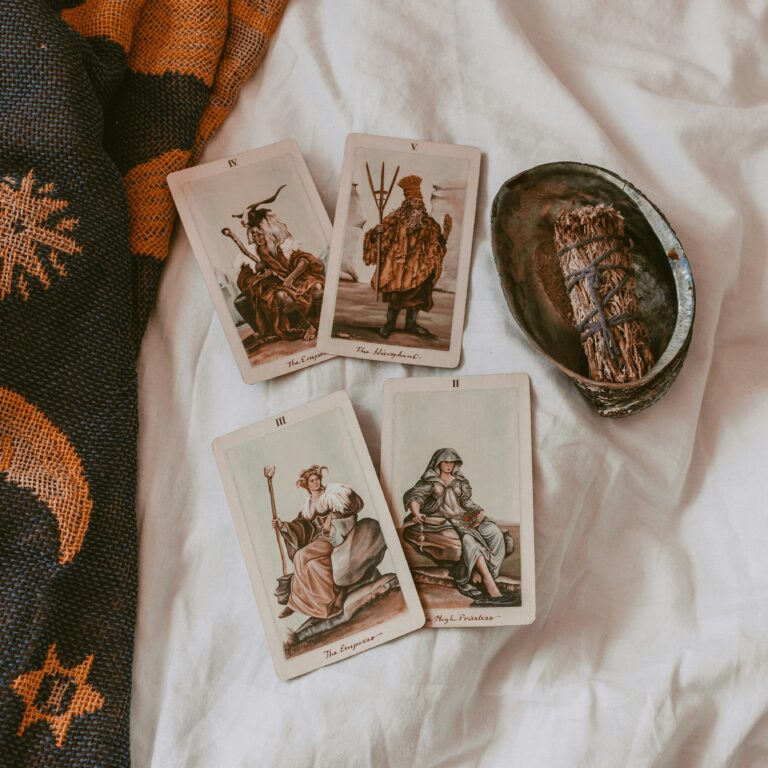
In modern practice, tarot readings at Samhain tend to carry unusual clarity. A reading focused on what is ending and what is being called forward for the new year fits the threshold energy of the festival particularly well.
Releasing and Letting Go
Samhain marks the end of the Celtic year in practice. The energetic invitation is to release what has genuinely ended: relationships that are complete, projects that will not be finished, versions of yourself you have outgrown, grief you have been carrying that is ready to move. Writing what needs releasing on paper and burning it safely in a fireproof dish is a simple and effective ritual. The intention is not to force endings that have not happened but to acknowledge what has already ended and consciously release your hold on it.
Protective Practices for Samhain Night
Because the veil is genuinely thinner at Samhain, grounding and protection matter alongside the celebratory and communicative aspects of the festival. Salt at the threshold, cleansed space before ritual begins, a clear energetic boundary around your working area and a deliberate closing at the end are all appropriate.
If you call the dead to your space, close the working with an equally clear farewell and a statement that the threshold is now closed. Do not leave ancestor work open-ended or simply walk away from it. A deliberate closing is part of respectful practice.
The Spiritual Meaning of Samhain
Samhain asks practitioners to hold death as part of life rather than as its negation. This is perhaps the hardest and most valuable thing any seasonal festival can offer: a dedicated time for sitting with mortality, loss and the reality of ending without either rushing past it or collapsing into it.
The darkness of the year that begins at Samhain is not punishment or void. It is the necessary inward half of the cycle, the time when what cannot survive winter is composted into what will feed the spring. The beloved dead are not gone from the wheel; they are on a different spoke of it. Samhain is the moment when that spoke and the one you stand on are closest together.
Frequently Asked Questions
What does Samhain mean and how do you pronounce it?
Samhain comes from the Old Gaelic meaning summer’s end. It is pronounced sow-en, with the first syllable rhyming with cow. The spelling is a relic of Old Irish orthography that does not follow modern English pronunciation rules.
Is Samhain the same as Halloween?
They share common roots but are not the same thing. Samhain is the ancient Gaelic festival marking the end of harvest and the beginning of the dark half of the year, with practices centered on honoring the dead, communal gathering and divination. Halloween developed when the Catholic Church placed All Saints’ Day on November 1st in the 8th century, absorbing and redirecting existing Celtic practices. Modern Halloween is largely secular and commercial. The folk practices between them overlap significantly but the frameworks and intentions are different.
When is Samhain in the southern hemisphere?
Around April 30th to May 1st, when autumn is deepening in the southern hemisphere. The wheel follows the actual seasons of the earth rather than a fixed northern calendar date.
Is Samhain the Celtic New Year?
This is commonly stated and captures something real about the festival’s position in the annual cycle, but historians including Ronald Hutton have noted the evidence for Samhain being a formally designated pan-Celtic New Year is not as definitive as popular accounts often suggest. What is clear is that significant customs clustered around Samhain in a way that gave it a genuine new-year quality in practice: the renewal of contracts, the beginning of new stories and the formal assembly of communities all happened at this time.
Do I need to be pagan or Wiccan to observe Samhain?
No. Samhain is observed across many witchcraft, pagan and earth-based spiritual traditions. Many practitioners who do not identify with any formal tradition observe the sabbat as part of their personal practice. The core practices of ancestor honoring, divination and seasonal reflection are available to anyone who finds them meaningful regardless of religious affiliation.
How is Samhain different from Día de los Muertos?
Both are festivals of the dead occurring at the same time of year and sharing the theme of welcoming the souls of the dead back to the living world. Samhain originated in Gaelic Celtic tradition across Ireland, Scotland and the Isle of Man. Día de los Muertos originated in Aztec traditions of honoring the dead and was later shaped by Spanish Catholic influence after colonization, now observed primarily in Mexico and Mexican diaspora communities. They developed independently and belong to distinct cultural traditions, though the underlying human impulse they express is strikingly similar.
[…] more: Samhain: Honoring the Cycle of Life and Death | Samhain vs. Halloween: What’s the Difference? | Witchy Halloween Rituals for Celebrating […]
[…] of the summer half of the year. It is one of the four great Celtic fire festivals alongside Samhain, Imbolc and Lughnasadh and in the ancient Irish calendar it held equal weight with Samhain as one […]
[…] it from the later harvest festivals. It is not yet the melancholy of Mabon or the full reckoning of Samhain. It is something closer to the feeling of a long afternoon knowing the evening is coming, beautiful […]
[…] The Wild Hunt imagery belongs specifically to Yule: Odin leading his host of the dead through winter storms, the sound of wind interpreted as the passing of the hunt. In practice this connects Yule to ancestor veneration and the presence of the dead in a way that parallels Samhain. […]
[…] solstice and the spring equinox. It is one of the four great Gaelic seasonal festivals alongside Samhain, Beltane and Lughnasadh and the first festival of the returning light after the deep winter of […]
[…] and practices specifically suited to October 31st, whether you are marking the night purely as Samhain or weaving your spiritual practice through a Halloween that also includes costumes, candles and […]
[…] its Celtic roots, its global parallels and how it became the most powerful sabbat of the year, see Samhain: Honoring the Cycle of Life and Death. For a direct comparison of where the two traditions converge and diverge, see Samhain vs […]
[…] a practitioner can work with. If you want context for why Samhain carries this specific quality, Samhain: Honoring the Cycle of Life and Death covers the full […]
[…] equinox and winter solstice. For full context on why this thinning happens and how to work with it, Samhain: Honoring the Cycle of Life and Death covers the festival’s history and practices in […]