
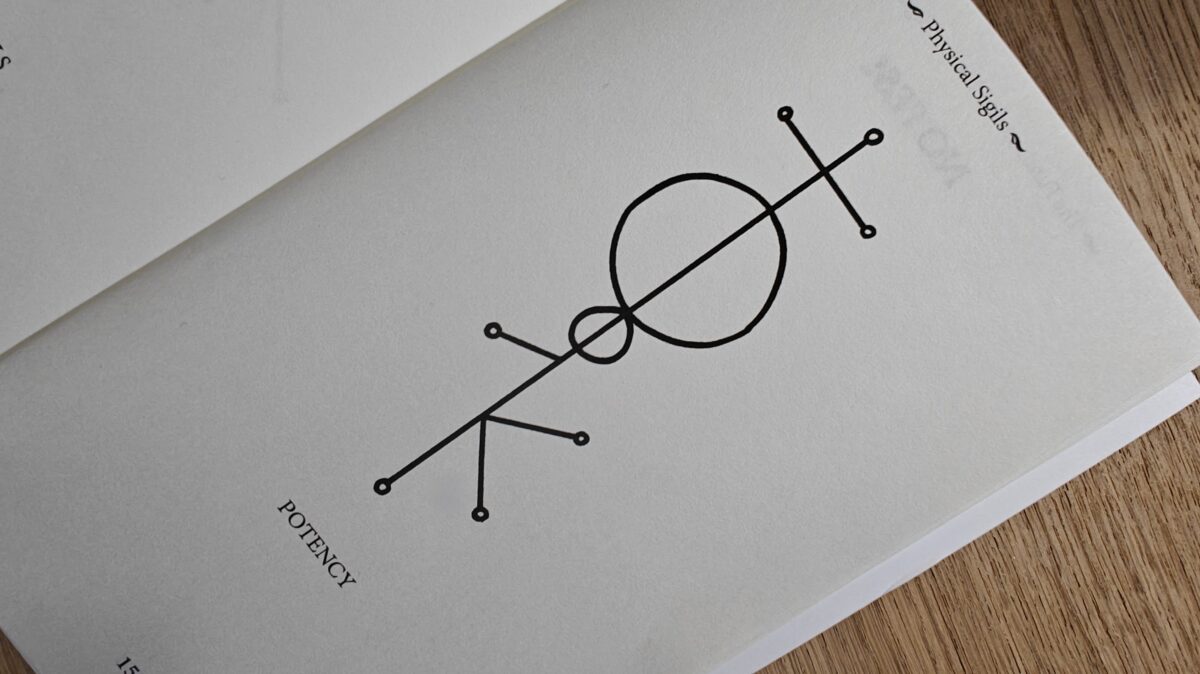
A sigil is a symbol charged with intention, designed to communicate directly with the subconscious mind and bypass the interference of conscious thought. The word comes from the Latin sigillum, meaning seal or sign, but the modern practice of sigil magic owes more to early 20th century occultist Austin Osman Spare than to any ancient tradition.
Sigil magic is one of the most accessible and widely practiced techniques in modern magic. It requires no special tools, no prior spiritual background and no adherence to a particular tradition. What it requires is a clear intention, a method for encoding it and the willingness to release it.
The Theory Behind Sigil Magic
The basic idea is that the conscious mind is noisy. When you want something badly, that wanting itself can become an obstacle. You monitor your progress, doubt your methods and second-guess your intentions. Sigil magic attempts to route around this problem by encoding your desire into a symbol, charging that symbol with focused energy and then forgetting it.
The subconscious mind, in this framework, is where magical work actually happens. It does not think in language. It thinks in images, symbols and associations. A sigil translates your intention into that language.
This approach was formalized by Austin Osman Spare, whose book The Book of Pleasure (1913) outlined the core method still used today. Peter J. Carroll later expanded on it in Liber Null, situating sigil magic within the broader framework of Chaos Magic.
You might wonder whether sigil magic is a psychological tool or a genuinely magical one, and the honest answer is that it does not matter as much as it seems. From a purely psychological standpoint, the process is already doing meaningful work. Clarifying exactly what you want forces you to think precisely about your goal. Encoding it into a symbol shifts your relationship to it. Releasing attachment to the outcome reduces the anxiety that often gets in the way of action and opportunity. These are real effects regardless of any metaphysical belief.
From a magical standpoint, the sigil is doing something additional: communicating an intention to forces or dimensions of reality that the conscious mind cannot directly access or control. Most experienced practitioners hold both views at once without finding them contradictory. The psychological and the magical are not competing explanations. They describe the same process from different angles and both illuminate something true about why it works.
How to Create a Sigil
There are several methods for creating sigils. The most widely used is the letter reduction method, but others have developed their own approaches over time.
The Letter Reduction Method
This is the method Spare popularized and remains the most common starting point.
Step 1: Write your intention as a statement
State your desire in the present tense as if it is already true. “I am confident” works better than “I want confidence.” Be specific. “I have the focus to complete my project by Friday” is more effective than “I am productive.”
Step 2: Remove repeating letters
Write the statement in capitals and cross out any letter that appears more than once. You are left with a set of unique letters.
Example: I AM CONFIDENT Unique letters: I, A, M, C, O, N, F, D, E, T
Step 3: Build the sigil
Combine the remaining letters into a single abstract symbol. Overlap them, rotate them, mirror them and simplify until the original letters are no longer recognizable. The goal is a symbol that feels complete and carries no obvious meaning to the conscious eye.
There are no rules about what it should look like. Trust your instincts and keep working until the symbol feels right.
The Kamea Method
A kamea is a magic square, a grid of numbers arranged so that every row, column and diagonal adds up to the same total. Each planet in Western ceremonial magic has its own kamea. Saturn’s is a 3×3 grid, Jupiter’s a 4×4, Mars a 5×5, and so on up through the Sun, Venus, Mercury and the Moon.
To create a sigil using a kamea, you first convert your intention into a name or single word, then convert each letter into a number using a numbering system such as the Hebrew gematria or a simple A=1 through Z=26 approach. You then plot those numbers on the kamea grid as dots and connect them in sequence with a line. The resulting shape is the sigil.
This method has roots in Renaissance ceremonial magic and appears in texts like Heinrich Cornelius Agrippa’s Three Books of Occult Philosophy from 1531, where planetary kameas were used to derive the seals of spirits and angels. It is more structured and historically grounded than the letter reduction method and tends to produce sigils with a geometric, angular quality.
The trade-off is complexity. You need to choose the right kamea for your intention, which requires some knowledge of planetary correspondences and the number conversion process adds steps that the letter method avoids entirely. For practitioners already working with ceremonial magic or astrology it integrates naturally. For beginners, the letter reduction method is the easier starting point.
Digital and Drawing-Based Methods
Some practitioners skip the letter method entirely and draw sigils intuitively, letting the symbol emerge through automatic drawing or doodling in an unfocused state. This approach emphasizes the subconscious more heavily from the start and can produce results that feel more personal.
Charging a Sigil
Creating the symbol is only the first half. The sigil needs to be charged, which means activating it with focused energy before you release it. Think of it like sending a letter: drawing the sigil writes the message, charging it puts it in the envelope and seals it.
The goal of charging is to get your conscious, analytical mind out of the way for a moment so the intention can land somewhere deeper. You do not need to enter a dramatic trance state for this to work, especially when starting out. What you do need is a genuine shift in your level of focus, even a small one.
How to Get Into the Right State
The simplest approach for beginners is breath-based. Sit somewhere quiet with your sigil in front of you. Take ten slow breaths, letting each exhale be longer than the inhale. By the end, your mind will be noticeably quieter than when you started. That is enough to begin.
From there, fix your gaze softly on the sigil without straining. Let your vision blur slightly. Hold that focus until you feel a sense of completion, which might feel like a subtle shift, a release of tension or simply a quiet inner knowing that the work is done. Then look away and move on.
As you develop a practice, you can explore more pronounced methods. Raising energy through movement works well for some practitioners: put on music, dance or move until you are fully absorbed, then stop suddenly and hold the sigil in your mind at that peak moment. Others prefer deep stillness and extended meditation. Neither approach is more valid than the other. The only measure is whether it produces a genuine shift in your state.
Practical Charging Options
If you want something concrete to start with, any of these work:
Stare at the sigil softly for two to five minutes while breathing slowly, then burn or put it away without looking back. Draw the sigil repeatedly in a notebook while listening to music that absorbs you completely. Hold the sigil in your mind at the end of a run or workout when your body is spent and your mind is quiet. Meditate for ten minutes and bring the sigil to mind clearly in the final moments before you open your eyes.
The specific method matters far less than the quality of your attention and the completeness of the release afterward.
The Forgetting Step
This is the step most beginners underestimate and it is arguably the most important.
After charging, the sigil needs to be forgotten. This does not mean you erase all memory of it. It means you stop actively thinking about it, monitoring it or wondering whether it worked. You treat the working as complete and move on.
The reason relates back to the original theory. If your conscious mind keeps returning to the intention, it continues to interfere with the subconscious process. Lust for result, as Spare called it, is the most common reason sigil magic fails.
Practical ways to encourage forgetting include destroying the physical sigil by burning or burying it after charging, creating many sigils at once so no single one holds excessive weight and simply directing your attention elsewhere and trusting the process.
Common Mistakes in Sigil Magic
Intentions that are too vague. “I want good things to happen” gives the subconscious nothing specific to work with. The clearer and more concrete the intention, the more directed the working.
Intentions that are too controlling. Trying to specify exactly how a result will come about often backfires. State what you want, not the precise mechanism by which it should arrive.
Forgetting to forget. Checking daily whether the sigil worked is the opposite of forgetting. If you find yourself constantly thinking about a charged sigil, make a new one and include the act of forgetting as part of the ritual itself.
Over-complicating the symbol. Some practitioners spend so long perfecting the visual design that the creative process becomes an anxious one rather than a focused one. The sigil does not need to be beautiful. It needs to feel charged.
Charging in an ordinary mental state. A sigil stared at during a distracted afternoon will carry less charge than one focused on during genuine gnosis. The quality of your state matters.
Sigil Magic Outside of Chaos Magic
While sigil magic is most closely associated with Chaos Magic, versions of symbol-based intention magic appear across many traditions. Bind runes in Norse practice combine runic symbols to create intention-laden charms. Vévés in Haitian Vodou serve as summoning symbols for specific lwa. Planetary seals in Western ceremonial magic encode astrological and numerical relationships into charged symbols.
The modern chaos magic approach differs in that it strips away the cultural framework and treats the symbol as a direct communication to the subconscious rather than a representation of an external spiritual force. Both approaches have their practitioners and their results.
Integrating Sigil Magic into a Regular Practice
Sigil magic works well as a standalone technique and equally well as part of a broader magical practice. Some practitioners create a sigil at the start of any new project or intention. Others use them only for specific goals where they feel conventional effort needs additional support.
A few approaches that practitioners find useful over time:
Keeping a sigil journal where you record the intention, the date and eventually the outcome, without obsessing over results before they arrive. Creating sigil batches during a single session so no individual sigil feels precious. Incorporating sigils into other practices such as tarot work, where a sigil might be placed beneath a card during meditation, or into altar setups as charged objects.
The deeper you work with sigil magic, the more your symbol-making instinct develops. Early sigils often feel mechanical. Over time, the process becomes more intuitive and the results more consistent.
Frequently Asked Questions About Sigil Magic
Do Sigils Actually Work?
Results vary by practitioner and intention, but sigil magic has a large and consistent following across many magical traditions for a reason. From a psychological standpoint, the process of clarifying an intention, encoding it and releasing attachment to the outcome is itself a useful practice regardless of metaphysical belief. Many practitioners report consistent results over time, particularly as they develop their own style and charging methods.
How Long Does a Sigil Take to Work?
There is no fixed timeline. Some sigils seem to produce results within days, others over weeks or months. Intentions involving things already in motion tend to manifest faster than those requiring large changes. Setting a time-bound intention in the sigil itself, such as “by the end of this month,” can help focus the working.
Can You Make a Sigil for Someone Else?
Yes, though most practitioners recommend getting the person’s consent before doing magical work on their behalf. The intention should be framed around what you want for them rather than what you want them to do, to avoid intentions that override their autonomy.
How Many Sigils Can You Work With at Once?
As many as you can genuinely charge and forget. The shoaling method used in Chaos Magic involves creating and releasing multiple sigils in a single session. The risk with too many at once is that none of them receive genuine focus during charging.
Does the Sigil Have to Look a Certain Way?
No. There is no correct appearance for a sigil. The only criterion is that it feels complete and that the original letters or meaning are no longer immediately obvious to your conscious mind when you look at it.
What Do You Do If You Remember a Sigil You Were Supposed to Forget?
Notice the thought and redirect your attention without engaging with it. If a particular sigil keeps surfacing, some practitioners choose to formally close the working by burning the sigil with the conscious intention of releasing it completely.
A Simple First Sigil Working
If you have never created a sigil before, here is a complete working to start with.
Choose a small, specific intention. Not a life-changing goal, but something concrete and achievable that you genuinely want. Write it as a present-tense statement. Apply the letter reduction method and build your symbol without overthinking it.
Find fifteen minutes of genuine quiet. Sit with the sigil in front of you. Breathe slowly and let your focus narrow until the sigil is all you are aware of. Hold that focus until something shifts, a sense of completion, a slight change in how the symbol looks, a feeling of release. Then put the sigil away or burn it and go do something completely unrelated.
That is sigil magic in its simplest form. Everything else is refinement.
Suggested Reading
| Title | Author | Focus |
|---|---|---|
| Practical Sigil Magic | Frater U.D. | The most widely recommended book on sigils, covers letter reduction and kamea methods with clear historical grounding |
| The Book of Pleasure | Austin Osman Spare | The original 1913 text that established modern sigil magic, dense but foundational |
| Liber Null & Psychonaut | Peter J. Carroll | Situates sigil magic within Chaos Magic as a whole, essential for understanding the broader system |
| Sigil Witchery | Laura Tempest Zakroff | A more intuitive and artistic approach, strong on drawing-based methods and personal symbol development |
| Six Ways: Approaches and Entries for Practical Magic | Aidan Wachter | Not exclusively about sigils but covers practical magic with a grounded and unsentimental perspective that experienced practitioners rate highly |
| The Tao of Craft | Benebell Wen | Explores sigil-equivalent traditions in Eastern esoteric practice, valuable for understanding how the same principles appear across cultures |
| The Fundamental Book of Sigil Magick | K.P. Theodore | Not a technique manual but a large visual catalogue of ready-made sigils, useful if you want drawn references for inspiration |
Sigil magic is one of the core techniques within a broader practice. To explore the system it grew from, read our complete guide to Chaos Magic.








[…] understand the foundation that hypersigil work builds on, read our complete guide to sigil magic and the broader system it comes from in our guide to Chaos […]