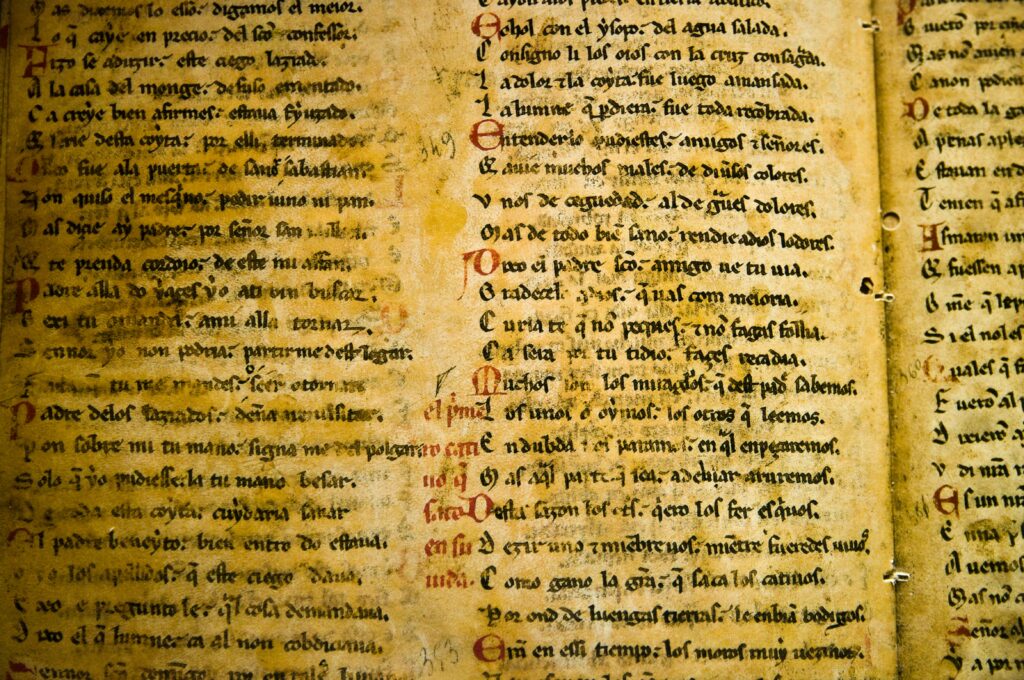
The Codex Gigas, Latin for “Giant Book,” is the largest known medieval manuscript in the world. Created in the early 13th century, it originated in the Benedictine monastery of Podlažice in the Kingdom of Bohemia, now part of the Czech Republic. The manuscript is believed to have been completed between 1204 and 1230, likely by a single monk.
The book is most famous for its enormous size, measuring 92 cm tall (approximately 36 inches), 50 cm wide (about 20 inches), and weighing over 75 kilograms (around 165 pounds), as well as for a full-page illustration of the Devil, which has earned it the nickname “The Devil’s Bible.” Despite this ominous moniker, the manuscript is not inherently satanic but rather a compendium of religious, historical, and medical knowledge.
What does the Codex Gigas contain?
The Codex Gigas is a vast encyclopedic work. Its contents reflect the intellectual and spiritual life of the medieval period. The manuscript includes:
- The complete Latin Vulgate Bible (Old and New Testaments)
- Two historical works by Flavius Josephus (Antiquities of the Jews and The Jewish War)
- Isidore of Seville’s Etymologiae, a medieval encyclopedia
- Medical texts by Hippocrates and Theophilus
- A calendar of saints and Bohemian local events
- Magical formulas, exorcism rituals, and penitential prayers
- A large, iconic illustration of the Devil (folio 290r), opposite a depiction of the Heavenly City
The uniformity of the handwriting throughout the manuscript suggests it was written by a single scribe, possibly over decades. The inclusion of both sacred and secular texts indicates that the manuscript was intended as a comprehensive reference work for monastic or scholarly use.
What is the legend behind the Codex Gigas?
According to medieval legend, the Codex Gigas was created in a single night by a monk who had broken his vows and was sentenced to be walled up alive. To avoid this fate, he promised to write a book containing all human knowledge in one night. Realizing the task was impossible, he allegedly made a pact with the Devil, who completed the manuscript in exchange for the monk’s soul.
This legend is likely a later invention, inspired by the manuscript’s size and the striking image of the Devil. Nonetheless, it has contributed significantly to the manuscript’s mystique and cultural legacy.
Was the Codex Gigas used or sought after by the Nazis?
There is no direct evidence that Adolf Hitler or the Nazi regime possessed or studied the Codex Gigas. However, the Nazis, particularly Heinrich Himmler and the SS, were known for their interest in occultism, esotericism, and ancient relics. Himmler’s fascination with mystical artifacts and medieval manuscripts has led to speculation that the Codex Gigas may have been of interest to Nazi occult researchers.
At the time of World War II, the manuscript was already housed in Sweden, having been taken from Prague by Swedish forces in 1648 during the Thirty Years’ War. It was not among the artifacts looted or studied by the Ahnenerbe, the Nazi research institute dedicated to ancestral heritage and occult studies.
Where is the Codex Gigas today and can it be viewed?
The Codex Gigas is currently preserved at the National Library of Sweden (Kungliga biblioteket) in Stockholm. Due to its age and fragility, it is not on permanent public display. However:
- A complete digital facsimile is available online through the library’s website, allowing scholars and the public to explore every page.
- The manuscript is occasionally exhibited during special events or academic exhibitions.
- Researchers may request access under controlled conditions for scholarly study.
The digital version includes high-resolution scans, transcriptions, and scholarly commentary, making it one of the most accessible medieval manuscripts in the world.
Why is the Codex Gigas considered unique among medieval manuscripts?
Several features distinguish the Codex Gigas from other medieval works:
- Size and scale: It is the largest known surviving medieval manuscript.
- Comprehensive content: It combines religious scripture, historical chronicles, medical knowledge, and magical texts.
- Artistic elements: The Devil illustration is unparalleled in medieval manuscript art.
- Legendary origins: The myth of its demonic authorship has fueled centuries of fascination.
- Historical journey: From Bohemia to Sweden, its survival through wars and political upheaval adds to its mystique.
How has the Codex Gigas influenced culture and scholarship?
The Codex Gigas has inspired numerous books, documentaries, and fictional works. It has appeared in television series, novels, and conspiracy theories, often portrayed as a cursed or forbidden tome. Scholars, however, view it as a remarkable example of medieval knowledge compilation and monastic dedication.
Its blend of sacred and secular content offers insight into the worldview of 13th-century Europe, where theology, science, and folklore coexisted within the same intellectual framework.
Can the Codex Gigas be studied today?
Yes. The National Library of Sweden has made the Codex Gigas freely accessible online. Scholars can study its contents, paleography, and iconography in detail. The digital edition includes:
- Full-page scans of all 310 leaves (Latin)
- Latin transcriptions and partial translations
- Contextual essays and historical background
This accessibility has allowed the Codex Gigas to remain a subject of ongoing academic interest in fields such as medieval studies, art history, theology, and manuscript conservation.
How can you read the Codex Gigas in English?
For those interested in exploring the Codex Gigas in English, there are several options available:
- The Swedish Royal Library offers a fully digitized version of the manuscript, including high-resolution scans and Latin transcriptions. While not fully translated, it provides access to the original content.
👉 Codex Gigas - A user-uploaded English translation of the Codex Gigas is available on SlideShare.net. This presentation claims to offer a translated PDF version of the manuscript.
👉 Codex Gigas English
Please note: SlideShare is a legitimate platform, but since content is user-generated, accuracy and authenticity may vary. Downloading or relying on third-party translations is at your own discretion, and it’s always wise to cross-reference with scholarly sources or official archives.
For academic or research purposes, the digital facsimile from the Swedish National Library remains the most authoritative source.
Photo by Mark Rasmuson on Unsplash