The concept of guides or helpers that exist beyond ordinary perception appears across nearly every spiritual tradition and culture. Whether called guardian angels, spirit allies, masters or ancestral helpers, these invisible beings are understood to provide wisdom, protection and guidance during crucial moments and transitions. However, not all non-ordinary entities claiming to be guides are genuine. Safe guide work requires understanding which traditions describe guides, how to distinguish true guides from deceptive entities and why protection and cleansing are the foundation of all guide communication.
What Are the Different Spiritual Traditions of Guides?
The concept of guides has taken many forms across time and culture. These traditions continue to influence modern spiritual practice.
What Is Spiritualism’s Understanding of Spirit Guides?
Modern Spiritualism emerged in 19th century America with the belief that the living could communicate directly with the dead through mediums. In this framework, spirit guides are typically deceased humans who have evolved spiritually and now assist the living. These guides are understood to be beings who once lived on Earth, developed spiritual wisdom through their own experiences and now choose to help others.
Spiritualist mediums work to establish contact with specific guides who belong to a particular person. A guide might be a deceased relative, a person from history, or a soul with whom you have connections from past lives. The relationship is personal and ongoing. Many spiritualists report having one primary guide and several secondary guides who offer assistance in different areas of life.
In Spiritualism, guides communicate through mediums using various methods: automatic writing, channeling, direct voice phenomena or visions. The guide may have a distinct personality, name and particular area of expertise.
What Is Theosophy’s Approach to Spiritual Guides?
Theosophical teachings introduce more elaborate hierarchies of spiritual beings. In Theosophy, guides might be ascended masters, mahatmas or evolved beings who have transcended the ordinary cycle of birth and death. These are not ordinary humans but highly evolved consciousnesses.
Theosophical teachings describe mahatmas as enlightened beings who watch over humanity’s spiritual evolution. They are not assigned to individuals but are available to those who genuinely seek wisdom and are ready to receive it. The relationship with a Theosophical guide is less personal than in Spiritualism and more focused on spiritual teachings and initiation into deeper mysteries.
Theosophists emphasize that these guides are not servants waiting to fulfill wishes but teachers who guide toward higher understanding. Their guidance often involves challenges and lessons rather than comfort.
What Is the Shamanic Perspective on Spirit Guides?
In shamanic traditions worldwide, spirits and guides are understood as non-human beings that inhabit unseen realms. These might include animal spirits, land spirits, ancestor spirits or other entities. The shaman’s role is to develop relationships with these spirits and work with them for healing and guidance.
Shamanic guides are often animals or nature beings rather than human spirits. A person might have a primary power animal as guide along with plant spirit allies or elemental guides. The relationship is built through direct experience: drumming, dancing, plant medicine work or other techniques that allow the shaman to enter non-ordinary states of consciousness and interact with spirits.
The guide relationship in shamanism is active and reciprocal. The human honors the spirit through offering and right behavior. The spirit assists in return. This is understood as a genuine relationship between beings not a one-directional channeling.
What Is Modern Witchcraft’s Understanding of Spirit Guides?
In contemporary witchcraft, spirit guides or spirit allies are understood as beings you intentionally build relationships with. These might be animal spirits, nature spirits, ancestors, elementals or other entities. Unlike the more passive reception of guides in other traditions, witchcraft emphasizes actively seeking out and building alliances.
Many witches distinguish between guides that find them (presenting themselves through repeated signs and dreams) and allies they deliberately court through ritual and intentional work. The relationship requires ongoing maintenance, offerings and respect. It is understood as a genuine partnership: you offer respect and sometimes material offerings. The ally offers protection, wisdom or practical assistance.
Some witches work with deceased practitioners from their tradition as guides and teachers. Others build relationships with local land spirits or with beings associated with specific magical practices.
What Is the Christian Framework of Guardian Angels?
In Christian theology, guardian angels are beings created by God specifically to guide and protect individual humans. Each person is understood to have been assigned one or more angels at birth. These angels work for God’s purposes and the person’s spiritual wellbeing though not necessarily their comfort or happiness.
The Christian framework emphasizes that angels are separate from God but work according to divine will. They may guide through intuition, synchronicities, dreams or messages but they are not under the person’s command. Prayer is the primary way Christians communicate with their guardian angels.
The relationship is hierarchical: God is the source and authority. Angels obey God not the individual. This differs significantly from frameworks where guides are more equal partners.
What Is the Difference Between a Soul Guide and a Spirit Guide?
The terms are often used interchangeably but some practitioners distinguish between them.
A soul guide typically refers to a guide that is connected to your soul on a deep level. This might be a being with whom you have worked across multiple lifetimes, an aspect of your own evolved consciousness, or a being specifically assigned to your spiritual journey. Soul guides are understood as deeply attuned to your soul’s purpose and direction.
A spirit guide is a broader category that might include any helpful non-ordinary being whether or not there is a deep soul-level connection. This could be a temporary guide that appears for a specific life challenge, an ancestor, an animal spirit or an elemental ally.
In practice, many people use the terms interchangeably. The distinction matters mainly for practitioners who work with multiple guides and want to differentiate between guides who are deeply connected to their soul path and those who are assisting with specific situations.
Can You Have Multiple Guides and What Purpose Do They Serve?
Most practitioners work with a primary guide (sometimes called a primary spirit guide, main ally or core guide) along with several secondary guides or helpers. The primary guide is the one most consistently present and most attuned to your overall soul path. Secondary guides might assist with specific areas of life: one for creative work, another for relationships, another for health or spiritual development.
The number of guides varies by tradition and individual experience. Some spiritual frameworks describe each person as having anywhere from three to seven guides working on their behalf at any given time. Others describe a primary guide with helpers appearing and disappearing as situations require. Different guides may have different roles and energies.
From a spiritual perspective, guides exist because the universe supports consciousness and evolution. Guides are beings who have evolved to a point where they can help others without interfering with free will. Their purpose is to facilitate growth, offer perspective and provide assistance during critical moments without controlling your choices.
Guides are not servants waiting to fulfill wishes. They are not forces that prevent all bad things from happening. Rather, guides assist in your learning process. They help you see what you need to see. They guide you toward growth even when that growth is uncomfortable. They offer protection and wisdom but they respect your autonomy to make your own choices.
What Are Shadow Spirit Guides and Dark Guides?
Not all guides are gentle teachers. Some spiritual traditions acknowledge shadow spirit guides or dark guides whose role is to facilitate transformation through challenging sometimes harsh means.
Shadow guides work similarly to Jungian shadow work: they bring your unconscious material and repressed aspects into conscious awareness. These guides trigger you to confront your fears, addictions, denial patterns and shadow self. Their guidance often feels uncomfortable or contradictory because they are reflecting back to you what you have been avoiding seeing.
Shadow guides are not malicious. Their purpose is profound growth through confrontation with yourself. Working with a shadow guide means being willing to see your darkness, your capacity for harm, your greed, your selfishness, your fear. By integrating these shadow aspects consciously rather than projecting them outward, you become whole.
The key distinction: a shadow guide challenges you internally. They push you toward self-awareness and personal responsibility. They do not ask you to harm others or violate your values. They ask you to know yourself fully. Some practitioners deliberately work with shadow guides through meditation or ritual. Others recognize a shadow guide’s presence retrospectively when they realize how challenging experiences or difficult people have catalyzed profound growth.
How Do You Recognize That You Have a Spirit or Soul Guide?
Many people experience the presence of guides without consciously seeking them. Recognition often comes through repeated patterns and signs.
Repeated synchronicities are a common sign. A guide often announces its presence through repetition. You might see the same animal repeatedly. You might encounter the same symbol in different contexts. You might have recurring dreams featuring a particular being or character.
Dream encounters are another indicator. Guides frequently communicate through dreams. You might see a consistent figure in dreams, have conversations with a wise being, or experience teaching dreams where you wake up knowing something you did not consciously learn.
Intuitive knowing happens when you simply know someone or something is with you. You might sense a presence, feel guided toward a particular choice or suddenly know something you had no way of knowing.
Assistance in difficult times appears when guides become noticeable during crossroads or difficulty. Unexpected help appears. Information arrives that you desperately needed. The timing feels too perfect to be coincidence.
How Do You Tell the Difference Between a Real Guide and a Deceptive Entity?
This is the most critical question for safe spiritual practice. Not all non-ordinary beings claiming to be guides are genuine guides. Some are deceptive, parasitic or manipulative entities that impersonate guides to access your energy.
True guides respect your sovereignty and free will absolutely. They offer guidance but never commands. They bring clarity and peace even when challenging you. They align with your deepest values even if they stretch you. They lead to real improvements in your life and expanded consciousness. They communicate with humility and never demand worship or obedience. They help you become more yourself not less. They support your relationships and community connections.
Deceptive entities pretending to be guides create confusion urgency or fear. They demand secrecy or isolation from trusted people. They ask you to harm yourself or others. They insist on blind obedience or unquestioning belief. They create dependency where you cannot function without them. They promise unrealistic results or power. They contradict your core values repeatedly. They make you feel smaller or more disempowered. They push you toward addictions or destructive behaviors. They create nightmares, dread or constant anxiety.
Low-vibrational trickster spirits appear helpful but subtly manipulate you toward their agenda. They tell you what you want to hear rather than what serves you. They create situations that seem synchronistic but lead to harm. They make you feel special or chosen but isolate you from others. They demand offerings or energy in exchange for help.
If you experience any suspicious characteristics from an entity claiming to be your guide, immediately establish boundaries: I revoke permission for any being that does not serve my highest good to be in my space. Leave. Now.
Why Protection and Cleansing Are Essential for Guide Work
The most important foundation for safe guide communication is not the technique. It is protection and energetic cleansing. Many people approach guide work with openness but without establishing spiritual boundaries first. This leaves you vulnerable to attachment by unwanted entities or low-vibrational beings.
The chakra framework you might have heard about (guides anchoring at heart, solar plexus or sacral chakra) is spiritually descriptive but practically incomplete. Yes entities can attach at chakra points. But the real work is establishing a protected energetic space where only authentic guides can enter.
Protection work means actively cleansing your space, grounding yourself physically and energetically and consciously defining who has permission to communicate with you. Cleansing work removes residual negative energy or unwanted attachments that might be interfering with your communication.
This is not paranoia. This is spiritual hygiene.
How Do You Establish Protection Before Communicating With Guides?
Protection first then communication.
Create a cleansed space using sage palo santo sound or salt. This removes lingering negative energy and marks the space as sacred. Ground yourself physically and energetically. Stand barefoot on earth or visualize roots extending from your feet deep into the ground. Grounding prevents you from being destabilized or manipulated by entities.
Set protective boundaries. Visualize white or golden light surrounding your body forming a protective cocoon. State your intention: Only beings of light and highest consciousness may communicate with me. I am protected from deception and harm.
Use protective crystals. Black tourmaline, obsidian and amethyst offer protection during spirit communication. Keep them near or in your hands while working.
Define consent explicitly. Guides of my highest good, you may communicate with me through dreams, synchronicities and divination. You may not appear in physical form without my permission. You may not speak through other people.
For more detailed protection practices see these related articles:
Simple Protection Spell for Everyday Safety
Salt in Witchcraft: Foundational Uses and History
For detailed cleansing methods:
Cleansing Negative Energy With an Egg Spell
How Do You Use Divination Tools to Communicate With Guides?
Once protection is established, divination tools create a clear bridge for guide communication.
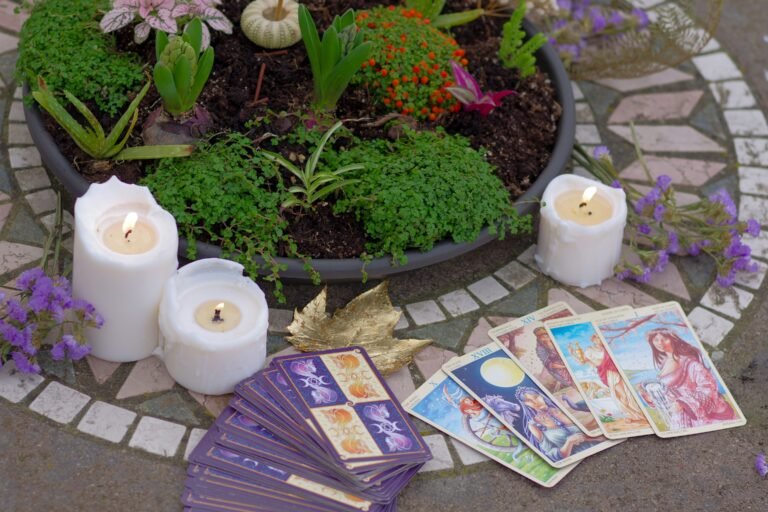
Tarot and oracle cards are among the most accessible divination tools for guide communication. You can ask your guides questions before a reading and notice which cards appear repeatedly. Over time you recognize how your guides communicate through particular cards. Some people develop personal relationships with specific cards as guide messengers.
Runes offer direct potent communication. Many practitioners work with runes specifically for receiving guidance from allies and guides. Rune practice develops a personal language with your guides where certain runes consistently appear when certain guides are communicating.
Pendulum work allows yes-or-no questions and rapid feedback from guides. Hold a pendulum and ask your guides clear questions. The pendulum’s movement becomes your guide’s communication system.
Automatic writing is a traditional practice where guides communicate through your hand movements as you write. You hold a pen loosely over paper and allow words to flow without consciously composing them.
Intuitive drawing or art allows guides to communicate through creative expression. You might sketch what your guide wants you to understand rather than receiving verbal messages.
Dreamwork is perhaps the most natural guide communication method. Before sleep ask your guides a question or request guidance. Keep a dream journal. Over time you recognize your guides’ communication style in your dreams.
Bibliomancy (randomly opening a book and finding guidance in the text) works well for guide communication if you use books that resonate with you spiritually. Ask your guide a question, open a book randomly and read the first passage your eyes land on.
The key to using divination for guide communication is consistency and attention. Use the same tool regularly. Build familiarity with how your specific guides communicate through that tool. Over time the tool becomes a clear channel for guide-to-you communication.
FAQ
What if I do not sense a guide’s presence? Am I missing something?
Not necessarily. Some people naturally sense non-ordinary presences. Others do not and that is fine. You can still develop a guide relationship through consistent practice without dramatic experiences. Many people work very effectively with guides through synchronicity and intuitive knowing without ever seeing them or feeling them physically.
Can multiple guides work with me simultaneously?
Yes. Many people have a primary guide but also work with secondary guides in different areas. You might have a guide for spiritual development, another for creative work and another for relationships. You can also have guides appear temporarily to help with specific life challenges then move on.
What if I ask for guidance and get conflicting messages?
Conflicting messages might indicate that multiple guides with different perspectives are communicating or that your own desires are interfering with clear reception. Take time to sit with the conflict. Usually clarity emerges when you stop trying to force an answer.
Is it disrespectful to have not worked with my guides until now?
No. Guides do not require constant attention or you would have sensed their presence already if they needed to communicate urgently. You can begin a guide relationship at any time. Most guides welcome genuine effort to connect.
What if my guide is giving me guidance that others disagree with?
Listen to the feedback from trusted people but trust your own intuition about what is right for you. If multiple trusted people are concerned about guidance you are receiving, take that seriously. Genuine guides do not isolate you or ask you to reject wisdom from your community.
Can I change guides or end a guide relationship?
Yes. You can release guides who no longer serve you. You can also ask for new guides to step forward. Express gratitude for what the previous guide offered and then consciously open to new guidance. This is not disloyal. Guides understand that relationships evolve.
How do I know if I am channeling a guide or just making things up?
This is a valid concern. The line between genuine guidance and imagination is not always clear. Trust the results: does following the guidance lead to real improvements in your life? Does it align with your values? Does it come consistently or only when you are trying hard? Genuine guidance usually has a quality of inevitability: it arrives whether you are trying to receive it or not.
What if I am afraid of guides or non-ordinary presences?
Fear is understandable. You do not have to work with guides if it frightens you. You can also work with guides through protection and clear boundaries. Many practitioners establish firm agreements with guides: you may communicate through dreams and synchronicities but not by appearing in my home or shocking me awake. Boundaries create safety.
Related Articles
Soul Contracts: Complete Guide to Types and Meaning
Soul Ties Signs: How to Recognize and Break Unhealthy Connections
Divination Basics: Exploring the Art of Self-Reflection and Insight
Photo by LAUREN GRAY on Unsplash