
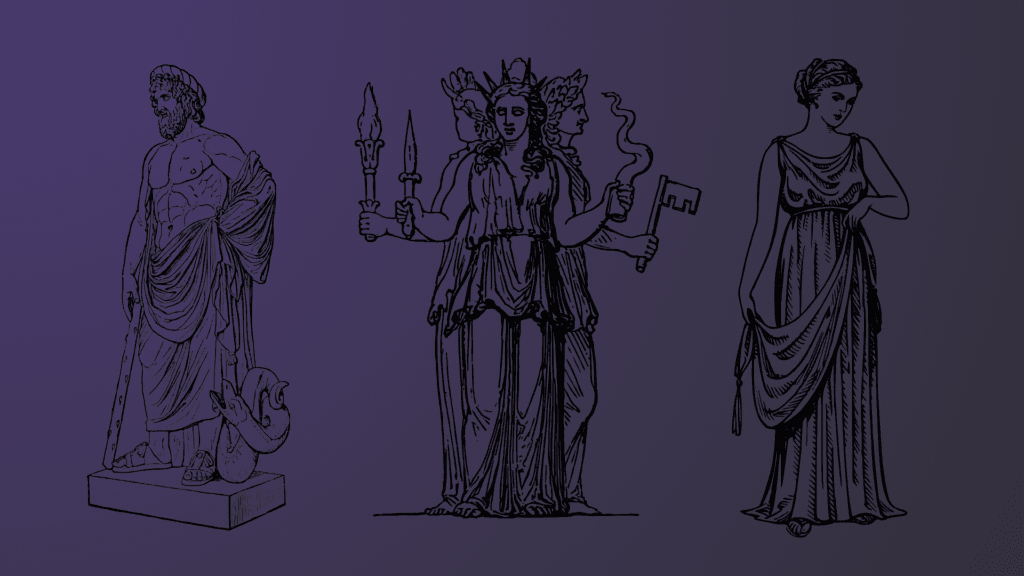
Across every culture and time period humans have sought relationships with beings beyond the physical world. Gods, goddesses, spirits, ancestors and entities of all kinds appear in every spiritual tradition ever documented. Whether you approach these relationships through a religious framework, a magical practice or simple personal curiosity, the principles for doing it well are remarkably consistent: research, respect, patience and honest discernment about what you are actually experiencing.
This guide covers how to begin working with deities and entities, how to maintain those relationships over time and how to recognise when something is not what it claims to be.
Deities, Entities and Angels: What Is the Difference
These three categories overlap in popular usage but they describe meaningfully different kinds of beings.
Deities are gods and goddesses drawn from the world’s mythological and religious traditions. They carry the accumulated devotion, story and cultural context of the traditions they come from. Working with a deity means entering a relationship with a being who has been understood, approached and described across centuries of human experience. That history matters and is worth learning before making contact.
Entities is a broader category that includes spirits, demons, fae, ancestors, egregores and beings that do not fit neatly into any specific theological tradition. Some are benevolent, some are neutral, some are actively hostile and many are simply indifferent to human concerns unless given a reason not to be.
Angels in the biblical tradition are divine servants with specific functions: messengers, warriors, healers and guardians. They operate with literal precision and respond to clarity of intention more than to elaborate ritual. For a complete guide to named biblical angels and how to work with them see Biblical Angels: Names, Roles and How to Work with Them.
For a comprehensive reference covering entities, demons and supernatural beings from mythologies worldwide see The Ultimate Guide to Entities and Demons: Unearthing Myths and Legends.
A complete reference of gods and goddesses across pantheons is available here: Gods and Goddesses: A Complete Guide to Deities Across Mythology.
Before You Make Contact: Research First
The single most common mistake in this work is approaching a deity or entity without knowing anything meaningful about them. Research is not optional preparation, it is the foundation of a respectful and effective relationship.
For deities, learn their mythology. Understand where they come from, which culture they belong to, what role they played in that culture’s understanding of the world and what their known attributes, symbols and preferences are. A deity of death and transformation requires a completely different approach than a deity of love and abundance. Confusing the two is at best ineffective and at worst genuinely disruptive.
Understand the cultural context. Some deities come from living religious traditions where specific protocols exist around how they are approached. Respecting those protocols is both ethically important and practically effective. A deity who has been honored in a particular way for centuries is more readily contacted through familiar forms than through improvised ones.
Know what you are asking for. Deities are not wish-granting machines. They have their own domains, interests and ways of working. A prosperity deity might bring abundance through unexpected paths. A transformation deity might clear away what is holding you back before the new thing can arrive. Understanding the deity’s nature prepares you for how their help actually tends to manifest.
Setting Up for First Contact
You do not need elaborate equipment to make first contact with a deity or entity. You need a dedicated space, a clear intention and a respectful attitude.
Create a physical anchor. An altar, even a very simple one, gives the relationship a physical location. It does not need to be large or expensive. A small shelf with a candle, a representation of the deity whether a statue, an image or a symbolic object and a space for offerings is sufficient to begin. The act of creating this space signals that you are serious about the relationship.
Choose offerings thoughtfully. Offerings are the primary language of this kind of relationship. They demonstrate that you are giving something, not only asking. Research what offerings are traditional or appropriate for the specific deity or entity. Common choices across many traditions include candles, incense, flowers, food, drink and handmade objects, but each being has their own preferences and some are quite specific.
Make your first contact simple. Introduce yourself. State who you are, what drew you to this being and what kind of relationship you are hoping to build. Do not open with a large request. A first contact that is purely an introduction, with no ask attached, establishes a very different tone than one that leads with a petition.
Communication and Signs
Most communication from deities and entities does not arrive as an audible voice or a dramatic vision. It comes through subtler channels that require attention to notice.
Dreams are one of the most consistent forms of communication across traditions. Keep a journal beside your bed and record whatever you remember upon waking, even fragments. Over time patterns emerge that carry meaning specific to the relationship you are building.
Synchronicities are meaningful coincidences that cluster around the deity’s domain. A deity associated with ravens will often make their presence known through repeated raven encounters, in images, in conversation, in the physical world. A deity of the sea might draw your attention through water in unexpected ways. These are not proof of anything but they are worth noting.
Physical sensations during ritual or meditation, warmth, a sense of presence, a shift in the quality of the air or a sudden emotional change, are among the most commonly reported forms of contact. They tend to be subtle and easy to dismiss, which is partly why a journal practice is useful. Patterns become clear over time.
Divination tools such as tarot, oracle cards or pendulums can serve as a communication channel. They work best for specific questions rather than open-ended ones, and the answers they provide should be weighed against everything else you are observing rather than treated as definitive on their own.
Maintaining the Relationship
A relationship with a deity or entity is exactly that, a relationship. It requires consistent engagement, honesty and reciprocity.
Show up regularly. You do not need to perform elaborate rituals daily, but returning to the altar, lighting a candle, making a small offering and spending a few minutes in quiet attention keeps the connection alive. Relationships that are only activated when something is needed tend not to develop depth.
Keep your promises. If you make a vow or commit to an offering in exchange for assistance, follow through. This is perhaps the most consistent piece of advice across every tradition that involves working with supernatural beings. Broken promises damage relationships with deities just as they damage relationships with people.
Express gratitude. Acknowledge when things have gone well, when you have received guidance that proved accurate or when you sense that your requests have been heard. Gratitude is not only good manners. It also keeps your own attention focused on what is working rather than only on what you want.
Be honest about where you are. If you have been neglecting the relationship, acknowledge it directly when you return. If you are confused about what you are experiencing, say so. Deities who are genuinely engaged with a practitioner tend to respond well to honesty and poorly to pretense.
Discernment: Is This What It Claims to Be
Not everything that presents itself during spiritual work is what it says it is. This is one of the most important and least discussed aspects of working with non-physical beings.
Genuine contact with a deity or beneficial entity tends to produce a sense of being seen clearly, a quality of steadiness even when the communication is challenging and results that, when you look back, actually served your genuine wellbeing rather than only your immediate wants.
Red flags worth taking seriously include a being that demands increasingly large offerings or sacrifices, communication that consistently flatters you or tells you exactly what you want to hear, pressure to isolate yourself from other spiritual practices or from people in your life, a sense of compulsion or fear around the relationship and requests that go against your own values or ethical sense.
If something feels wrong, trust that feeling. End the session deliberately, cleanse your space thoroughly and give yourself time before returning to the work. Approaching with discernment is not disrespectful. It is necessary.
When You Want to End the Relationship
Spiritual paths change. A deity or entity that was the right fit at one point in your practice may no longer be. This is normal and does not mean the relationship was wrong or unsuccessful.
End the relationship respectfully and clearly. Return to the altar one final time, thank the being for what the relationship brought and state clearly that you are closing this chapter. Make a final offering if appropriate. Remove their representations from your altar and cleanse the space.
Some traditions suggest waiting a specific period before removing all traces of the relationship to give the energy time to settle. Others recommend an immediate and complete clearing. Follow your own sense of what feels respectful given what you know about the specific being.
Frequently Asked Questions
Do I need to follow a specific religion to work with deities?
No. Many practitioners work with deities from traditions they were not born into, approaching them as living forces rather than through the lens of organised religion. What matters is respect for the cultural and historical context the deity comes from and a genuine investment in the relationship rather than a superficial one.
How do I know which deity or entity is calling to me?
Repeated encounters with a deity’s symbols or animals, dreams involving imagery connected to a specific tradition, a persistent draw toward a particular mythology and a sense of recognition when you first encounter a specific deity’s name or story are all common ways that practitioners describe being drawn to a particular being. Take your time. Research before making contact. The draw tends to persist if it is genuine.
Can I work with deities from multiple pantheons at the same time?
Yes, though it requires attention. Some deities are known to have conflicting energies or historical enmity with each other. Research specific combinations before proceeding and pay attention to whether your practice feels coherent or scattered. Some practitioners work with a single deity deeply for a period before expanding, finding that this builds a stronger foundation than a broad but shallow engagement with many beings simultaneously.
What is the difference between a deity and a spirit?
Deities are gods and goddesses who carry the weight of entire mythological and cultural traditions and who have been worshipped, approached and described across centuries of human experience. Spirits are a broader category including ancestors, nature spirits, place spirits and many other kinds of non-physical beings who tend to operate at a more local or personal level. The distinction matters because the approach, the research required and the nature of the relationship differ significantly between the two.
How long does it take to establish a relationship with a deity?
There is no fixed timeline. Some practitioners report a strong sense of connection from a first encounter. Others build a relationship gradually over months or years before it feels established. Consistency matters more than intensity. Regular small acts of devotion over a long period tend to build deeper relationships than occasional elaborate rituals.
What if I receive no response at all?
No response is itself information. It may mean that the timing is not right, that your approach needs adjustment, that the deity is simply not interested in a relationship with you at this time or that you are not yet in a state to perceive the communication that is happening. Try adjusting your method, deepening your research or working with your altar more consistently for a period before drawing conclusions. Some relationships take time to begin.







[…] she is a goddess of love and she does not require softening. Approach her honestly. The article on working with deities covers how to open that kind of relationship […]
[…] For guidance on how to approach, research and build relationships with these beings see A Guide to Working with Deities and Entities. […]