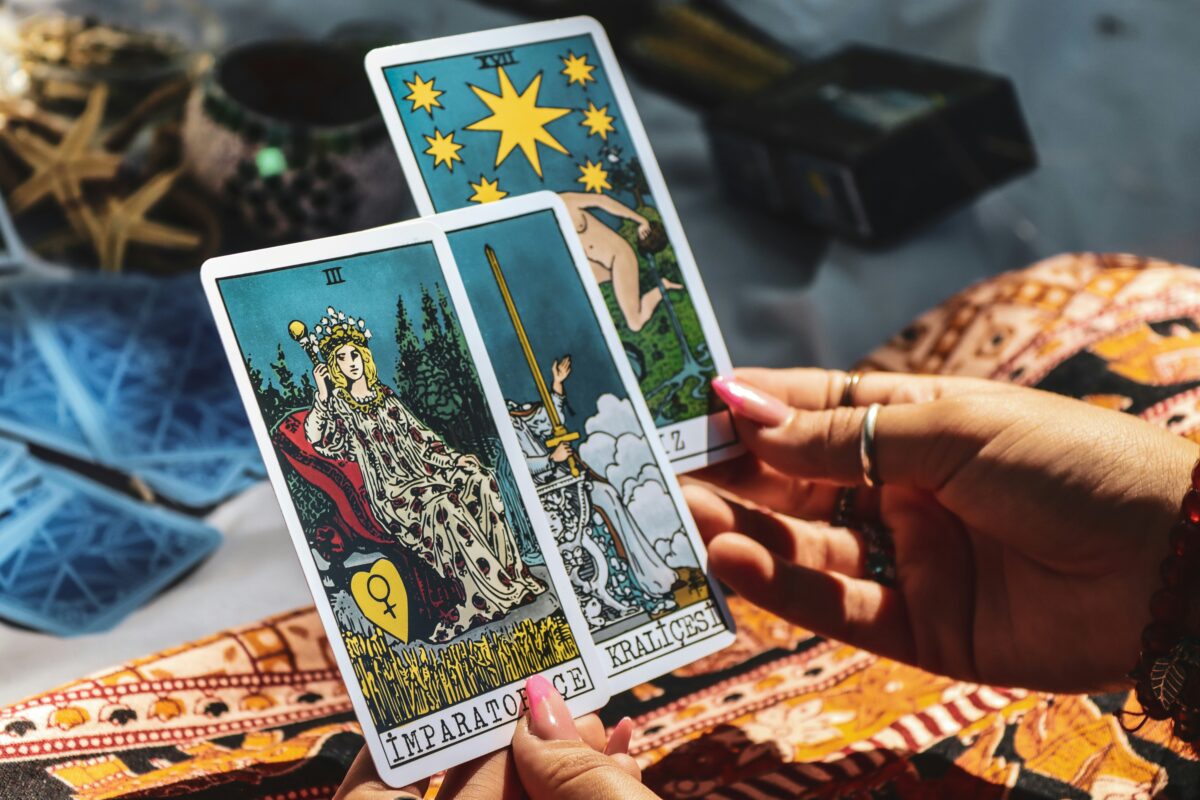
Tarot and alchemy speak the same language: images of death and rebirth, sun and moon, kings and queens, fire and water. Read side by side, the cards can become a map of the alchemical Great Work. In turn, the alchemical stages can deepen the way you read the cards.
This guide brings the two together. It explains how tarot and alchemy became connected, which cards mirror each stage and where alchemical symbols hide in the Rider-Waite-Smith deck. It ends with a full Great Work spread that follows the whole cycle from lead to gold. For the stages themselves, see The Alchemical Stages.
How Tarot and Alchemy Became Connected
Tarot began in 15th-century Italy as a card game. Nothing in its origins was alchemical. The link came later, through the occult revival. In 1781 Antoine Court de Gébelin claimed that the tarot preserved ancient Egyptian wisdom. In the 19th century Éliphas Lévi tied the Major Arcana to the Hebrew alphabet, Kabbalah and Hermetic philosophy.
The Hermetic Order of the Golden Dawn, founded in 1888, then gave every card a planet, a sign or an element. Two of the most influential decks grew out of that tradition. The Rider-Waite-Smith deck was drawn by Pamela Colman Smith under A. E. Waite’s direction and published in 1909. The Thoth deck was painted by Lady Frieda Harris for Aleister Crowley and is the most openly alchemical of them all.
The pairings in this guide are therefore interpretive. They are not historical alchemy. They are a way of reading two symbolic systems that have grown into each other over the past two centuries.
Temperance: The Alchemist’s Card
If one card stands for alchemy as a whole, it is Temperance (XIV). An angel pours liquid from one cup into another, with one foot on land and one in water. Blending, balancing and purifying: the patient work of the alchemist in a single gesture.
In the Thoth deck the card is renamed Art and shows the alchemical work outright. It carries the motto V.I.T.R.I.O.L., short for a Latin phrase usually translated as “visit the interior of the earth; by rectifying you will find the hidden stone.” For anyone reading tarot through alchemy, Temperance is the card of the work itself.
Alchemical Symbols in the Rider-Waite-Smith Deck
Several Rider-Waite-Smith cards carry alchemy openly once you know where to look:
- The Magician (I) has the four elements on his table: the cup, the sword, the wand and the pentacle.
- The Wheel of Fortune (X) carries the alchemical symbols for mercury, sulfur, salt and water on its inner circle.
- Death (XIII) shows a sun rising between two towers in the background: rebirth behind the ending.
- Temperance (XIV) pours between two cups, the alchemical work in one image.
- The Sun (XIX) pairs a child on a white horse with golden sunflowers, the white and the gold side by side.
Tarot Cards for Each Stage
| Stage | Color | Major Arcana | Minor Arcana | Theme |
|---|---|---|---|---|
| Nigredo | Black | Death, The Tower, The Moon, The Devil, The Hanged Man | Five of Cups, Nine of Swords, Ten of Swords | Breakdown and the shadow |
| Albedo | White | The Star, Temperance, The High Priestess | Four of Swords, Six of Swords, Ace of Cups | Washing and reflection |
| Citrinitas | Yellow | The Sun, Strength, The Magician | Ace of Wands, Three of Wands, Page of Wands | Dawn and direction |
| Rubedo | Red | The Lovers, Judgement, The World | Ace of Pentacles, Four of Wands, Ten of Cups | Integration and wholeness |
Nigredo in the Cards
Death and The Tower mark the breakdown, The Moon the confusion of the dark and The Devil the meeting with the shadow. Read more in Nigredo: The Blackening Stage of Alchemy.
Albedo in the Cards
The Star pours healing water after The Tower falls and The High Priestess listens beneath the moon. Read more in Albedo: The Whitening Stage of Alchemy.
Citrinitas in the Cards
The Sun rises, Strength holds the new fire gently and The Magician turns insight into will. Read more in Citrinitas: The Yellowing Stage of Alchemy.
Rubedo in the Cards
The Lovers unite the opposites, Judgement raises the dead and The World completes the circle. Read more in Rubedo: The Reddening Stage of Alchemy.
The Great Work Tarot Spread
This seven-card spread follows the whole alchemical cycle. Use it for a larger life transition or whenever you want to see where you stand in the work.
- Prima materia: the raw material I am working with right now.
- Nigredo: what needs to break down.
- Albedo: what needs to be washed and understood.
- Citrinitas: where my own light is beginning to show.
- Rubedo: what wants to be embodied and lived.
- The stone: what this cycle will give me.
- Mercurius: the hidden helper that makes the transformation possible.
Lay the first six cards in a circle, starting at the bottom and moving clockwise, so that the stone ends up beside the prima materia. Place the seventh card in the center. In alchemy Mercurius was the elusive spirit that carried matter through every stage. Jung saw it as the transforming power of the unconscious itself.
Reading the Spread
Look first at which position holds the strongest card. A Major Arcana card in the nigredo or albedo position often shows where the real work is happening now. Several cards from the same stage family, such as Death and the Ten of Swords together, suggest you are deep in that stage. Reversed cards can point to resistance in that phase of the work. The center card deserves extra time: Mercurius often appears as something you would not expect to be helpful.
A Simpler Three-Card Version
For a quick check-in, draw three cards: what is dissolving (nigredo), what is becoming clear (albedo) and what is ready to be lived (rubedo). This follows the three-stage model that many later alchemists used.
Using Alchemy in Everyday Readings
You do not need a special spread to read alchemically. In any reading, ask which stage the cards seem to describe. Is something breaking down, being washed, dawning or being lived?
Placing a situation in the cycle can change how you read even familiar cards. The Tower in a nigredo reading confirms that a necessary collapse is under way. The Tower in a rubedo reading may warn that something new is being built on old foundations. For more on the inner side of this work, see Alchemy and the Shadow.
Frequently Asked Questions
Is tarot connected to alchemy?
Not originally. Tarot began as a card game in 15th-century Italy. From the late 18th century occultists linked it to Egyptian, Kabbalistic and Hermetic ideas. The Golden Dawn tradition behind the Rider-Waite-Smith and Thoth decks then wove in alchemy directly.
Which tarot card represents alchemy?
Temperance is usually seen as the alchemist’s card. In the Thoth tarot it is called Art and shows the alchemical work directly.
Which tarot cards represent the stages of alchemy?
Nigredo is mirrored by Death, The Tower and The Moon; albedo by The Star and The High Priestess; citrinitas by The Sun and Strength; rubedo by The Lovers, Judgement and The World. These pairings are interpretive rather than historical.
What is the Great Work tarot spread?
It is a seven-card spread that follows the alchemical cycle from prima materia through nigredo, albedo, citrinitas and rubedo to the philosopher’s stone. Mercurius sits at the center as the hidden agent of change.
Photo by dilara irem sancar on Unsplash