

Lilith is one of the most complex and contested figures in the history of religion, mythology and occultism. She appears in ancient Mesopotamian texts as a storm spirit, in Jewish folklore as Adam’s rebellious first wife, in medieval demonology as a child-killing night demon and in modern spirituality as a symbol of female autonomy and shadow work. No single description contains her. She has been feared, demonized, reclaimed and worshipped across three thousand years of cultural history, and none of those responses are wrong. They are all responses to something real in what she represents.
Origins: The Night Spirit of Mesopotamia
Lilith’s earliest traceable roots are in the ancient Near East. Akkadian and Sumerian texts describe a category of spirit called the lilitu or ardat lili, nocturnal entities associated with storms, winds, infertility and predatory sexuality. These were not benevolent beings. They were feared as causes of illness, miscarriage and infant death. The ardat lili in particular was a young female spirit unable to fulfill the social roles expected of women, who therefore preyed on others in compensation.
The etymology of the name Lilith is genuinely debated among scholars. The most common attribution connects her name to the Hebrew word layil, meaning night. A secondary tradition links her to the Akkadian lilitu. Both are plausible and neither is definitively established. What is clear is that by the time she appears in Jewish texts she is associated with darkness, the night and the boundary between the human world and whatever lies beyond it.
A brief but significant mention of Lilith appears in the Hebrew Bible in Isaiah 34:14, where the wilderness of Edom is described as inhabited by lilit, typically translated in older English versions as screech owl or night creature. Whether this refers to a spirit or an actual nocturnal animal is debated, but the association with desolation and danger is consistent with her later mythology.
Adam’s First Wife: The Alphabet of Ben Sira
The version of Lilith’s story most people know today comes from the Alphabet of Ben Sira, a medieval Jewish text dated roughly between the eighth and tenth century CE. This is not an ancient canonical text. It is a folkloric compilation, often satirical and deliberately provocative, and its account of Lilith as Adam’s first wife should be understood in that context.
According to this text, Lilith was created alongside Adam from the same earth, making her his equal by origin. Conflict arose when Adam expected her to adopt a subordinate position. Lilith refused, invoking the equality of their creation, and when Adam pressed the matter she pronounced the ineffable name of God and departed. She left the Garden of Eden not because she was expelled but because she chose to leave.
She went to dwell near the Red Sea, described as a region inhabited by demons. When God sent the angels Senoy, Sansenoy and Semangelof to retrieve her, she refused to return. The consequence was an agreement of sorts: she would not harm children protected by amulets inscribed with the angels’ names. This detail explains the historical use of such amulets in Jewish households, particularly around newborns.
After her departure from Eden she became associated with Samael, a figure in Jewish mysticism with complex roles that include aspects of accusation, destruction and the adversarial. Together they were said to parent demonic offspring. This is not a detail present in ancient sources. It developed through medieval mystical elaboration.
Lilith as a Night Predator
Beyond the Eden narrative, Jewish folklore attributes to Lilith a specific form of nocturnal predation that connects her directly to the incubus and succubus traditions. She was described as coming to men in their sleep, seducing them and draining their vitality. Nocturnal emissions were attributed to her visits. She was said to use the resulting material to produce more demonic children.
This is functionally identical to what Christian demonology would later call the succubus, though Lilith predates that terminology by centuries. The sleep paralysis experiences that most researchers believe gave rise to nocturnal demon legends, specifically the sensation of a presence, pressure and helplessness during waking from sleep, were likely attributed to Lilith in the Jewish tradition just as they were attributed to succubi and incubi in the Christian one.
The protective practices this generated were extensive. Amulets inscribed with the angel names were placed in rooms where women had given birth. Specific prayers and ritual preparations were used before sleep. The fear of Lilith was not abstract. It was woven into practical daily and nightly life.
Her Association with Lucifer
In later Christian occult traditions, Lilith is sometimes described as the consort of Lucifer or Satan. This connection has no firm basis in ancient texts. It appears to have developed through a synthesis of Jewish demonological figures and Christian theological categories during the medieval and early modern period. The pairing amplified both figures: Lucifer’s rebellion from God and Lilith’s rebellion from Adam resonated as parallel narratives, and linking them created a unified mythology of primordial defiance.
This association has been enthusiastically adopted in modern occultism, particularly in left-hand path traditions, where Lilith and Lucifer together represent sovereignty, self-determination and the refusal of imposed order. Whether this is understood as literal theology or as symbolic framework varies by practitioner.
Lilith in Kabbalistic Tradition
In Kabbalistic mysticism, Lilith’s role expands significantly. She becomes associated with the qliphoth, the shadow side of the Kabbalistic tree of life, representing the unprocessed, unintegrated and chaotic forces that exist in opposition to divine emanation. She is sometimes described as ruling the Nahemoth or the shells, the outermost realm of the qliphothic structure.
This Kabbalistic Lilith is not simply a demon. She is a cosmic principle: the force of untamed feminine power that exists outside the structured order, that cannot be integrated into the divine hierarchy and that exerts constant pressure against containment. For shadow work practitioners working within a Kabbalistic framework, engaging with Lilith means engaging with exactly the energy that cannot be politely acknowledged within the normal structures of identity.
Modern Reclamation
The modern spiritual reclamation of Lilith as a feminist icon and empowerment figure emerged primarily in the twentieth century through the convergence of feminist theology, Jungian depth psychology and the revival of goddess-focused spirituality. Rather than reading her exile as punishment, contemporary practitioners read it as liberation. Rather than her demonic aspects being literal, they are understood as the projection of patriarchal anxiety onto female autonomy.
Lilith in this framing is not a threat. She is a mirror for everything that has been denied, suppressed or driven out by the demand for conformity. Working with her energy, in ritual, in shadow work or in meditation, becomes a practice of reclaiming the exiled parts of the self.
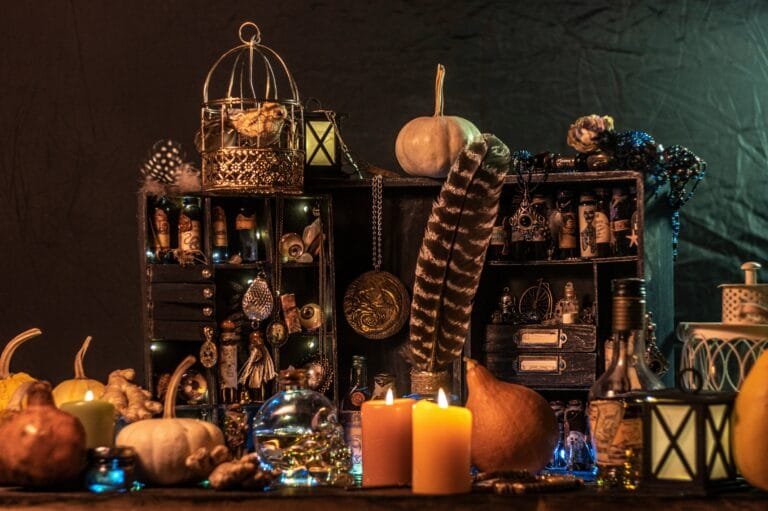
Altars dedicated to Lilith in modern practice often feature imagery of owls and serpents, symbols of wisdom and primal energy associated with her throughout her history. Black candles, crescent moon symbols and night-blooming flowers are common additions. Her connection to shadow work makes her particularly relevant for practices focused on self-integration and the honest examination of suppressed desires and wounds.
Lilith in Popular Culture
Lilith has appeared widely in modern media, though the quality and accuracy of those portrayals varies considerably. In the television series Supernatural, she appears as a powerful demon consistent with her folkloric roots. In Diablo IV, she is presented as the daughter of Mephisto and a ruling demonic figure, drawing on her Kabbalistic associations with the qliphoth more than her Jewish folkloric ones. In True Blood, she is reimagined as the progenitor of vampires.
The Lilith Fair music festival, founded by Sarah McLachlan in 1997, used her name explicitly to signal female creative autonomy and the refusal to be excluded from public space, drawing directly on the Alphabet of Ben Sira narrative of a woman who left rather than submit.
Dante Gabriel Rossetti depicted her in both painting and poetry as a femme fatale, beautiful and dangerous, capturing one strand of her tradition. Contemporary feminist literature has increasingly focused on her as a figure of resistance and self-determination rather than danger.
Frequently Asked Questions
Who is Lilith in the Bible?
Lilith appears once in the canonical Hebrew Bible, in Isaiah 34:14, where the Hebrew word lilit refers to a creature inhabiting a desolate wilderness. The translation varies between screech owl, night creature and night monster depending on the version. Her more developed mythology as Adam’s first wife comes not from the Bible but from the Alphabet of Ben Sira, a medieval Jewish folkloric text from the eighth to tenth century CE.
Is Lilith a demon or a goddess?
She is neither in simple terms. In Jewish tradition she was primarily a dangerous spirit or demon. In Kabbalistic mysticism she became a cosmic principle associated with the qliphoth, the shadow structure of the divine order. In modern feminist spirituality and paganism she is often approached as a goddess or divine feminine principle. Which framing applies depends entirely on the tradition and the practitioner working with her.
What is the connection between Lilith and the succubus?
Lilith is in many ways the original figure from which the succubus tradition derived. Her mythology describes her as coming to men during sleep, seducing them and draining their vitality, which is functionally identical to the Christian succubus. She predates the Latin terminology and the medieval Christian demonological framework but represents the same archetype. The succubus is explored in the succubus.
What does Lilith symbolize in shadow work?
In shadow work, Lilith represents the parts of the self that have been exiled, denied or suppressed because they were judged too powerful, too sexual, too independent or too threatening to the social order. Working with her energy means reclaiming what has been driven out and integrating it rather than continuing to project it outward as a source of shame or fear. Her refusal to submit in the Eden story is the central image: the insistence on wholeness over conformity.
What animals and symbols are associated with Lilith?
Lilith is consistently associated with owls, which appear alongside her in ancient Near Eastern imagery and in the Isaiah passage. Serpents are also a recurring symbol, connecting her to primal wisdom and the transgression of boundaries. The crescent moon, nocturnal flowers and representations of the night sky appear in modern devotional practice. Her Mesopotamian ancestry associates her with storms and winds as well as the night.
How is Lilith connected to astrology?
In astrology, Black Moon Lilith is a calculated point in the birth chart representing the Moon’s apogee, its farthest orbital point from Earth. It is named for Lilith because of its association with the raw, unintegrated aspects of the psyche, the places where rebellion, shame and suppressed desire collect. Its placement in the chart indicates where a person has felt exiled or shamed and where their deepest, most ungovernable power resides. This is explored in full in the Lilith in astrology.







[…] Lilith (Jewish Folklore) […]
[…] If you want to understand where the incubus comes from, Lilith is an essential thread. Her story is explored in depth in the Lilith mythology. […]
[…] For more on Lilith’s mythology and her origins in Jewish and Mesopotamian tradition, see the Lilith mythology. […]