
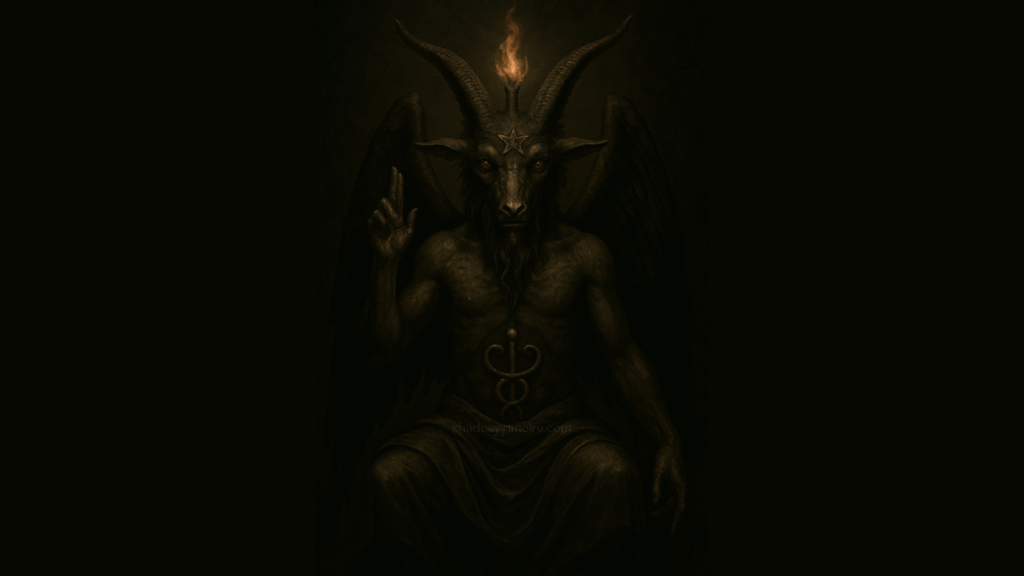
Baphomet is one of the most visually striking and intellectually loaded figures in Western esotericism. The goat-headed, winged, androgynous figure raising one hand to the heavens and lowering the other to the earth has appeared on church walls, in grimoires, in courtrooms and on concert stages. It has been called a demon, a god, a philosophical cipher and a political provocation. Most of those descriptions are projections. The actual history of Baphomet is stranger and more interesting than any of them.
The Templars and the Origin of the Name
The word Baphomet first appears in reliable historical sources in the context of the suppression of the Knights Templar, beginning in 1307. Philip IV of France, deeply indebted to the Templar order and coveting their wealth, orchestrated their arrest and charged them with heresy. Under torture, some Templars confessed to worshipping an idol called Baphomet, described variously as a severed head, a skull, a bearded male face or a cat. The confessions were wildly inconsistent, which is what torture-extracted confessions tend to produce.
Most historians who have examined the Templar trial records in detail regard the Baphomet confessions as politically motivated fabrications. The Templars had no unified doctrine of idol worship. The Order was suppressed, its leaders burned and its assets absorbed. The name Baphomet passed into folklore as a symbol of secret heretical knowledge.
The etymology of the word is genuinely uncertain. The most commonly cited explanation is that it is a corrupted Old French transliteration of Mahomet, meaning Muhammad, which French Crusaders used as a generic term for what they imagined Muslims worshipped. This would make Baphomet not a real entity at all but a slander, the Crusaders’ distorted image of Islamic faith projected onto the Templars as an accusation of apostasy. Other proposed etymologies include a Greek construction meaning baptism of wisdom and the Atbash cipher theory discussed below. None is definitively established.
Eliphas Lévi and the Creation of the Modern Image
The Baphomet that most people recognize today was created by the French occultist Eliphas Lévi in 1856 for his book Dogme et Rituel de la Haute Magie. Lévi did not claim to be reviving a historical image. He was constructing a philosophical emblem, a visual synthesis of what he understood to be the core principles of Hermetic and magical philosophy.
Every element of Lévi’s figure was deliberately chosen. The gesture of the two arms, one raised toward the waxing crescent moon above and one lowered toward the waning crescent below, directly illustrates the Hermetic principle of as above so below. This is not decorative. The arms are a diagram of the principle of correspondence, showing that the same reality manifests at the celestial and material level simultaneously. The full explanation of this principle is in the as above so below article on this site.
The phrase inscribed on the forearms, solve et coagula, dissolve and coagulate, describes the two fundamental movements of alchemical transformation: breaking down existing forms and reconstituting them into something new. The torch between the horns represents enlightenment and the divine intellect. The androgynous body, with female breasts and a male caduceus, represents the reconciliation of the masculine and feminine principles that Hermetic philosophy understood as generative of all creation. The caduceus is the wand of Hermes, the symbol of the tradition from which this entire symbolic language derives. The wings represent spirit, the capacity for transcendence that coexists with the animal nature represented by the goat form.
Lévi was explicit that this figure was not a deity to be worshipped. It was a philosophical diagram in visual form, a comprehensive symbol of the Hermetic worldview.
The Atbash Cipher and the Sophia Theory
One of the more intellectually interesting theories about Baphomet was proposed by biblical scholar Hugh Schonfield in his 1984 book The Essene Odyssey. Schonfield noted that if the name Baphomet is rendered in Hebrew letters and subjected to the Atbash cipher, a Hebrew substitution system in which the first letter of the alphabet is replaced by the last and vice versa, the result is the word Sophia.
Sophia is the Greek word for wisdom and the name of the divine feminine principle in Gnostic cosmology. In Gnostic theology, Sophia is the aspect of divine intelligence that descends into the material world carrying light into darkness, whose eventual return to unity with the divine source represents the redemption of the cosmos.
If the Atbash interpretation is correct, then the name Baphomet is a cipher for divine wisdom deliberately hidden in a form that would escape casual detection. This reframes the entire figure: not a demon or an idol but an encrypted symbol of the Gnostic feminine principle. The theory is intriguing and has been seriously discussed by scholars but remains speculative. It requires that the original users of the word were encoding it deliberately in Hebrew using a specific cipher, which is possible but not demonstrated.
Baphomet, Pan and the Goat of Mendes
The goat form of Baphomet invites comparison with other goat-associated figures. Understanding the differences clarifies what Baphomet actually represents.
Pan is the Greek deity of the wild, of flocks and of instinctual nature. Half-goat and half-man, he is associated with music, fertility and the untamed aspects of the natural world. Pan represents the principle of wild nature within the human, the part that cannot be domesticated. He shares visual features with Baphomet but not symbolic content. Pan is not a symbol of philosophical balance or the reconciliation of opposites. He is a deity of one pole.
The Christian Devil borrowed extensively from Pan in his medieval iconography, incorporating the goat features, the cloven hooves and the association with lust and the body as part of the theological project of demonizing pre-Christian nature worship. This is the primary reason why goat imagery became associated with evil in the Christian imagination and the root of the persistent confusion between Baphomet and Satan.
Baphomet as Lévi designed it explicitly represents both poles held in equilibrium: the animal and the spiritual, the material and the celestial, the masculine and the feminine. This insistence on holding opposites together distinguishes it from Pan (purely natural), the Devil (purely condemned) or any straightforwardly divine figure (purely transcendent).
The Sigil of Baphomet and the Church of Satan
In 1966 Anton LaVey founded the Church of Satan and adopted as its primary symbol the Sigil of Baphomet: a goat’s head within an inverted pentagram enclosed in two circles, with the Hebrew letters spelling Leviathan at the five points. This symbol is distinct from Lévi’s figure though it clearly derives its goat imagery from the same tradition.
LaVeyan Satanism is a materialist philosophy centered on individualism and the rejection of supernatural religion. It is not theistic and does not worship Satan or any other entity. For LaVey, Satan was a symbol of carnality and self-assertion. The Baphomet connection reinforced the association between the goat and the flesh, between the rejected and the reclaimed.
The Satanic Temple, founded in 2013 and philosophically distinct from LaVey’s organization, commissioned a bronze Baphomet statue that became internationally known when they proposed installing it beside a Ten Commandments monument in Oklahoma in 2015. Their use of Baphomet is primarily political: the figure represents religious plurality and the separation of church and state. Their statue has a child at each knee looking up with wonder rather than fear.
Baphomet and Alchemy
The solve et coagula on Lévi’s Baphomet encodes the central dynamic of alchemical transformation. Solve, dissolve: the breaking down of existing forms, the reduction to first matter, the nigredo of the alchemical process. Coagula, coagulate: the reconstitution of what has been dissolved into a new and more refined form, the albedo and rubedo.
The Baphomet figure holds both arms extended simultaneously, suggesting that solve and coagula are not sequential but concurrent, that dissolution and reconstitution are happening at different levels of the same unified process at the same time. The figure as a whole represents the completed alchemical work: the being who has undergone the full process of transformation and holds all opposites in conscious integration.
The full alchemical context is in the alchemy history and philosophy article on this site. The stages of inner transformation the alchemical process maps are covered in the alchemy and shadow work article on this site.
Baphomet and Shadow Work
The Baphomet figure is one of the most direct visual representations of the core insight of shadow work: that integration requires holding what has been rejected rather than continuing to suppress it.
The figure does not resolve the tension between its opposites. It holds them. The animal and the divine coexist in the same form. The male and female principles are present simultaneously. The material and the celestial are both indicated by the gesture of the arms. Nothing has been purified away. Nothing has been elevated at the expense of its opposite. The wholeness the figure represents is achieved by inclusion rather than exclusion.
This is exactly the orientation that shadow work requires. The goal is not to become purely light, to eliminate difficult qualities or to transcend the animal nature. The goal is integration: becoming someone who can carry the full range of what they are without splitting off the parts that are inconvenient, shameful or threatening. The Hermetic philosophical framework that gives Baphomet its content is explored in the Hermeticism article on this site.
Baphomet in Modern Occult Practice
Contemporary practitioners engage with Baphomet in several distinct ways depending on their tradition and intent.
In ceremonial magic traditions working within Thelemic or Golden Dawn frameworks, Baphomet appears as a symbol of the magical self, the initiated identity that has undergone transformation and holds its opposites consciously. Crowley used Baphomet as his magical name within the Ordo Templi Orientis, understanding it as a symbol of the divine masculine reconciled with the divine feminine through the alchemical work.
In traditional witchcraft and some left-hand path practice, Baphomet is approached as an actual entity or divine principle rather than purely as a symbol, engaged through invocation and ritual. The philosophical content of the symbol is understood as pointing toward a genuine presence rather than being merely conceptual.
In shadow work and esoteric visual practice, Baphomet functions as a contemplative image: a representation of the integrated state toward which the work moves, held in mind as an orientation.
Frequently Asked Questions
What is Baphomet?
Baphomet is a figure whose modern form was created by the French occultist Eliphas Lévi in 1856 as a philosophical symbol representing the reconciliation of opposites: above and below, male and female, matter and spirit, animal and divine. The name appears earlier in connection with the suppression of the Knights Templar in 1307, but the goat-headed figure most people recognize was Lévi’s original creation, a deliberately constructed emblem of Hermetic philosophy rather than a historical demon or ancient deity.
Is Baphomet the same as Satan?
No. Baphomet as designed by Lévi was an explicitly philosophical symbol with no theological identity as an evil being. The confusion arises from the goat imagery, which Christian iconography borrowed from Pan and associated with the Devil, and from Anton LaVey’s adoption of the Sigil of Baphomet as the symbol of the Church of Satan in 1966. LaVeyan Satanism is itself a materialist philosophy rather than devil worship. The conflation of Baphomet with Satan reflects the history of how goat imagery was demonized in Christian tradition rather than anything inherent in Lévi’s symbol.
What does the gesture of Baphomet mean?
The gesture of one arm raised and one arm lowered directly illustrates the Hermetic principle of as above so below: the same laws operate at the celestial level above and the material level below simultaneously. The words solve and coagula inscribed on the forearms describe the two fundamental movements of alchemical transformation: dissolution and reconstitution. Together the gesture and the inscription say that transformation operates simultaneously at both levels through these two concurrent movements.
What does solve et coagula mean?
Solve et coagula is Latin for dissolve and coagulate. It describes the two fundamental movements of alchemical transformation: the breaking down of existing forms and the reconstitution of what has been dissolved into something new. In shadow work terms, solve corresponds to the nigredo, the confrontation with and dissolution of false self-structures. Coagula corresponds to the albedo and rubedo, the gradual integration of what was dissolved into a more complete and honest sense of self.
What is the Atbash cipher theory about Baphomet?
Scholar Hugh Schonfield proposed in 1984 that the name Baphomet, rendered in Hebrew and subjected to the Atbash cipher, decodes to the word Sophia, the Greek term for wisdom and a central figure in Gnostic cosmology representing divine feminine intelligence. If correct, this would suggest Baphomet was originally an encrypted reference to divine wisdom rather than a demon. The theory is seriously discussed but remains speculative and unproven.
How is Baphomet connected to shadow work?
The Baphomet figure represents integration rather than purification: the conscious holding of opposites rather than the elevation of one pole at the expense of the other. This makes it a useful symbol for shadow work, which moves toward integrating rejected or suppressed material into a more complete sense of self rather than eliminating difficult qualities. Baphomet as a meditational image offers a visual representation of the integrated state that shadow work moves toward.





[…] For an in-depth exploration of Baphomet’s symbolism and history, see our article: Baphomet: Occult Symbol, Misunderstood Entity or Mirror of Human Duality? […]
[…] Baphomet (Occultism) […]
[…] The solve et coagula inscribed on the arms describes the two fundamental movements of transformation in alchemical practice. Solve: break down, dissolve, reduce to first matter. Coagula: bring together, condense, allow a new form to crystallize from what was dissolved. The gesture and the inscription together say that the same process of dissolution and reformation operates at the celestial level above and the material level below simultaneously. The full history and symbolism of the figure is explored in the Baphomet article on this site. […]