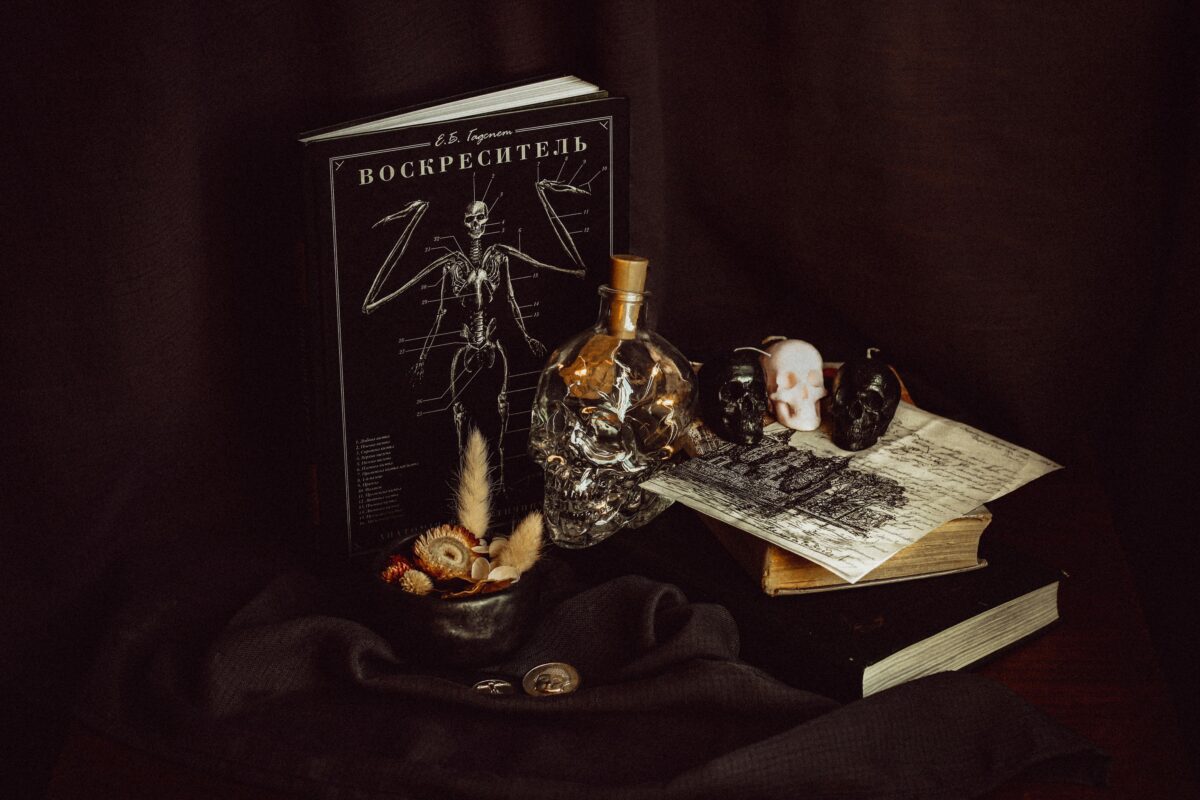
Alchemy is one of the most misread traditions in Western history. The standard story reduces it to a failed attempt at making gold, a prescientific embarrassment that chemistry eventually replaced. That story is wrong in almost every particular.
Alchemy was a sophisticated and internally consistent tradition that operated on two levels simultaneously for most of its history. At the material level, alchemists worked with real substances in real laboratories and produced real results: distillation techniques, acid synthesis, early pharmacology and metallurgical processes that passed directly into modern chemistry. At the symbolic and spiritual level, the same work was understood as a map of inner transformation, the purification of the practitioner in parallel with the purification of matter. These two levels were not separate projects. They were understood as expressions of the same underlying reality.
The history of alchemy spans more than two thousand years, crosses three major civilizations and culminates in the twentieth century in Jung’s psychological reinterpretation of the entire tradition. This is that history.
The Word and Its Origins
The word alchemy comes to English through Arabic. Al-kimiya was the Arabic term, itself borrowed from the late Greek khemeia or khumeia. The Greek root is disputed. Zosimos of Panopolis, writing around 300 CE, derived it from the name of a book, the Khemeu. Others have traced it to the Egyptian word keme, meaning black earth, referring to the fertile soil of the Nile. A third possibility is that it derived from the Greek word for metal casting.
The Egyptian connection is significant. The black earth etymology links alchemy directly to the Nile valley, where the tradition’s earliest practical roots appear to lie. Alchemical writers from Zosimos onward consistently associated Egypt with the origins of the art.
Alexandria: Where Alchemy Began
The oldest clearly identifiable alchemical tradition emerged in Hellenistic Alexandria during the first few centuries of the common era. Alexandria was precisely the right place for it: a city where Egyptian craft knowledge, Greek philosophical tradition and Near Eastern religious practice met and mixed.
The earliest surviving alchemical documents are the Stockholm Papyrus and the Leyden Papyrus, both dating to around 250 to 300 CE and both discovered in Egypt. They contain practical recipes for dyeing, manufacturing artificial gemstones and producing imitation gold and silver. They lack the mystical dimension of later alchemy but show the craft tradition from which the art developed.
Maria the Jewess is the first named alchemist of whom any record survives. Working probably in the first to third century CE, she is credited with inventing several pieces of laboratory apparatus still in use today, including the bain-marie, the water bath used in chemistry and cooking alike and the tribikos, an early distillation device. Her maxim, that one becomes two and two becomes three and out of the third comes the one as the fourth, became a central alchemical principle and was interpreted for centuries as a description of the structure of transformation itself.
Zosimos of Panopolis, working around 300 CE, is the earliest alchemist whose texts survive in significant quantity. He is also the first to articulate the inner dimension of the work explicitly. His writings blend practical laboratory instructions with visionary experiences and Gnostic mysticism. He describes visions of divine beings teaching the sacred art and frames alchemical work as a form of spiritual discipline aimed at the purification of the soul. The material and the interior were already inseparable in the oldest surviving sources.
In 292 CE the Roman emperor Diocletian, suppressing a revolt in Egypt, ordered all alchemical books burned. Most early Egyptian alchemical texts were lost. What survived were fragments preserved by later copyists and the texts that had already made their way to other parts of the Mediterranean world.
The Islamic Transmission
When the Arab forces took Alexandria in 641 CE, they inherited the intellectual legacy of the city including its alchemical manuscripts. In the fifth century, Nestorian Christian scholars fleeing persecution had already carried Greek philosophical and scientific texts eastward into Persia, translating them from Greek into Syriac Aramaic and later into Arabic. By the time of the Islamic Golden Age, alchemical knowledge had been preserved and was actively being expanded.
Jabir ibn Hayyan, known in the Latin West as Geber, was the central figure of Islamic alchemy. Working in the eighth century, he introduced a systematic experimental methodology that genuinely anticipates the scientific method. He classified substances into spirits (volatiles such as mercury and sulfur), metals and stones. He developed the mercury-sulfur theory of metals, which held that all metals are composed of these two principles in different proportions: sulfur supplying the combustible quality and mercury the metallic luster. This theory shaped European alchemy for the next six centuries and directly informed how lead, mercury and the other metals were understood in magical and alchemical practice.
Jabir’s view of alchemy was explicitly not limited to the material. He understood it as a spiritual and moral pursuit, the pursuit of understanding through disciplined practice. His writings synthesized Greek philosophy, Islamic theology and practical experimentation into a single framework.
Al-Razi, the Persian physician working in the ninth and tenth centuries, developed distillation processes, classified minerals systematically and insisted on empirical observation over theoretical authority. His approach to chemistry was more skeptical and more rigorously material than Jabir’s but his innovations in laboratory technique passed directly into both Islamic medicine and later European chemistry.
The Medieval European Tradition
Alchemical texts entered Europe through two main routes in the twelfth and thirteenth centuries: through Toledo in Spain, where the translation movement rendered Arabic texts into Latin and through Sicily, where Arab and Norman scholars worked in close proximity. The texts that arrived included Jabir’s works, Aristotle’s natural philosophy and the Turba Philosophorum, one of the earliest Latin collections to present the alchemical stages in terms of color and transformation.
Roger Bacon, the thirteenth century English friar, was among the first European intellectuals to take alchemy seriously as an experimental discipline. He argued that understanding nature required empirical investigation rather than pure authority and saw alchemical practice as part of a broader project of natural philosophy. He was also one of the first Europeans to speculate about the philosopher’s stone in terms that included its spiritual dimension.
Thomas Aquinas engaged with alchemy in his theological writings and the question of whether alchemically produced gold was genuine gold occupied serious medieval scholastic attention. The debate reflects how seriously the tradition was taken.
The Rosarium Philosophorum, the Rosary of the Philosophers, was compiled during this period and first circulated in manuscript. It is the text most directly associated with the four-stage color sequence of alchemical transformation. A collection of quotations and teachings from authorities including Hermes, Jabir and Arnaldus de Villanova organized into a symbolic framework illustrated with woodcuts, it would become the text that Jung worked with most intensively six hundred years later.
Paracelsus and the Reformation of Alchemy
Theophrastus von Hohenheim, who took the name Paracelsus, is the pivotal figure of the European Renaissance tradition. Working in the early sixteenth century, he rejected the dominant medical theory of his time, which was based on the four humors and proposed that illness had specific chemical causes with specific chemical remedies. This was the beginning of pharmacology.
Paracelsus extended Jabir’s mercury-sulfur theory by adding a third principle: salt, representing the body, the fixed and the grounded. Mercury represented the spirit, volatile and mutable. Sulfur represented the soul, the animating principle between. This tria prima (three primes) became the central theoretical framework of Paracelsian alchemy and influenced European medicine and natural philosophy for over a century.
He was also explicit that the material work and the inner work could not be separated. The goal of alchemy was not wealth but wisdom: the understanding of nature and the self as part of nature. A physician who had not undergone inner transformation could not practice medicine well because the inner and outer were the same reality viewed from different angles.
The Splendor Solis, an illuminated manuscript produced around 1532 and attributed to Salomon Trismosin, belongs to this period. Its elaborate sequence of paintings depicting the solar king, the lunar queen and their transformation through the alchemical stages is among the richest visual documentation of the tradition.
Isaac Newton’s Secret Work
Isaac Newton is remembered as the founder of modern physics. He spent more time on alchemy than on any other subject.
Newton’s alchemical notebooks, which he kept hidden and which were not seriously studied until the twentieth century, run to more than a million words. He was not pursuing gold. He was pursuing what he called the secret fire, the active principle underlying matter, which he believed the ancient tradition preserved in coded form. His understanding of gravity as action at a distance, a force operating through empty space, was partly shaped by his alchemical thinking about hidden active powers operating through matter.
Newton worked extensively with mercury and lead in his laboratory. Both appear throughout his alchemical notebooks as central substances in the Great Work. His interest in the philosopher’s stone was genuine and serious, not peripheral. He approached the alchemical texts as encrypted records of real knowledge about how nature operated at its most fundamental level.
Newton represents the final phase of alchemy as a unified tradition. Within a generation of his death, chemistry and alchemy had definitively separated. Lavoisier’s identification of oxygen in the 1770s and the development of atomic theory in the early nineteenth century established chemistry on an entirely different foundation. Alchemy’s material program was abandoned. Its symbolic and spiritual dimension went underground.
Carl Jung and the Psychological Rediscovery
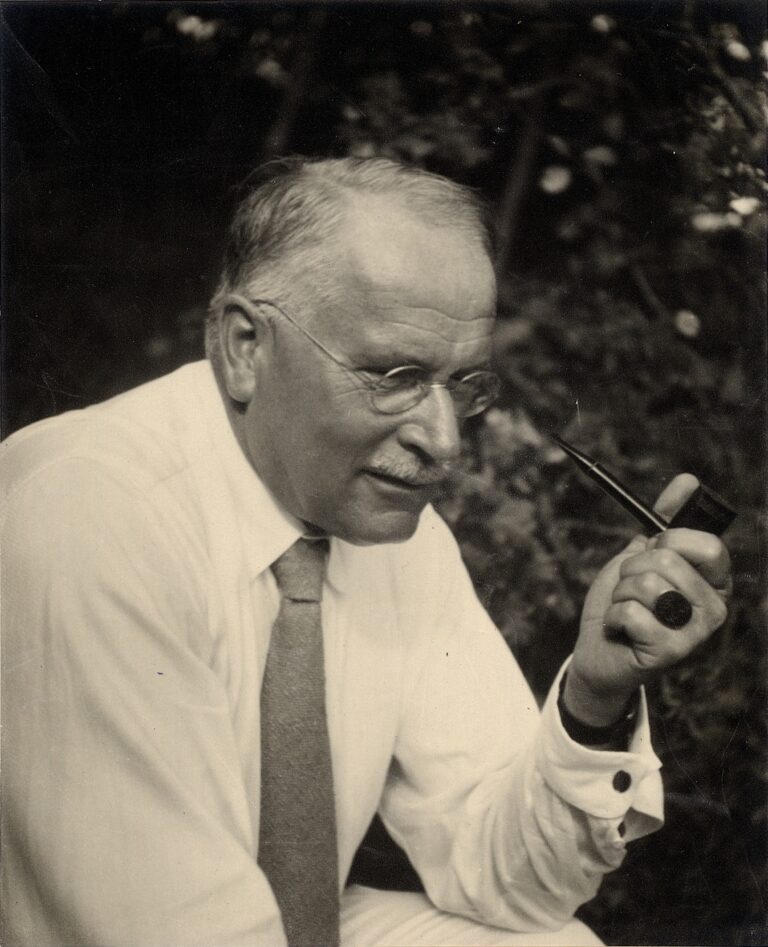
Carl Jung encountered the alchemical tradition in the 1920s through the work of historian Herbert Silberer, who had proposed a psychological interpretation of alchemical symbols. Jung was initially skeptical. Then he began reading the texts directly.
What he found transformed his understanding of the psyche. The alchemists, Jung concluded, had not been failed chemists. They had been projecting the inner world onto matter, describing in the symbolic language of laboratory work the same processes he was observing in his patients’ dreams and psychological development. The centuries of accumulated alchemical imagery constituted an extraordinarily rich symbolic vocabulary for inner transformation that no modern psychological framework had developed.
Jung spent over a decade tracking down manuscripts, having them translated and working through their imagery before publishing Psychology and Alchemy in 1944. He followed it with Mysterium Coniunctionis in 1955, a detailed analysis of the coniunctio, the union of opposites that the alchemical tradition placed at the center of the Great Work.
His key insights were these. The nigredo, the blackening that begins the alchemical process, corresponds to the confrontation with the shadow: the encounter with what has been denied and suppressed. The albedo, the whitening, corresponds to the emergence of self-awareness and the making conscious of what was unconscious. The rubedo, the reddening and completion, corresponds to individuation: the integration of all parts of the self into a functioning whole.
Mercury appeared throughout Jung’s alchemical studies as the symbol of the unconscious itself: volatile, shape-shifting, impossible to fix in place, the substance that makes transformation possible. Lead appeared as the prima materia, the starting point, the heaviest and most Saturnine of metals, the raw material of the Great Work before transformation begins.
Both metals carry these associations into the magical and witchcraft traditions that work with them today.
The Seven Sacred Metals and Alchemy
The alchemical tradition assigned each of the seven classical planets a corresponding metal and understood these correspondences as real: the planet and the metal were different expressions of the same underlying principle.
Saturn governed lead: heavy, slow, associated with time, limitation and the confrontation with mortality. Lead was the prima materia in many traditions, the starting point from which the Great Work begins.
Mercury governed mercury: volatile, shape-shifting, the spirit of transformation itself. Mercury as a metal is literally liquid at room temperature, uniquely fluid among metals, which made it the perfect symbol for the substance that mediates between states.
Venus governed copper: the metal of beauty, desire and creative relationship.
The Sun governed gold: the completion of the Great Work, the philosopher’s stone in material form.
The Moon governed silver: the metal of reflection, intuition and the albedo stage.
Mars governed iron: the metal of will, force and the working of change.
Jupiter governed tin: the metal of expansion, abundance and the ripening of potential.
These correspondences are active in contemporary magical practice. Understanding their alchemical origins gives them a depth and coherence that purely symbolic use lacks.
What Alchemy Actually Contributed
The separation of alchemy from chemistry in the eighteenth century obscured how much modern science owes to the alchemical tradition.
Distillation was developed and refined by alchemists. Jabir ibn Hayyan’s laboratory techniques for separating volatile from fixed substances passed directly into pharmaceutical production. The preparation of acids, including sulfuric acid, nitric acid and hydrochloric acid, was first achieved by alchemists. Early metallurgy, including processes for refining and working gold, silver, copper and lead, developed within alchemical practice. The systematic classification of substances into categories based on their properties, which became the foundation of chemistry, was first attempted by Jabir.
Alchemy also contributed to medicine. Paracelsus’s insight that specific illnesses require specific chemical treatments, not general humoral rebalancing, was genuinely revolutionary. His use of mercury compounds to treat syphilis, though toxic by modern standards, represented the first targeted chemical treatment of an infectious disease.
And alchemy contributed to psychology. Jung’s engagement with the tradition produced his most sophisticated theoretical work and gave psychological thought a symbolic vocabulary for inner transformation that remains unmatched in its richness.
Frequently Asked Questions
What is the history of alchemy in brief?
Alchemy emerged in Hellenistic Alexandria around the first to third centuries CE at the intersection of Egyptian craft tradition, Greek philosophy and Near Eastern spiritual practice. It passed into the Islamic world in the seventh and eighth centuries, where Jabir ibn Hayyan systematized it and introduced experimental methodology. It entered Europe through Latin translations in the twelfth and thirteenth centuries and reached its European peak in the Renaissance with Paracelsus. Isaac Newton spent more time on alchemical study than on any other subject. Carl Jung rediscovered the tradition in the twentieth century and interpreted it as a symbolic map of psychological transformation.
Who were the most important alchemists in history?
Maria the Jewess was the first named alchemist, inventor of the bain-marie and foundational laboratory apparatus. Zosimos of Panopolis was the earliest whose texts survive in quantity and the first to articulate the inner dimension of the work explicitly. Jabir ibn Hayyan systematized alchemical practice and introduced experimental methodology in the eighth century. Paracelsus reformed European alchemy in the sixteenth century and founded pharmacology. Isaac Newton spent decades on alchemical study alongside his physics. Carl Jung translated the entire symbolic tradition into psychological terms in the twentieth century.
What did alchemists actually discover?
Alchemists developed distillation techniques still in use today, synthesized the mineral acids including sulfuric and nitric acid, advanced metallurgy and mining technology, pioneered early pharmacology and produced the first targeted chemical treatments for disease. Paracelsus’s insistence that specific illnesses have specific chemical remedies was the foundation of modern medicine. The laboratory apparatus invented by Maria the Jewess remains in use in modified form. Much of what alchemists did was real experimental chemistry conducted within a symbolic and spiritual framework.
What is the philosopher’s stone?
The philosopher’s stone was the legendary product of the Great Work: a substance that could transmute base metals into gold and produce an elixir of life. For many alchemists this was understood as a literal material goal. For others it was always primarily symbolic: the completed inner transformation that allows continuous further transformation. Jung identified it with the individuated self, the capacity for ongoing self-knowledge and self-renewal that becomes available after genuine shadow work has been done.
How does alchemy connect to Jung’s psychology?
Jung spent over a decade studying alchemical manuscripts before concluding that the alchemists had been unconsciously projecting psychological processes onto matter. The stages of the alchemical work correspond precisely to the phases of individuation: nigredo to the confrontation with the shadow, albedo to the making conscious of the unconscious and rubedo to the integration of all parts of the self into a functioning whole. Jung named his final major work Mysterium Coniunctionis after the alchemical union of opposites that he considered the central symbol of the entire tradition.
What is the difference between alchemy and chemistry?
Alchemy operated on two levels simultaneously: material experimentation with real substances and symbolic spiritual practice aimed at the transformation of the practitioner. Modern chemistry separated from alchemy in the eighteenth century by retaining the material dimension and discarding the symbolic and spiritual one. The separation was productive for science but meant the loss of a sophisticated understanding of how inner and outer transformation relate. Many of the practical techniques chemistry uses were first developed within the alchemical tradition.
Further Reading
The Art of Modern Alchemy: Practices for Spiritual Transformation
Alchemy and the Shadow: The Ancient Map of Inner Transformation
Mercury: The Alchemist’s Metal in Magic and Tradition
Lead in Witchcraft: Saturn’s Metal, the Binding Curse and the Weight of Transformation
Hermeticism: Principles, History and Practice
Photo by Nastia Petruk on Unsplash