
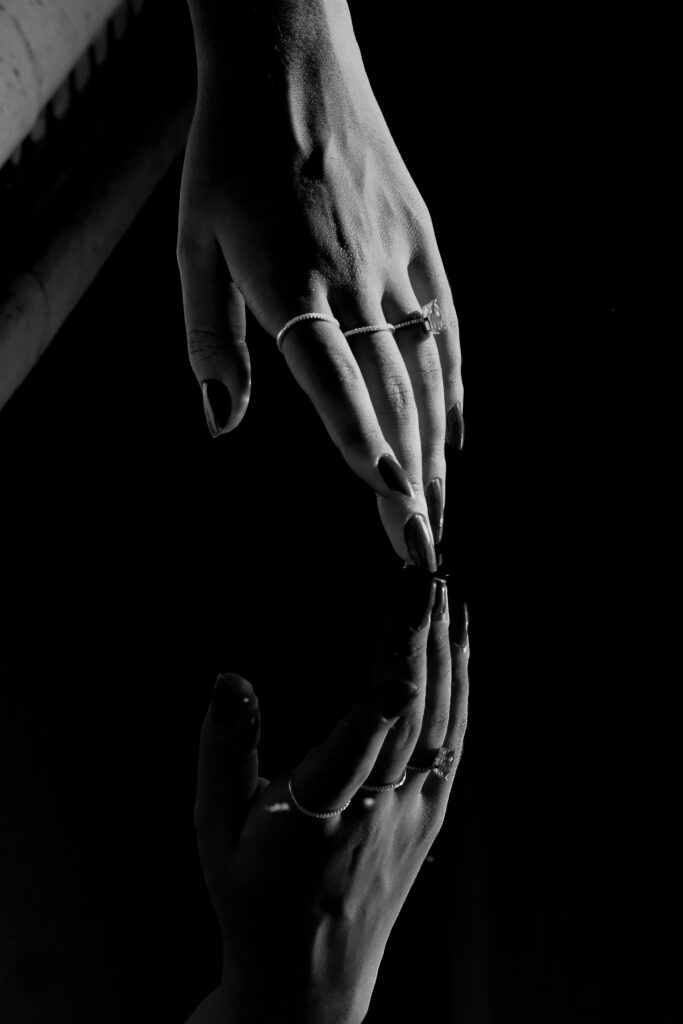
Few phrases in the history of Western occultism have traveled further or been misunderstood more completely than “as above, so below.” It appears on tattoos and album covers, in witchcraft rituals and physics lectures, in Renaissance alchemy texts and modern astrology apps. Most people who use it know it means something about connection, something about the universe reflecting itself in the individual. That instinct is correct, but the full depth of what the phrase means and why it became the cornerstone of an entire magical tradition is something else entirely.
This is the idea that unlocked alchemy, gave astrology its philosophical foundation and gave practitioners of magic a framework for understanding exactly how and why ritual works.
What As Above So Below Actually Means
The phrase originates in the Emerald Tablet, known in Latin as the Tabula Smaragdina. This is one of the most influential texts in the history of Western esotericism, and also one of the shortest. The entire document is roughly a dozen lines. Its attributed author is Hermes Trismegistus, a legendary figure who merged the Egyptian god Thoth with the Greek god Hermes, embodying the synthesis of Egyptian and Greek wisdom traditions.
The relevant passage reads, in the most commonly cited Latin translation: “Quod est inferius est sicut quod est superius, et quod est superius est sicut quod est inferius.” What is below is like what is above, and what is above is like what is below, to accomplish the miracles of the one thing.
The dating of the Emerald Tablet is genuinely uncertain. The earliest known Arabic versions appear in texts from around the eighth century CE, though the content draws on older Hellenistic and Egyptian sources. Hugo of Santalla translated it into Latin in the twelfth century, which is when it entered the European esoteric mainstream.
The phrase “as above, so below” is a modern compression of the original. It is accurate as a summary but strips away the crucial phrase that follows: to accomplish the miracles of the one thing. That suffix is not decorative. It tells you what the principle is for. This is not merely a philosophical observation about the nature of reality. It is an operational statement about how magic works.
The Hermetic worldview understood the universe as a single unified system operating at multiple levels simultaneously. The divine realm, the celestial realm and the material realm are not three separate worlds. They are three expressions of the same underlying reality, each reflecting the structure and laws of the others. This is the principle of correspondence, the second of the seven Hermetic principles systematized in The Kybalion (1908). If the macrocosm and the microcosm are structured by the same laws, then influencing one genuinely affects the other. This is the philosophical architecture underneath every form of sympathetic magic, every astrological reading and every ritual that works with planetary timing.
As Above So Below in the Emerald Tablet and Alchemy
Medieval and Renaissance alchemists treated the Emerald Tablet as a manual for their work and the principle of correspondence was central to how they understood both the physical and spiritual dimensions of alchemical practice.
The alchemical process of transmutation operated on two levels simultaneously. On the material level it was a genuine experimental practice. On the spiritual level it was a metaphor for the purification of the soul. These were not separate projects. They were the same project at different levels of the same unified reality, which is exactly what the Emerald Tablet describes.
Paracelsus (1493–1541) developed an entire medical and philosophical system around this principle. He argued that the human body was a microcosm of the universe, that each planet corresponded to a specific organ, each metal to a specific planetary influence and each illness to a disruption of correspondence between the human system and the cosmic one. His system assigned Saturn to the spleen and bones, Jupiter to the liver, Mars to the gallbladder, the Sun to the heart, Venus to the kidneys, Mercury to the lungs and the Moon to the brain. Treatment meant restoring the correspondence between the afflicted organ and its governing planetary principle using alchemically prepared substances.
Cornelius Agrippa’s Three Books of Occult Philosophy (1531) systematized the correspondences between the celestial and material worlds in extraordinary detail. Every plant, metal, stone, color, number and time of day was mapped onto a planetary influence, operating on the premise that the same laws governing the heavens also govern every material thing. Agrippa’s correspondence tables remain one of the most comprehensive practical resources in the Western magical tradition.
Isaac Newton spent a significant portion of his intellectual life studying alchemy and Hermetic philosophy. His personal annotated copy of the Emerald Tablet survives in the Keynes Collection at King’s College Cambridge. The same mind that formalized the laws of gravity was genuinely occupied with whether the principle of correspondence described something real about the structure of the universe.
The complete story of how this principle shaped the alchemical tradition is covered in the alchemy history and philosophy.
As Above So Below and Baphomet
One of the most recognizable visual representations of the as above so below principle is the Baphomet figure drawn by the French occultist Eliphas Lévi in 1856 for his work Dogme et Rituel de la Haute Magie. In Lévi’s illustration, Baphomet raises one arm upward and lowers one arm downward, with the Latin words “solve” (dissolve) and “coagula” (coagulate) inscribed on the forearms. The gesture directly illustrates the Hermetic maxim: the hand pointing above reflects the hand pointing below, and the two alchemical movements of dissolution and coagulation are the same movement at different scales.
Lévi did not invent Baphomet. The name appears in historical records as early as the twelfth century, when the Knights Templar were accused of worshipping an idol by that name during their suppression by Philip IV of France in 1307. Most historians regard those accusations as politically motivated and extracted under torture, with no reliable factual basis. Lévi’s Baphomet is a nineteenth century synthetic image drawing on Hermetic, Kabbalistic and alchemical symbolism to represent the reconciliation of opposites: male and female, light and dark, material and spiritual, above and below.
The solve et coagula inscribed on the arms describes the two fundamental movements of transformation in alchemical practice. Solve: break down, dissolve, reduce to first matter. Coagula: bring together, condense, allow a new form to crystallize from what was dissolved. The gesture and the inscription together say that the same process of dissolution and reformation operates at the celestial level above and the material level below simultaneously. The full history and symbolism of the figure is explored in the Baphomet article on this site.
As Above So Below Tattoo Meaning
The phrase has become one of the most common occult tattoo choices, and understanding what the marking actually encodes is worth exploring.
At its most general, the tattoo represents a personal philosophy of interconnectedness: the belief that internal states and external circumstances reflect each other, that what happens within corresponds to what manifests without and that working on the inner life is the most direct form of working on the outer one. This is Hermeticism applied as a life orientation rather than a ritual practice.
The Baphomet gesture, with one hand pointing up and one pointing down, is the most common visual representation alongside the phrase itself. Some practitioners use the phrase in mirrored text, with “as above” legible normally and “so below” legible only in reflection, encoding the correspondence principle in the physical structure of the design.
For practitioners who use it as a magical marker rather than a philosophical statement, the tattoo functions as a permanent sigil: a constant reminder of and commitment to working with correspondence consciously. In this reading it is not decorative but operative, a seal encoding the Hermetic worldview as a permanent presence on the body.
As Above So Below in the Bible and Christian Tradition
The phrase itself does not appear in the Bible, which is a Hermetic rather than a Biblical text. However, the underlying concept of correspondence between heavenly and earthly realities appears extensively throughout both the Hebrew Bible and the New Testament.
The most direct parallel is in the Lord’s Prayer: “Thy kingdom come, thy will be done on earth as it is in heaven.” This is functionally a statement of the principle of correspondence. What is established above should be manifest below, and prayer is the mechanism by which the human level aligns with the divine level.
The tabernacle described in Exodus was explicitly constructed according to a heavenly pattern shown to Moses: “See that you make everything according to the pattern shown you on the mountain” (Exodus 25:40). The earthly sanctuary was to be a material correspondence of a divine original. This is the same principle in architectural form.
Pseudo-Dionysius the Areopagite, writing in the late fifth century, developed a systematic theology of correspondence between the celestial hierarchy of angels and the ecclesiastical hierarchy of the Church. Understanding the order above illuminated the proper order below. His work was enormously influential in medieval Christian thought and demonstrates that the principle of correspondence was not foreign to Christian theology but was operating within it.
The historical tension between Hermeticism and orthodox Christianity was therefore not primarily about the principle itself but about authority: who had the right to interpret the correspondences and what practical conclusions could be drawn from them.
As Above So Below in Astrology
Astrology is the most visible and continuous application of the as above so below principle in the history of Western thought. The entire premise of astrology is that the movements of celestial bodies correspond to patterns and conditions in human life and in the material world below.
Classical astrology did not understand this correspondence as mechanical causation. The planets do not cause events by emitting forces. The relationship is one of correspondence and synchronicity: events above and events below are expressions of the same underlying pattern at different scales.
The Chaldean Order, the sequence of the seven classical planets used in traditional astrology and magical timing (Saturn, Jupiter, Mars, Sun, Venus, Mercury, Moon), determines both the day rulerships and the planetary hour system that has been used continuously since at least the first century BCE. Each day of the week is named for a planetary ruler: Saturday for Saturn, Sunday for the Sun, Monday for the Moon. Each hour of each day cycles through the planetary sequence in the Chaldean order. Knowing which planet governs the current hour allows the practitioner to align workings with the corresponding quality of cosmic energy: Jupiter hours for expansion, Saturn hours for banishment, Venus hours for love and beauty work.
This is the as above so below principle applied as a practical timing system. The pattern above determines what is available below, and the practitioner who understands the pattern can work with it rather than in ignorance of it.
As Above So Below in Witchcraft and Ritual Magic
In practical witchcraft the principle operates through the use of correspondences: the materials, colors, herbs, crystals and timing that reflect specific celestial qualities. When a practitioner uses rosemary for memory and mental clarity, the logic is Hermetic. Rosemary’s solar and Mercurial correspondence reflects a structural relationship in which the plant’s properties at the material level correspond to a specific quality of energy at the celestial level.
Circle casting enacts the principle directly. The circle represents the whole cosmos, the four directions corresponding to the four elements which in turn correspond to qualities of reality at every level. A properly cast circle is a space where above and below are brought into alignment, where the correspondence between levels becomes actively operative rather than simply present.
Aleister Crowley’s Liber 777 (1909), drawing on the Golden Dawn’s systematic correspondence work, is the most comprehensive modern attempt to map the Hermetic principle in practical magical form. Every column assigns a different category of magical material, from Tarot cards to divine names to perfumes, to its corresponding position on the Kabbalistic Tree of Life and its associated planetary, elemental or zodiacal quality. The underlying logic is always the principle of correspondence: the same pattern operates at every level of reality and knowing the correspondences allows deliberate work with that pattern.
As Above So Below and Shadow Work
The as above so below principle has a dimension directly relevant to shadow work. If the outer world reflects the inner, then what appears in external experience, the patterns that repeat, the relationships that frustrate, the situations that keep arising in different forms, is a correspondence of something in the internal landscape.
This is a practical diagnostic framework rather than a moral judgment. The macrocosm is the world you move through. The microcosm is your internal structure of beliefs, wounds and unconscious patterns. The principle of correspondence predicts exactly what shadow work practitioners observe: the outer world reflects the inner one in forms that can be read and worked with.
Jung’s concept of synchronicity, developed in dialogue with physicist Wolfgang Pauli, is a psychologized version of the same principle. Pauli was deeply interested in Hermetic tradition and the two men corresponded extensively about the relationship between their frameworks. The idea that inner and outer events can correspond meaningfully without being causally connected is the principle of correspondence restated in the language of twentieth century depth psychology.
The alchemical stages of nigredo, albedo and rubedo map the as above so below principle onto the specific territory of inner transformation. The full account is in the alchemy and shadow work.
As Above So Below in Freemasonry and Rosicrucianism
Freemasonry incorporated Hermetic symbolism extensively, particularly in its higher degrees. The temple is the central symbol of Masonic philosophy, representing simultaneously the physical Solomon’s Temple, the cosmos as a whole and the interior of the human soul. The principle that the temple within mirrors the divine architecture above is the as above so below principle in architectural and initiatory form.
The Square and Compasses encode the principle geometrically. The compasses work in the celestial sphere above, the square on the earthly plane below. Their combination represents the Mason’s task: to bring celestial order into material expression.
Rosicrucianism, whose founding manifestos appeared in Germany between 1614 and 1616, placed the Hermetic principle at the center of its worldview. The Rosicrucian philosopher’s stone depends entirely on the premise that material transformation and spiritual transformation are the same operation at different levels of the same unified reality. The full philosophical tradition that underlies all of these movements is explored in the Hermeticism article on this site.
Recommended Books to Go Deeper
These are the texts that serious practitioners and scholars return to when working with the Hermetic principle and its applications.
The Kybalion by the Three Initiates (1908) is the most accessible systematic introduction to the seven Hermetic principles including correspondence. It is a modern text rather than an ancient one, but as an entry point into the framework it is genuinely useful.
Three Books of Occult Philosophy by Cornelius Agrippa (1531, Llewellyn modern edition annotated by Donald Tyson) is the Renaissance masterwork of correspondence tables. It is the source of the detailed planetary and elemental correspondences underlying most subsequent Western magical practice.
The Secret Teachings of All Ages by Manly P. Hall (1928) is encyclopedic in scope and covers Hermeticism, alchemy, astrology and Kabbalah in extraordinary detail. As a reference for understanding how these traditions interconnect it has no real competitor.
Psychology and Alchemy by Carl Jung (1944) is the primary text for understanding the relationship between Hermetic philosophy, alchemical symbolism and depth psychology. It is demanding but repays careful reading.
The Hermetic Tradition by Julius Evola (1931, English translation 1995) is the most rigorous scholarly examination of alchemy as a genuine spiritual discipline. Evola reads the alchemical texts as a precise symbolic description of initiatory transformation and his analysis of the correspondence principle is unusually clear.
Giordano Bruno and the Hermetic Tradition by Frances Yates (1964) is the scholarly foundation for understanding how Hermeticism shaped Renaissance thought and magic. Yates is a historian rather than a practitioner but her analysis of how the principle of correspondence operated within Renaissance natural philosophy is essential.
The Emerald Tablet: Alchemy for Personal Transformation by Dennis William Hauck (1999) bridges historical scholarship and practical application well, tracing the tablet’s transmission across cultures and explaining each section in terms of both its historical meaning and contemporary relevance.
Frequently Asked Questions
What does as above so below mean?
As above so below is the central principle of Hermetic philosophy, originating in the Emerald Tablet attributed to Hermes Trismegistus. It expresses the idea that the same laws and patterns operating at the cosmic or divine level also operate at the material and human level, because all levels of reality arise from the same unified source. In magical practice it means that influencing something at one level through ritual, timing, correspondence or intention genuinely affects its reflection at every other level.
Where does as above so below come from?
The phrase is a condensed version of a line from the Emerald Tablet, a short Hermetic text whose earliest surviving versions are from the eighth century CE in Arabic, though the content draws on older Hellenistic and Egyptian sources. It was translated into Latin in the twelfth century and became foundational to European alchemy and the broader esoteric tradition.
What is the as above so below tattoo meaning?
The tattoo typically represents a commitment to the Hermetic philosophy of correspondence: the belief that internal states and external circumstances reflect each other and that conscious inner work is the most direct form of working on outer reality. The Baphomet gesture with one hand pointing up and one pointing down is the most common visual representation. For some practitioners it functions as a permanent magical sigil encoding the Hermetic worldview as a constant presence on the body.
What does as above so below mean in the Bible?
The phrase does not appear in the Bible, as it comes from the Hermetic Emerald Tablet. However, the principle of correspondence between heavenly and earthly realities appears throughout Biblical thought, most directly in the Lord’s Prayer (“on earth as it is in heaven”) and in Exodus, where the earthly tabernacle is constructed according to a heavenly pattern shown to Moses. Neoplatonist Christian theologians also developed systematic theologies of correspondence between celestial and ecclesiastical hierarchies.
What is the connection between as above so below and Baphomet?
The Baphomet figure drawn by Eliphas Lévi in 1856 directly illustrates the as above so below principle through the gesture of one raised arm and one lowered arm, with the words “solve” and “coagula” inscribed on the forearms. The gesture represents the bidirectional nature of Hermetic correspondence and the twin alchemical processes of dissolution and coagulation operating simultaneously at different levels of reality.
How is as above so below used in witchcraft?
In practical witchcraft the principle operates through the use of correspondences: materials, colors, herbs, crystals and timing that reflect specific celestial qualities. Timing magic by moon phases, working with planetary hours and days, choosing herbs by planetary rulerships and casting circles that represent the cosmos are all direct applications of the principle that what is arranged above corresponds to and amplifies what is worked below.
Is as above so below the same as the law of attraction?
They are related but not identical. The law of attraction focuses on thought attracting matching circumstances. The Hermetic principle of correspondence is broader and more structural: it describes a fundamental relationship between all levels of reality and includes the use of material tools, timing and ritual as ways of working with that relationship, rather than focusing purely on the internal state of the practitioner.
Photo by Allec Gomes on Unsplash






[…] modern alchemy practices. The Hermetic principle underlying all alchemical work is explored in the as above so below article. The full philosophical tradition from which alchemy emerged is covered in the Hermeticism […]
[…] Every element of Lévi’s figure was deliberately chosen. The gesture of the two arms, one raised toward the waxing crescent moon above and one lowered toward the waning crescent below, directly illustrates the Hermetic principle of as above so below. This is not decorative. The arms are a diagram of the principle of correspondence, showing that the same reality manifests at the celestial and material level simultaneously. The full explanation of this principle is in the as above so below article on this site. […]